
Contents
- 1 The Definitive Pilgrimage Guide to Vedeshwar Temple, Varanasi
The Definitive Pilgrimage Guide to Vedeshwar Temple, Varanasi
By Bharat Temples Heritage Architects
In the sacred geography of Kashi (Varanasi), where every stone resonates with spiritual energy, stands the Vedeshwar Temple. This ancient shrine is a vital thread in the city’s spiritual tapestry, offering devotees a unique path to knowledge and salvation.
1. Introduction & Spiritual Essence
Shrouded in the eternal mists of Kashi, the Vedeshwar Temple is dedicated to Lord Shiva in his form as Vedeshwar—the Lord of the Vedas. Unlike the grand golden spires of modern shrines, this temple embodies the humble austerity of ancient spiritual practice.
The Deity: Vedeshwar
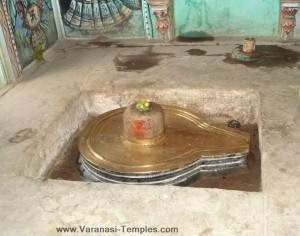
The Shiv Linga enshrined here is considered a Swayambhu (self-manifested) representation of cosmic knowledge. According to the Kashi Khand of the Skanda Purana, Lord Shiva described the sacred teerths (ponds) and lingas of Varanasi to Goddess Parvati. The Vedeshwar Linga is situated towards the south of Adi Keshav, the Guardian of Kshetra.
Phalaśruti: The Benefits of Worship
The spiritual potency of this shrine is unparalleled. Scripture dictates that a devotee who performs Rudra Abhishekam or Japam at this specific shrine attains the spiritual merit equivalent to studying all Four Vedas—Rigveda, Yajurveda, Samaveda, and Atharvaveda.
“A devotee who worships this Ling will attain the benefits accruing out of learning four Vedas. This is indeed a great thing because learning even one Veda may take several long years, let alone four Vedas.”
— Kashi Khand, Chapter 97
For the spiritual seeker, this represents the ultimate purification of ancestral karma and the awakening of higher consciousness.
2. Historical Origins & Scriptural Legend
While specific dating is challenging due to the antiquity of Kashi, the temple follows the narrative structure of Skanda Purana texts.
Scriptural Context
The Vedeshwar Temple is not merely a structure; it is a Mantra manifested in stone. It dates back to the mythological era when Kashi was established as a Moksha Dham (Liberation Land). The temple finds its place in the southern region of Kashi Kshetra, near the historic Adi Keshav shrine.
Renovation and Preservation
Tradition holds that the temple has been restored by devout families over centuries. The architecture bears the marks of the Maratha and Benares styles, featuring distinct stone carvings typical of the mid-19th century, though the spiritual lineage is timeless. It stands near the banks of the Ganges, specifically at the Rajghat Fort area, preserving the ancient geometry of the original Kashi.
3. Architectural Marvels
The Vedeshwar Temple is a classic example of the Nagara style of temple architecture, adapted for the holy city of Varanasi.
Structure and Design
- The Shikhara (Tower): The temple features a curvilinear Shikhara rising vertically, symbolizing the ascent of the soul from the material plane to the divine.
- Garbhagriha (Sanctum): The inner sanctum is compact, housing the ancient Linga, designed to focus energy and sound vibrations.
- Mandapa: A pillared hall allows devotees to sit in meditation. The pillars feature carvings of flora and geometric patterns indicative of traditional Vastu Shastra.
The temple is located in a complex that includes the Adi Keshav shrine. The geometry of the layout aligns with the southern flow of the sacred Ganga, harmonizing the elemental energies of the site.
4. Darshan & Ritual Logistics
To ensure a profound spiritual experience, devotees should plan their visit according to the temple’s ritual schedule. The temple atmosphere is most active during the Sandhya (twilight) periods.
Daily Timings
Timings may vary slightly during festivals or specific astronomical events.
| Period | Timing | Ritual Focus |
|---|---|---|
| Morning | 6:00 AM – 12:00 PM | Mangala Arti & Abhishekam |
| Midday | 12:00 PM – 4:00 PM | Closed for Rest / Bhog |
| Evening | 4:00 PM – 9:00 PM | Shayan Arti & Darshan |
Key Sevas & Online Booking
Devotees can perform various Sevas to honor Vedeshwar:
- Abhishekam: Ritual bathing of the Linga with milk, honey, and ghee.
- Rudra Path: Recitation of the Rudra Sukta for spiritual cleansing.
- Archana: Offering flowers and Bilva leaves with personalized prayers.
Booking: While many Kashi temples operate on-site bookings, the temple falls under the Kashi Vishwanath Temple Trust purview. Devotees are advised to visit the official Varanasi Teerth websites for updated online portal availability for 2026.
2026 Festival Dates
Major festivals observed here align with Shaivite traditions:
- Shivratri (Feb 26, 2026): Special night-long Jagran and extended darshan hours.
- Kartik Purnima (Nov 5, 2026): Deep Daan (lamp offering) ceremony near the river ghats followed by temple darshan.
- Pradosh Vrat: Observed on the 13th day of every lunar fortnight.
5. Practical Visitor Guidance
Visiting Vedeshwar Temple requires preparation, as it is located in the dense, historic lanes of Old Varanasi.
Code of Conduct
- Dress Code: Traditional attire is preferred. Men should wear dhotis or pants; women should cover shoulders and knees.
- Photography: Strictly prohibited inside the Garbhagriha. Photography is allowed in the outer complex with discretion.
- Electronics: Mobile phones are permitted but must be silenced during Arti. Photography flash is prohibited.
- Footwear: There are designated shoe storage facilities near the entrance. A small fee is usually required.
Crowd Management & Best Hours
- Best Time to Visit: Early morning (6:00 AM – 8:00 AM) offers the most peaceful darshan.
- Seasonal Advice:
- Summer (April–June): Temperatures exceed 40°C. Carry a water bottle, cover your head, and visit post-dusk to avoid the heat.
- Monsoon (July–Sept): The lanes become slippery. Wear non-slip footwear.
- Accessibility: The temple is situated in a narrow lane. It is not wheelchair accessible due to ancient steps and uneven terrain.
6. Pilgrimage Connectivity
How to Reach
The Vedeshwar Temple is located at A-37/51, Rajghat Fort, Varanasi.
- By Air: Lal Bahadur Shastri International Airport (LBS) is approximately 25 km away (45–60 mins by taxi).
- By Rail: Varanasi Junction (BSB) is the nearest major railway station (5 km).
- By Road: The temple is located near Adi Keshav. The closest approach is via NH-19 (formerly NH-2) towards Varanasi City. Auto-rickshaws and cycle rickshaws are the best mode to navigate the narrow lanes leading to Rajghat.
Nearby Sacred Sites
A complete pilgrimage circuit includes these nearby shrines:
- Adi Keshav Temple: Located in the same complex, one of the oldest shrines in Kashi.
- Nakshatreshwar Linga: Just a short walk away, associated with the constellation nakshatras.
- Vishwanath Gali: 3 km away, leading to the main Kashi Vishwanath Temple for the complete Darshan of Lord Shiva.
7. Frequently Asked Questions (FAQ)
1. Is there a VIP darshan entry at Vedeshwar Temple?
No, due to the intimate size of the temple and the dense location, there is no formal VIP gate. Darshan is on a first-come, first-served basis. Early morning arrival is the best way to avoid crowds.
2. Can I perform my own Abhishekam?
Generally, for specific Sevas like Abhishekam, it is recommended to utilize the services of the resident Pandit (priest) who knows the specific rituals and mantras for Vedeshwar. You may carry your own milk/flowers, but prior permission at the temple office is advisable.
3. Is the temple safe for solo female travelers?
Yes, but standard precautions for Varanasi apply. Visit during daylight hours or accompanied by a trusted guide or rickshaw driver. The temple is a peaceful sanctuary, but the approach lanes can be crowded.
4. What is the significance of the “South of Adi Keshav” location?
According to the Kashi Khand, Lord Shiva divided the Kashi region into protected zones. Vedeshwar is the guardian deity of the southern zone, protecting the devotee from negative influences and guiding them toward wisdom.
5. Are non-Hindus allowed inside?
Like most ancient Hindu shrines in Varanasi, entry is traditionally reserved for Hindus. This is maintained to preserve the sanctity of the rituals and the sanctum sanctorum.
About BharatTemples.com
At Bharat Temples, we are architectural historians and SEO strategists dedicated to preserving the digital legacy of India’s sacred sites. Our guides combine scriptural research with on-ground practical logistics to help devotees plan the perfect pilgrimage.
Recent Posts

ओ सांवरे तूने ही मुझको संभाला – Lyrics & Meaning
ओ सांवरे तूने ही मुझको संभाला – A Prayer to Shyam Origin & Spiritual Essence Why This Bhajan Resonates Devotees chant this when overwhelmed by life’s storms—the refrain ‘तूने ही मुझको संभाला’ is the soul’s sigh of relief: “You…

कथा ये है महाराज मेरे की – Lyrics & Meaning
कथा ये है महाराज मेरे की छत्रपति संभाजी महाराज – A Prayer to Chhatrapati Sambhaji Maharaj Origin & Spiritual Essence Why This Bhajan Resonates Devotees chant this when their spirit feels tested—its powerful refrain “महाराज मेरे” is a soul’s…

Rigveda Samhita Yathartha Anuvada (ऋग्वेद संहिता यथार्थ अनुवाद) – Complete Set with Anvayartha & Hindi/English Translation
The Rigveda is the oldest surviving scripture of humanity and the foundational text of Sanātana Dharma. For serious students, scholars, UPSC aspirants studying ancient Indian history, Sanskrit learners, and spiritual seekers, a precise and grammatically structured translation is indispensable.…

आना भी अकेला है जाना भी अकेला है – Lyrics & Meaning | BharatTemples
आना भी अकेला है जाना भी अकेला है – A Prayer to the Divine Witness Origin & Spiritual Essence Why This Bhajan Resonates Devotees turn to this bhajan in moments of deep reflection—when life’s attachments begin to ache. The…

माता शेरावाली के द्वार जो भी जाता है – Lyrics & Meaning
माता शेरावाली के द्वार जो भी जाता है – A Prayer to Maa Sherawali Origin & Spiritual Essence Why This Bhajan Resonates Devotees turn to this bhajan in times of fear or uncertainty—its promise that no one leaves Maa’s…

मार लेना सपणी उबार लेणा भवरा – Lyrics & Meaning
मार लेना सपणी उबार लेणा भवरा – A Prayer to the Divine Beloved Origin & Spiritual Essence Why This Bhajan Resonates Devotees chant this in moments of deep vulnerability—its cry of “मार लेना सपणी, उबार लेणा भवरा” is the…

हमें श्याम सुंदर भरोसा तुम्हारा – Lyrics & Meaning
हमें श्याम सुंदर भरोसा तुम्हारा – A Prayer to Shyam Sundar Origin & Spiritual Essence Why This Bhajan Resonates Devotees chant this when feeling alone—its refrain ‘de do sahara’ is the soul’s cry for divine support. Lyrics in Hindi…

Mere Satguru Ne Di Thi Davai Lyrics in Hindi & Meaning
Mere Satguru Ne Di Thi Davai: Invoking the Guru’s Liberating Wisdom This soul-stirring bhajan venerates the Satguru (True Spiritual Master) as the divine physician who dispenses the only remedy for life’s deepest sufferings. Composed by Sant Karmaveer Tufani, it…

Janm Diyo Thari Maa Dukh Dekhiyo Lyrics in Hindi & Meaning
जन्म दियो थारी माँ दुख देखियो (Maa’s Grief Upon Birthing You) This soul-stirring Chetavani Bhajan (admonitory hymn) is addressed to the Divine Mother (Maa) – a call for repentance when children forget their filial duties in the dark age…
Bhadi Sabha Mein Thane Manaun Lyrics in Hindi & Meaning
Bhadi Sabha Mein Thane Manaun: Invoking the Spear-Wielding Mother Mata Bhawani (श्री ज्वाला भवानी), the fiery manifestation of Shakti worshipped as the Protector of Dharma in Her Dhaulagarh sanctum. Origin & Spiritual Essence Composed in Rajasthani folk tradition by…