
Contents
Introduction & Spiritual Essence
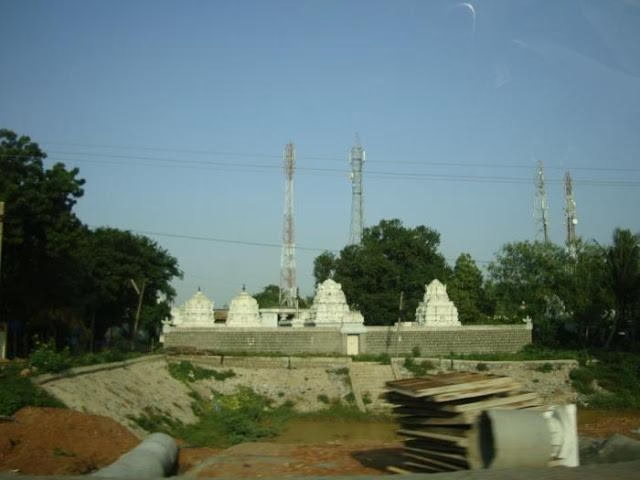
The Vijayaraghava Perumal Temple in Puduvayal is a timeless Divya Desam located in the Thiruvallur district of Tamil Nadu. Steeped in the lore of the Ramayana and the Vedas, this 1200-year-old sanctuary offers a profound spiritual atmosphere for devotees seeking relief from karma and worldly obstacles.
Primary Deity and Form
The presiding deity is Vijayaraghava Perumal (a form of Lord Vishnu), enshrined in the Veetrirunda Thirukolam—a seated posture with his consorts, Sridevi and Bhoodevi, on either side. He sits in the Bhoga Asana (comfortable posture) facing East. The Vimanam (roof over the sanctum) is known as Vijayakoti Vimanam. The consort is Kamalavalli Thayar (also revered as Swatantra Lakshmi).
Phalaśruti: The Fruits of Visiting
Devotees visit this temple to achieve specific spiritual and material benefits:
- Victory & Health: Lord Vijayaraghava blesses devotees with victory in all undertakings (Vijaya) and excellent physical health.
- Marital & Legal Resolution: Kamalavalli Thayar is renowned for resolving marital disputes and granting favorable outcomes in legal battles.
- Progeny: Couples seeking children pray to Venugopala Swamy (located behind the sanctum). It is a tradition to offer milk as Naivedya and consume it to receive blessings for a child.
- Ancestral Karma: The temple is believed to cleanse ancestral karma, particularly through prayers to Lord Venugopala.
Historical Origins & Scriptural Legend
According to temple records and oral tradition, this shrine dates back nearly 1200 years, reflecting the early Chola or Pallava architectural influence. The temple is often referred to as the Sri Kanva Rishi Kshetram.
The Legend of Sage Kanva & Shakuntala
Tradition holds that Sage Kanva (the foster father of Shakuntala from Kalidasa’s epic, Abhijnanasakuntalam) built an ashram on the banks of the Brahma Aranya river (a tributary of the Aranya). Here, Shakuntala met and married King Dushyanta in the Gandharva tradition. Due to a curse, the King forgot her, but after Shakuntala prayed to Kamalavalli Thayar, her memory was restored, and their son Bharata was born here.
The Legend of Sage Vaikhasana
A Gandharva named Sumali was cursed to become a demon (Nivdan) and disrupted the Yagnas of sages. Sage Kanva performed penance and, guided by Brahma, sought the help of Sage Vaikhasana. Lord Vishnu (as Veeraraghavan) vanquished the demon. To honor Sage Vaikhasana’s guidance, he is worshipped as a Vigraha (idol) inside the sanctum—a rare feature adhering to the Vaikhanasa Agama.
Architectural Marvels
The temple showcases the classic Tamil Temple Architecture with Dravidian stylistic elements. The layout follows strict Vastu Shastra principles, aligning the sanctum with the cardinal directions.
Key Architectural Features
- Shikhara/Vimanam: The roof over the main sanctum is the Vijayakoti Vimanam. The mother goddess shrine has the Kamalakruti Vimanam.
- Sculptures & Mantapas: The Kalyana Mandapam (Marriage Hall) features intricate stone carvings depicting mythological scenes. Standing opposite the Dhwaja Sthambam are Periya Thiruvadi (Garuda) and Siriya Thiruvadi (Anjaneyar).
- Venugopala Shrine: Located behind the main sanctum, this shrine depicts Lord Krishna with a cow prostrating at his feet (Saranagathi posture).
- Theertham: The Kamala Theertham is situated directly behind the Lord’s sanctum, a rare layout where the sacred tank is placed adjacent to the sanctum.
Note: While the temple possesses immense historical value, it does not currently hold UNESCO or ASI heritage status, preserving its authentic village charm.
Darshan & Ritual Logistics
The temple follows the Vaikhanasa Agama for daily rituals. Below is the schedule for 2026.
Daily Timings
| Session | Timings |
|---|---|
| Morning Opening | 07:00 AM |
| Ushathkala Darshan | 07:00 AM – 08:00 AM |
| Thirumanjanam (Abhishekam) | 08:00 AM – 09:00 AM |
| Ardhajama Pooja | 12:00 PM |
| Temple Closing | 12:00 PM – 04:00 PM |
| Evening Opening | 04:00 PM |
| Deeparadhana | 06:00 PM – 06:30 PM |
| Closing (Palliyarai) | 08:00 PM |
Key Sevas & Booking
Devotees can perform the following rituals. Booking is usually done at the temple counter or via the local temple administration trust.
- Abhishekam: Performed for Vijayaraghava Perumal and Venugopala Swamy (Sankalpa with milk/juice).
- Archana: Sahasranamam Archana for Perumal; Lakshmi Ashtotharam for Thayar.
- Kalyana Utsavam: A special ceremony for childless couples invoking Venugopala.
2026 Major Festivals
- Panguni Uthiram (March-April): The grand chariot festival (Rathotsavam) celebrating the celestial wedding of the Lord and Goddess.
- Vaikuntha Ekadashi (January): Special Garuda Sevai and readings of the Nammalwar Pasurams.
- Brahmotsavam (October-November): A 10-day festival featuring processions of Venugopala Swamy and Vijayaraghava Perumal.
Practical Visitor Guidance
Dress Code & Etiquette
To maintain the sanctity of the temple:
- Attire: Men must wear Dhoti or formal trousers with a shirt; women must wear Saree, Salwar Kameez, or traditional attire. Avoid jeans and shorts.
- Photography: Strictly prohibited inside the inner sanctum (Garbhagriha) and the temple tank.
- Electronic Devices: Mobile phones are allowed but must be kept on silent. Photography is permitted in the outer prakarams, but flash is discouraged.
Crowd Management & Seasonal Advice
- Best Time to Visit: The ideal time for Darshan is between 7:00 AM and 9:00 AM when the crowd is minimal and the morning rituals are active.
- Seasonal Tips: Puduvayal can get humid. In May and June, carry a water bottle and a head cover. The Venugopala Swamy shrine is covered, offering a cool resting spot.
- Accessibility: The temple has a flat floor, making it accessible for senior citizens, though the inner sanctum has a few steps.
Pilgrimage Connectivity
How to Reach
The temple is located on the Chennai-Calcutta Highway (National Highway 16), north of Chennai.
- By Air: Chennai International Airport (MAA) is approximately 48 km away (1-hour drive via NH16).
- By Rail: Kavaraippettai Railway Station (5 km) is the nearest local station. Alternatively, Ponneri Railway Station (9 km) is accessible. For major trains, Chennai Central is 35 km away.
- By Road: Puduvayal Bus Stop is just 650 meters from the temple. Frequent buses ply from Ponneri (8 km) and Chennai (T Nagar/Saidapet).
Nearby Sacred Sites
Extend your pilgrimage to these nearby locations:
- Kelambakkam Vada Pazhavaneeswarar Temple: (30 km) A powerful Shiva temple associated with the Kamadhenu cow.
- Thiruputkuzhi (Sri Vishnu Hasthal Temple): (15 km) A nearby Divya Desam where the Lord is in a reclining posture (Vishnu Hasthal).
- Ponneri Uma Maheswarar Temple: (8 km) A historic Shiva temple with unique architectural features.
Frequently Asked Questions (FAQ)
1. Is there a VIP darshan entry?
No, the Vijayaraghava Perumal Temple follows a traditional system. However, donations for special Archana can be made at the counter to prioritize the prayer listing, though the physical queue remains the same for all devotees.
2. What is the significance of Venugopala Swamy here?
Located behind the main sanctum, Venugopala Swamy is the focal point for couples seeking progeny. The presence of the prostrating cow at his feet signifies total surrender (Saranagathi), which is central to the Vaikhanasa Agama followed here.
3. Are there guest houses or lodging facilities at the temple?
The temple does not have an attached guest house. However, basic lodgings are available in Ponneri town (8 km) and more comfortable hotels are available in Chennai or Tiruvallur for pilgrims planning a longer stay.
4. Can I perform the Thirukalyanam (Divine Wedding) for my child here?
Yes, the Kalyana Mandapam is available for conducting weddings. Many devotees prefer this venue due to the presiding deities’ blessings for marital harmony. Prior booking with the temple trust is required.
5. What is the ‘Brindaranya Shetram’?
This is the ancient name of the Puduvayal region mentioned in Puranas. It refers to a forest of Tulsi (Holy Basil), specifically Krishna Tulsi, which is also the Sthala Vriksham (temple tree) here, owing to the presence of Lord Venugopala (Krishna).
Recent Posts

ओ सांवरे तूने ही मुझको संभाला – Lyrics & Meaning
ओ सांवरे तूने ही मुझको संभाला – A Prayer to Shyam Origin & Spiritual Essence Why This Bhajan Resonates Devotees chant this when overwhelmed by life’s storms—the refrain ‘तूने ही मुझको संभाला’ is the soul’s sigh of relief: “You…

कथा ये है महाराज मेरे की – Lyrics & Meaning
कथा ये है महाराज मेरे की छत्रपति संभाजी महाराज – A Prayer to Chhatrapati Sambhaji Maharaj Origin & Spiritual Essence Why This Bhajan Resonates Devotees chant this when their spirit feels tested—its powerful refrain “महाराज मेरे” is a soul’s…

Rigveda Samhita Yathartha Anuvada (ऋग्वेद संहिता यथार्थ अनुवाद) – Complete Set with Anvayartha & Hindi/English Translation
The Rigveda is the oldest surviving scripture of humanity and the foundational text of Sanātana Dharma. For serious students, scholars, UPSC aspirants studying ancient Indian history, Sanskrit learners, and spiritual seekers, a precise and grammatically structured translation is indispensable.…

आना भी अकेला है जाना भी अकेला है – Lyrics & Meaning | BharatTemples
आना भी अकेला है जाना भी अकेला है – A Prayer to the Divine Witness Origin & Spiritual Essence Why This Bhajan Resonates Devotees turn to this bhajan in moments of deep reflection—when life’s attachments begin to ache. The…

माता शेरावाली के द्वार जो भी जाता है – Lyrics & Meaning
माता शेरावाली के द्वार जो भी जाता है – A Prayer to Maa Sherawali Origin & Spiritual Essence Why This Bhajan Resonates Devotees turn to this bhajan in times of fear or uncertainty—its promise that no one leaves Maa’s…

मार लेना सपणी उबार लेणा भवरा – Lyrics & Meaning
मार लेना सपणी उबार लेणा भवरा – A Prayer to the Divine Beloved Origin & Spiritual Essence Why This Bhajan Resonates Devotees chant this in moments of deep vulnerability—its cry of “मार लेना सपणी, उबार लेणा भवरा” is the…

हमें श्याम सुंदर भरोसा तुम्हारा – Lyrics & Meaning
हमें श्याम सुंदर भरोसा तुम्हारा – A Prayer to Shyam Sundar Origin & Spiritual Essence Why This Bhajan Resonates Devotees chant this when feeling alone—its refrain ‘de do sahara’ is the soul’s cry for divine support. Lyrics in Hindi…

Mere Satguru Ne Di Thi Davai Lyrics in Hindi & Meaning
Mere Satguru Ne Di Thi Davai: Invoking the Guru’s Liberating Wisdom This soul-stirring bhajan venerates the Satguru (True Spiritual Master) as the divine physician who dispenses the only remedy for life’s deepest sufferings. Composed by Sant Karmaveer Tufani, it…

Janm Diyo Thari Maa Dukh Dekhiyo Lyrics in Hindi & Meaning
जन्म दियो थारी माँ दुख देखियो (Maa’s Grief Upon Birthing You) This soul-stirring Chetavani Bhajan (admonitory hymn) is addressed to the Divine Mother (Maa) – a call for repentance when children forget their filial duties in the dark age…
Bhadi Sabha Mein Thane Manaun Lyrics in Hindi & Meaning
Bhadi Sabha Mein Thane Manaun: Invoking the Spear-Wielding Mother Mata Bhawani (श्री ज्वाला भवानी), the fiery manifestation of Shakti worshipped as the Protector of Dharma in Her Dhaulagarh sanctum. Origin & Spiritual Essence Composed in Rajasthani folk tradition by…