
Contents
Introduction & Spiritual Essence
Vishalaksheeshwar Temple stands as a pillar of spiritual sovereignty within the sacred geography of Varanasi. While the city is famed for the Kashi Vishwanath Jyotirlinga, the Vishalaksheeshwar Lingam holds a unique place in the hearts of Shaivites. This temple is dedicated to Lord Shiva, revered here specifically as Vishalaksheeshwar—the Lord of the Great Eyes.
According to the sacred Kashi Khand (Chapter 97) of the Skanda Purana, Goddess Parvati desired to learn about the various Shiv Lingas and deities residing in Kashi. Pleased by her devotion, Lord Shiva narrated the significance of these holy shrines. He revealed the presence of Vishalaksheeshwar in the immediate vicinity of the Vishalakshy Devi (Goddess with Large Eyes) temple. Thus, this shrine is intrinsically linked to the divine feminine energy of the Dharma Peeth.
Phalaśruti (Spiritual Benefit): As per ancient scriptures, devotees who worship Vishalaksheeshwar with a sincere heart are blessed with immense happiness, prosperity, and the cleansing of ancestral karma. It is believed that a visit here brings stability to one’s life and spiritual awakening, mirroring the cosmic vision of the deity.
Historical Origins & Scriptural Legend
The origins of the Vishalaksheeshwar Temple are deeply embedded in the Vedic and Puranic traditions of Kashi. While specific dynastic construction records (such as those found in later medieval temples) are scarce for this shrine, its history is preserved through oral traditions and scriptural continuity.
The Sthala Purana: Tradition holds that this shrine has existed since time immemorial. The term Swayambhu (self-manifested) is often associated with the Lingas of Varanasi. The Kashi Khand highlights this site as a powerful energy center. The Lingam is not merely a carved stone but a manifestation of the Lord’s cosmic eye.
Renovations: Over centuries, the temple has undergone several renovations by devout patrons and the local Mahant. The current structure reflects the resilience of Varanasi’s spiritual heritage, maintained by the continuous flow of devotees rather than royal patronage in the modern era. The temple stands as a testament to the uninterrupted continuity of worship in the “City of Light.”
| Date built: | – |
|---|---|
| Deity: | Vishalaksheeshwar |
| Architectural style: | Hindu Temple architecture |
| Major festivals | – |
| Locale: | Varanasi |
| District:: | Varanasi |
| Address: | – |
| Phone | – |
Goddess Parvaty wanted to know about various Shiv Lings and deities at several places in Kashi and Lord Shiva was pleased to narrate about such deities (Kashi Khand, Chapter 97).
Kashi Khand mentions one Shiv Ling named Vishalaksheeshwar in the vicinity of Vishalakshy Devi.
Devotees who worship Vishalaksheeshwar will be blessed with happiness and prosperity.
Architectural Marvels
The Vishalaksheeshwar Temple is a classic example of the Nagara style of temple architecture, adapted to the narrow lane structures of old Varanasi. While the external facade is modest due to space constraints, the interior sanctity is profound.
Vastu Shastra Alignment: The temple follows the principles of Vastu, with the Garbhagriha (sanctum sanctorum) located precisely to allow the morning sun rays to touch the Lingam during the equinoxes.
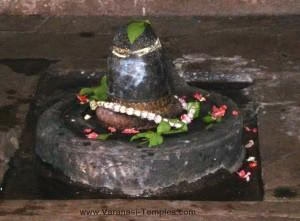
The Sanctum: The primary deity, Vishalaksheeshwar, is a black stone Lingam adorned with a silver mask (Mukhalingam). The sanctum is enclosed by a carved wooden canopy and silver-plated doors, reflecting the devotion of local artisans.
The Complex: The temple is located within the premises of the adjacent Vishalakshy Devi temple at Mir Ghat. This compound is often referred to as a powerful Shakti Peeth (Dharma Peeth). The architectural layout integrates the shrine of the Goddess and the Lingam of the Lord, symbolizing the inseparable union of Shiva and Shakti.
Darshan & Ritual Logistics (2026 Guide)
Planning your visit requires an understanding of the daily rituals and seasonal variations. Being situated in the heart of the old city, accessibility can vary based on crowd density.
Daily Timings
The temple generally remains open from early morning until late evening. However, specific timings for Shringar (decoration) and Aarti may vary seasonally.
| Session | Timings | Ritual |
|---|---|---|
| Morning | 05:00 AM – 12:00 PM | Mangala Aarti & Abhishekam |
| Afternoon | 12:00 PM – 04:00 PM | Rest Period (Sayan Aarti) |
| Evening | 04:00 PM – 11:00 PM | Shringar & Sandhya Aarti |
Key Sevas & Booking
Devotees can perform various sevas at the temple. While many sevas are conducted in person, some larger organizations in Varanasi are adopting digital systems for booking Pujas in advance.
- Abhishekam: Ritual bathing of the Lingam with water, milk, honey, and bhasma. Best performed during the morning hours (6:00 AM – 9:00 AM).
- Archana: Recitation of names and Rudra Sukta. Can be done individually or in groups.
- Maha Shivratri (2026): February 15, 2026. Special night-long darshans and Rudra Path will be conducted. Expect heavy crowds; pre-booking accommodation is advised.
- Pradosh Vrat: Every 13th lunar day of the month. A significant time for Darshan.
Online Seva Booking: For the main Kashi Vishwanath Corridor, bookings are online via the official UP government portal. However, for smaller shrines like Vishalaksheeshwar, sevas are typically arranged directly with the temple priests or local pandits.
Practical Visitor Guidance
Visiting the Mir Ghat area requires preparation due to the heritage nature of the lanes.
Rules & Etiquette
- Dress Code: Traditional attire is recommended (Kurta-Pajama for men, Saree/Salwar Kameez for women). Avoid shorts or sleeveless tops.
- Photography: Photography is generally restricted inside the inner sanctum (Garbhagriha). You may take photos of the exterior architecture and the complex.
- Mobile & Lockers: Mobile phones are allowed, but please maintain silence. Electronic items are usually not permitted inside the main shrine; keep them in bags or use available lockers near the entrance.
- Accessibility: The temple is located on uneven stone slabs near the Ghat steps. It is not wheelchair accessible due to the heritage layout.
Crowd Management
- Best Hours: The most serene time for Darshan is 5:00 AM to 7:00 AM, immediately after the morning Aarti.
- Seasonal Advice: Summers (April-June) in Varanasi are hot; carry a water bottle and cover your head. Winters (Dec-Jan) are foggy and cool; carry layers.
- Footwear: There are shoe-keeping facilities at the entrance, usually for a nominal fee.
Pilgrimage Connectivity
The Vishalaksheeshwar Temple is located in the heart of Varanasi’s spiritual district, making it highly accessible if you know the landmarks.
How to Reach
- Nearest Airport: Lal Bahadur Shastri International Airport (LBS) is approximately 25 km away. Taxi/cab services are available to the Kashi Vishwanath Corridor.
- Railway Station: Varanasi Junction (BSB) is about 7 km away. From the station, take an auto-rickshaw to Dasaswamedh Ghat or Bansphatak Vishwanath Gulli.
- Walking Route: The temple is located at D.3/85, in the premises of Vishalakshy Temple at Mir Ghat. Once you reach Dasaswamedh Ghat, walk towards the Vishwanath Temple lane, then navigate towards the banks of the Ganges (south direction) to reach Mir Ghat.
Nearby Sacred Sites
To complete your pilgrimage circuit, visit these sites within walking distance:
- Vishalakshy Devi Temple: Located in the same compound as Vishalaksheeshwar. The Goddess here has large eyes, representing the vision of awareness.
- Kashi Vishwanath Temple: Located approximately 10-15 minutes walk north of Mir Ghat. The primary Jyotirlinga.
- Annapurna Devi Mandir: The Goddess of Food, located near the Vishwanath Temple.
Frequently Asked Questions (FAQs)
1. What is the significance of the name Vishalaksheeshwar?
The name translates to “Lord of the Great Eyes.” It represents the all-seeing nature of Lord Shiva and is closely associated with the adjacent Vishalakshy Devi (Goddess of Vision). Worshiping here is believed to enhance one’s spiritual perception.
2. Is there a VIP Darshan entry available?
Unlike the main Kashi Vishwanath Temple, Vishalaksheeshwar does not have a formal VIP entry system. Darshan is based on a first-come, first-served basis. However, visiting during early morning hours ensures a quick and peaceful darshan.
3. Can I combine the Darshan of Vishalaksheeshwar with the main Vishwanath Temple?
Yes. It is highly recommended. The temples are located in the same vicinity (Mir Ghat to the Kashi Vishwanath Corridor). Most devotees perform the Shakti Peetha darshan (Vishalakshy) followed by the Shiva darshan (Vishalaksheeshwar and Vishwanath).
4. What are the accommodation options nearby?
Due to the heritage nature of the old city, hotels near Mir Ghat are limited but available. It is advisable to book hotels closer to the Kashi Vishwanath Corridor or the railway station for better amenities, as the lanes near the temple are narrow and not suitable for large vehicles.
5. How is the temple maintained?
The temple is maintained by the Mahant (Head Priest) and local devotees. Unlike state-funded monuments, it relies on the donations and service (Seva) of pilgrims, preserving the ancient traditions of temple care.
Contact Details
Official Address:
Vishalaksheeshwar Temple, D.3/85, Mir Ghat, Varanasi, Uttar Pradesh 221001, India.
Photo Gallery
Legend / Local stories
As derived from the Kashi Khand of Skanda Purana:
It is said that the great sage Narada once visited Kashi to test the knowledge of the Devas. He asked for a boon that only one who could identify all the forms of Shiva in Kashi would remain a scholar. Goddess Parvati, worried about the Devas, asked Lord Shiva to reveal his forms. Lord Shiva smiled and revealed that the essence of all his forms resided in the Vishalaksheeshwar Lingam, located just beside the Great-Eyed Goddess. To worship one is to worship the other, as they are inseparable in this Dharma Peeth.
Recent Posts

ओ सांवरे तूने ही मुझको संभाला – Lyrics & Meaning
ओ सांवरे तूने ही मुझको संभाला – A Prayer to Shyam Origin & Spiritual Essence Why This Bhajan Resonates Devotees chant this when overwhelmed by life’s storms—the refrain ‘तूने ही मुझको संभाला’ is the soul’s sigh of relief: “You…

कथा ये है महाराज मेरे की – Lyrics & Meaning
कथा ये है महाराज मेरे की छत्रपति संभाजी महाराज – A Prayer to Chhatrapati Sambhaji Maharaj Origin & Spiritual Essence Why This Bhajan Resonates Devotees chant this when their spirit feels tested—its powerful refrain “महाराज मेरे” is a soul’s…

Rigveda Samhita Yathartha Anuvada (ऋग्वेद संहिता यथार्थ अनुवाद) – Complete Set with Anvayartha & Hindi/English Translation
The Rigveda is the oldest surviving scripture of humanity and the foundational text of Sanātana Dharma. For serious students, scholars, UPSC aspirants studying ancient Indian history, Sanskrit learners, and spiritual seekers, a precise and grammatically structured translation is indispensable.…

आना भी अकेला है जाना भी अकेला है – Lyrics & Meaning | BharatTemples
आना भी अकेला है जाना भी अकेला है – A Prayer to the Divine Witness Origin & Spiritual Essence Why This Bhajan Resonates Devotees turn to this bhajan in moments of deep reflection—when life’s attachments begin to ache. The…

माता शेरावाली के द्वार जो भी जाता है – Lyrics & Meaning
माता शेरावाली के द्वार जो भी जाता है – A Prayer to Maa Sherawali Origin & Spiritual Essence Why This Bhajan Resonates Devotees turn to this bhajan in times of fear or uncertainty—its promise that no one leaves Maa’s…

मार लेना सपणी उबार लेणा भवरा – Lyrics & Meaning
मार लेना सपणी उबार लेणा भवरा – A Prayer to the Divine Beloved Origin & Spiritual Essence Why This Bhajan Resonates Devotees chant this in moments of deep vulnerability—its cry of “मार लेना सपणी, उबार लेणा भवरा” is the…

हमें श्याम सुंदर भरोसा तुम्हारा – Lyrics & Meaning
हमें श्याम सुंदर भरोसा तुम्हारा – A Prayer to Shyam Sundar Origin & Spiritual Essence Why This Bhajan Resonates Devotees chant this when feeling alone—its refrain ‘de do sahara’ is the soul’s cry for divine support. Lyrics in Hindi…

Mere Satguru Ne Di Thi Davai Lyrics in Hindi & Meaning
Mere Satguru Ne Di Thi Davai: Invoking the Guru’s Liberating Wisdom This soul-stirring bhajan venerates the Satguru (True Spiritual Master) as the divine physician who dispenses the only remedy for life’s deepest sufferings. Composed by Sant Karmaveer Tufani, it…

Janm Diyo Thari Maa Dukh Dekhiyo Lyrics in Hindi & Meaning
जन्म दियो थारी माँ दुख देखियो (Maa’s Grief Upon Birthing You) This soul-stirring Chetavani Bhajan (admonitory hymn) is addressed to the Divine Mother (Maa) – a call for repentance when children forget their filial duties in the dark age…

Bhadi Sabha Mein Thane Manaun Lyrics in Hindi & Meaning
Bhadi Sabha Mein Thane Manaun: Invoking the Spear-Wielding Mother Mata Bhawani (श्री ज्वाला भवानी), the fiery manifestation of Shakti worshipped as the Protector of Dharma in Her Dhaulagarh sanctum. Origin & Spiritual Essence Composed in Rajasthani folk tradition by…