
Contents
Introduction & Spiritual Essence
Nestled within the labyrinthine lanes of the ancient city of Varanasi (Kashi), the Janakeshwar Temple stands as a profound testament to the spiritual power of the Jyotirlinga. The name ‘Janakeshwar’ derives from Sanskrit, where ‘Janaka’ refers to the father of Sita (King Janaka) and ‘Ishwar’ denotes the Supreme Lord Shiva. This temple is historically revered as the specific site where King Janaka is said to have worshipped Lord Shiva to seek blessings for his kingdom and family.
Locally, this temple is also closely associated with Mrityunjay Mahadev. The spiritual essence of this temple is deeply tied to the Kashi Khand of the Skanda Purana. It is believed that Lord Shiva himself described the sanctity of this site to Parvati.
Phalaśruti: The Benefits of Darshan
According to ancient texts, the linga at Janakeshwar is a Swayambhu (self-manifested) form. The spiritual benefits, or Phalaśruti, of worshipping here are immense:
- Ultimate Knowledge (Jnana): As per the Kashi Khand, worshipping the Janakeshwar Ling bestows the devotee with supreme spiritual wisdom and enlightenment.
- Curing Diseases: In the immediate vicinity of the temple lies the Kalodak Koop (Well). The water from this well is traditionally believed to possess miraculous healing properties, capable of curing chronic diseases and ailments.
- Removal of Fear: Being a Mrityunjay Mahadev shrine, it is a potent place to overcome the fear of death and attain longevity.
Historical Origins & Scriptural Legend
While specific construction dates for many ancient Kashi temples are lost to time due to centuries of reconstruction, the Janakeshwar Temple finds its roots in the rich soil of scriptural tradition.
Scriptural References
The primary scriptural authority is the Skanda Purana, specifically the Kashi Khand (Chapter 97). Tradition holds that Lord Shiva, while describing the geography of the holy city to Parvati, highlighted the immense energy of this specific linga. It is distinct from other Shiva temples in Varanasi because of its direct association with the Solar Dynasty (Suryavansha) and King Janaka.
Local Legends
Legend holds that King Janaka, while traveling through Kashi, established this linga to protect his lineage. Local priests narrate that the energies of this temple align with the Mritunjaya Mantra, a chant dedicated to conquering death. The temple has undergone numerous renovations over the centuries by local devotees, preserving the traditional Kashi architectural style amidst the dense urban fabric of Daranagar.
Architectural Marvels
The Janakeshwar Temple is a classic example of the Nagara style of temple architecture, adapted to the constraints of an urban Varanasi setting. Unlike sprawling temple complexes, this shrine is vertical and compact, drawing the eye upward towards the Shikhara (tower).
Key Architectural Elements
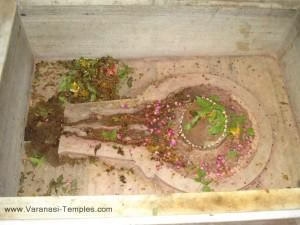
- The Sanctum (Garbhagriha): The inner sanctum houses the Janakeshwar Linga, which is adorned with a silver face of Lord Shiva. The small space creates an intimate atmosphere for darshan.
- Shikhara: The tower is built in the Northern Indian style, featuring amalaka (disk-like stones) at the apex.
- Sculptures: Though compact, the exterior walls feature intricate carvings of various forms of Lord Shiva, along with motifs from Hindu iconography.
- Kalodak Koop: The ancient well within the temple complex is an architectural relic, built with stone steps leading down to the water level. It represents the groundwater connection to the Ganges, a key feature of Kashi’s hydrology.
Darshan & Ritual Logistics
Managing darshan in Varanasi requires planning. Below are the operational details for 2026. Note: Temple timings may vary slightly during festivals.
Daily Timings
| Session | Timing | Activity |
|---|---|---|
| Morning | 05:00 AM – 11:00 AM | Morning Puja & Shringar |
| Midday | 11:00 AM – 4:00 PM | General Darshan (Closed 1:00-2:00 PM) |
| Evening | 4:00 PM – 9:00 PM | Sandhya Aarti & Shayan Darshan |
Key Sevas & Online Booking
Devotees can perform various Sevas (ritual services) at the temple. While the Janakeshwar Temple is a smaller shrine, major Sevas in Varanasi can often be booked through the official Kashi Vishwanath Temple portal or local priest associations.
- Abhishekam: Ritual bathing of the linga with water, milk, and honey. Timing: 6:00 AM – 8:00 AM.
- Mrityunjaya Jaap: Special chanting of the Mritunjaya Mantra for health and longevity.
- Rudrabhishek: An elaborate Vedic ritual. Advance booking is recommended through local priests at Daranagar.
2026 Festival Calendar (Major Dates)
- Maha Shivaratri: February 26, 2026 (Special night-long darshan)
- Kartik Purnima: November 5, 2026 (Deepawali of the Gods)
- Sawan Somvar: July 14 – August 22, 2026 (Peak rush days)
Practical Visitor Guidance
Visiting temples in Varanasi requires adherence to traditional protocols and practical awareness of the environment.
Rules & Etiquette
- Dress Code: Traditional attire is preferred. Men should wear dhoti/kurta or trousers and shirt; women should wear saree or salwar kameez. Avoid shorts and sleeveless tops.
- Photography: Photography is generally restricted inside the inner sanctum. Flash photography is prohibited to maintain the sanctity of the space.
- Footwear: Shoes must be removed at the designated holding area outside the temple. A nominal fee is usually charged.
- Mobile Lockers: There is no official locker facility at this specific small temple. It is advised to travel light.
Crowd Management & Seasonal Advice
- Best Hours: For a peaceful darshan, visit between 7:00 AM and 9:00 AM or after 7:00 PM. Avoid the midday rush.
- Summer (April-June): Varanasi can be extremely hot. Carry a water bottle (fill at Kalodak Koop only if advised by locals) and a handkerchief to cover your head while walking between temples.
- Monsoon (July-September): The old city lanes get slippery. Wear rubber-soled footwear with good grip.
Pilgrimage Connectivity
The Janakeshwar Temple is located in the heart of the old city, making it accessible but challenging for vehicles.
How to Reach
- Nearest Airport: Lal Bahadur Shastri International Airport (LBS), Varanasi (approx. 25 km). Taxis and the Varanasi Metro (Kabir Chaura station) are available.
- Nearest Railway Station: Varanasi Junction (BSB) is about 5 km away. From the station, take an auto-rickshaw to Daranagar or Bisheshwarganj/GPO.
- Local Access: The temple is located at K-52/39, Daranagar. The lanes are narrow; the last mile connectivity is best covered by cycle-rickshaw or on foot.
Nearby Sacred Sites (Pilgrimage Circuit)
- Mrityunjay Mahadev Temple: Located very close to Janakeshwar (often considered part of the same complex). Worshipped as the conqueror of death.
- Kashi Vishwanath Temple (New): The primary Jyotirlinga. A 15-minute rickshaw ride away.
- Sankat Mochan Hanuman Temple: Famous for removing obstacles. Located on the southern side of the city.
Frequently Asked Questions (FAQ)
1. Is there a VIP darshan entry?
As Janakeshwar is a smaller, local shrine within the dense city, there is no official VIP gate like at the main Kashi Vishwanath Corridor. Darshan is generally open to all and proceeds quickly due to the single-lane sanctum.
2. Can we drink water from the Kalodak Koop?
Traditionally, the water is considered holy and medicinal. However, for health safety, we recommend checking with the local temple priests regarding the current potability before consuming it.
3. Is the temple accessible for senior citizens?
The temple is in the old city with narrow lanes. While there are steps to enter the temple, the pathway is uneven. It is advisable for senior citizens to visit during early morning hours when the crowds are thinner.
4. What is the language spoken by the priests?
The priests primarily speak Bhojpuri and Hindi. Some may understand basic English, but a local guide is helpful for detailed explanations of rituals.
5. Is there parking available?
There is no car parking near the temple due to narrow lanes. Visitors must park at designated lots near Godaulia or Dashashwamedh Ghat and walk or take a rickshaw to Daranagar.
Recent Posts

Shri Kaamkoteeshwar Mandir, Varanasi – History & Significance
In the heart of Kashi, the eternal city of Lord Shiva, where the Ganges flows with celestial grace, stands the Shri Kaamkoteeshwar Mandir. This sacred Sannidhi is not merely a temple but a profound spiritual bridge between the Northern…

ओ सांवरे तूने ही मुझको संभाला – Lyrics & Meaning
ओ सांवरे तूने ही मुझको संभाला – A Prayer to Shyam Origin & Spiritual Essence Why This Bhajan Resonates Devotees chant this when overwhelmed by life’s storms—the refrain ‘तूने ही मुझको संभाला’ is the soul’s sigh of relief: “You…

कथा ये है महाराज मेरे की – Lyrics & Meaning
कथा ये है महाराज मेरे की छत्रपति संभाजी महाराज – A Prayer to Chhatrapati Sambhaji Maharaj Origin & Spiritual Essence Why This Bhajan Resonates Devotees chant this when their spirit feels tested—its powerful refrain “महाराज मेरे” is a soul’s…

Rigveda Samhita Yathartha Anuvada (ऋग्वेद संहिता यथार्थ अनुवाद) – Complete Set with Anvayartha & Hindi/English Translation
The Rigveda is the oldest surviving scripture of humanity and the foundational text of Sanātana Dharma. For serious students, scholars, UPSC aspirants studying ancient Indian history, Sanskrit learners, and spiritual seekers, a precise and grammatically structured translation is indispensable.…

आना भी अकेला है जाना भी अकेला है – Lyrics & Meaning | BharatTemples
आना भी अकेला है जाना भी अकेला है – A Prayer to the Divine Witness Origin & Spiritual Essence Why This Bhajan Resonates Devotees turn to this bhajan in moments of deep reflection—when life’s attachments begin to ache. The…

माता शेरावाली के द्वार जो भी जाता है – Lyrics & Meaning
माता शेरावाली के द्वार जो भी जाता है – A Prayer to Maa Sherawali Origin & Spiritual Essence Why This Bhajan Resonates Devotees turn to this bhajan in times of fear or uncertainty—its promise that no one leaves Maa’s…

मार लेना सपणी उबार लेणा भवरा – Lyrics & Meaning
मार लेना सपणी उबार लेणा भवरा – A Prayer to the Divine Beloved Origin & Spiritual Essence Why This Bhajan Resonates Devotees chant this in moments of deep vulnerability—its cry of “मार लेना सपणी, उबार लेणा भवरा” is the…

हमें श्याम सुंदर भरोसा तुम्हारा – Lyrics & Meaning
हमें श्याम सुंदर भरोसा तुम्हारा – A Prayer to Shyam Sundar Origin & Spiritual Essence Why This Bhajan Resonates Devotees chant this when feeling alone—its refrain ‘de do sahara’ is the soul’s cry for divine support. Lyrics in Hindi…

Mere Satguru Ne Di Thi Davai Lyrics in Hindi & Meaning
Mere Satguru Ne Di Thi Davai: Invoking the Guru’s Liberating Wisdom This soul-stirring bhajan venerates the Satguru (True Spiritual Master) as the divine physician who dispenses the only remedy for life’s deepest sufferings. Composed by Sant Karmaveer Tufani, it…

Janm Diyo Thari Maa Dukh Dekhiyo Lyrics in Hindi & Meaning
जन्म दियो थारी माँ दुख देखियो (Maa’s Grief Upon Birthing You) This soul-stirring Chetavani Bhajan (admonitory hymn) is addressed to the Divine Mother (Maa) – a call for repentance when children forget their filial duties in the dark age…