
Contents
Introduction & Spiritual Essence: The Remedy for Nag Dosh
In the spiritual labyrinth of Kashi, every stone vibrates with ancient energy. The Vasukeeshwar Temple, a hidden sanctuary dedicated to Lord Shiva in the form of Vasukeeshwar, stands as a profound testament to the cosmic connection between the divine and the Nagas (serpents). Located near the ghats of Varanasi, this temple is not merely a place of worship but a potent Punya Kshetra (field of merit) for devotees seeking relief from malefic planetary alignments.
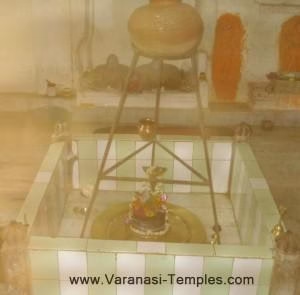
Primary Deity & Form: The sanctum houses a Shwayambhu Jyotirling (self-manifested lingam) of Lord Shiva, revered as Vasukeeshwar. The temple complex also venerates Vasuki Nagraj, the King of Serpents, whose idol is enshrined within.
Phalaśruti: The Spiritual Benefits
Why do pilgrims make the arduous journey to this specific ghat? According to Kashi Khand, the scriptures of Kashi, the spiritual merit gained here is unique:
- Cleansing Ancestral Karma: Devotees perform rituals here to neutralize Naga Dosha (Sarpa Dosha) and Pitru Dosha, ensuring peace for their ancestors.
- Removal of Fear: It is believed that worshipping Lord Vasukeeshwar grants freedom from fear of snakes, venom, and hidden enemies.
- Marital & Family Harmony: Couples facing delays in marriage or issues in progeny often visit to seek the blessings of Vasuki Nagraj.
| Date built: | – |
|---|---|
| Deity: | Vasukeeshwar |
| Architectural style: | Hindu Temple architecture |
| Major festivals | – |
| Locale: | Varanasi |
| District:: | varanasi |
| Address: | – |
| Phone | – |
Historical Origins & Scriptural Legend
Evidence from Kashi Khand
The roots of Vasukeeshwar Temple are deeply embedded in the Kashi Khand, a segment of the Skanda Purana. According to temple records and scriptural tradition, the deity Lord Kartikeya described the powerful Lingas situated on the four sides of the revered Jyeshteshwar Ling.
In the southern sector of Jyeshteshwar lies the Vasukeeshwar Ling. The scriptures narrate that adjacent to this spot exists (or once existed) the Vasuki Kund. The legend holds that this holy water body was formed by the sweat emanating from the massive body of Vasuki Nagraj during the Sagar Manthan (Churning of the Ocean).
The Connection to Sagar Manthan
While the physical Vasuki Kund has vanished from modern maps, local folklore asserts that an underground river still flows beneath the temple. In ancient texts, Vasuki is the serpent king upon whom Lord Shiva rests. Therefore, this temple is not just a tribute, but a direct conduit to the energy of the Sagar Manthan, where Vasuki was the rope used by Devas and Asuras to extract Amrit.
Architectural Marvels
Style and Layout
The Vasukeeshwar Temple reflects the classic Kashi Nagara style, characterized by a tiered Shikhara (spire) that rises towards the heavens, symbolizing the ascent of the soul. Unlike grand monolithic structures, this temple is built in the intimate architectural vocabulary of Varanasi’s ghat architecture—compact yet profoundly detailed.
Sculptural Details
Inside the sanctum, the architecture prioritizes the spiritual ambiance over decorative excess. The focal point is the Garbhagriha (inner sanctum), which houses the Shwayambhu Ling. A notable architectural element is the presence of the Idol of Vasuki Nagraj, often depicted in a coiled, protective posture. The stone walls bear the patina of centuries, retaining the energy of countless Abhisheks performed over the ages.
Darshan & Ritual Logistics
The temple follows a traditional routine, though the specific gatekeepers of the ghat regulate the timing based on the movement of the river.
| Session | Timing |
|---|---|
| Morning Darshan | 06:00 AM – 12:00 PM |
| Evening Darshan | 05:00 PM – 09:00 PM |
| Special Timing | Sunrise (approx. 5:30 AM) – Highly auspicious |
Key Sevas and Offerings
- Naag Puja: Specific rituals performed with milk and flowers for the idol of Vasuki Nagraj.
- Abhishekam: Sacred bathing of the Shiva Linga.
- Offering of Alms: As per Kashi Khand, offering food (Dharma) here is as meritorious as a Yajna.
2026 Festival Dates at Vasukeeshwar
Based on the Hindu calendar, specific days are dedicated to this temple:
- Naga Panchami: Date: July 27, 2026. This is the most significant day for this temple. Devotees are advised to perform pooja specifically on this day to cure Sarp Dosh entirely.
- Maha Shivaratri: Date: February 26, 2026. Continuous Jagran and special Abhishekams are organized.
- Haritalika Teej: Date: August 23, 2026. A major festival for married women in Varanasi.
Practical Visitor Guidance
Dress Code & Etiquette
Given its location on the Ghats, modesty is key. Traditional Indian attire (Saree, Kurta-Pajama) is recommended. Remove footwear outside the temple premises.
Photography & Electronics
Strict rules apply within the sanctum. Mobile phones should be kept in silent mode. It is advised to use mobile lockers provided by guides or keep devices away while navigating the steep steps of the ghat.
Crowd Management & Accessibility
Accessibility: The temple is not wheelchair accessible due to the ancient steps leading down to Scindia Ghat. It requires walking on uneven stones.
Best Time to Visit:
- Winter (Oct-Feb): Ideal weather. Cool breezes from the Ganges make darshan pleasant.
- Summer (May-June): Carry water and visit early morning (6 AM) to avoid the scorching heat reflecting off the stone steps.
- Monsoon (July-Sept): The ghat can be slippery. Exercise caution.
Devotees have been advised to perform pooja etc. on Naag Panchami Day which falls in the months of July-August.
The temple also contains the idol of Vasuki Nagraj. Vasuki Nagraj is the huge serpent which was used as a rope by Devas and Asuras in Sagar Manthan (churning of ocean) for extracting Amrit.
It is believed that Vasuki Kund (mentioned at para two above) was formed out of sweat emanating from of the body of Vasuki Nagaraj. While there is no trace of Vasuki Kund in the present day, old timers believe that a river called Vasuki still exists below the premises and may be flowing underground.
Pilgrimage Connectivity
How to Reach
- Address: House No. Ck.7/155, Scindia Ghat, Varanasi (Near Brihaspateshwar Temple).
- Nearest Airport: Varanasi Lal Bahadur Shastri International Airport (approx. 25 km away). From there, take a taxi to Chowk or Dashashwamedh Ghat.
- Nearest Railway Station: Varanasi Junction (approx. 7 km). Auto-rickshaws are readily available.
- Walking Route: Enter the narrow lanes of Chowk. Near Tulsi Ghat, ask locals for the way to Atma Veereshwar Temple (a famous landmark). The path descends towards Scindia Ghat.
- Boat Route: Hire a boat to Scindia Ghat and disembark. The temple is located just above the Ghat steps.
Nearby Sacred Sites (Pilgrimage Circuit)
Combine your visit to Vasukeeshwar with these nearby spiritual power centers:
- Brihaspateshwar Temple: Just a few steps away, dedicated to Lord Brihaspati (Jupiter). Worshipping here removes obstacles in career and education.
- Atma Veereshwar Temple: A key Shiva temple on the route to Chowk, believed to grant courage (Veer).
- Scindia Ghat: Not a temple, but a historically significant ghat with a partially submerged palace. Boat rides from here offer views of the Varanasi skyline.
Frequently Asked Questions (FAQs)
1. Is there a VIP darshan entry for Vasukeeshwar Temple?
As this is a heritage temple located in the narrow lanes of the old city, there is no formal VIP entry system like in large pilgrim cities like Tirupati. However, visiting early morning (before 7 AM) ensures a peaceful, private darshan with minimal crowd.
2. How is Vasukeeshwar Temple connected to Vasuki Kund?
According to Kashi Khand, the temple is spiritually linked to Vasuki Kund. While the physical kund is no longer visible, legends say an underground stream flows here. It is mandatory to mentally or spiritually connect the darshan here with the energies of the Nagas.
3. Can I perform Rudrabhishekam at this temple?
Yes, Rudrabhishekam can be performed. It is advisable to contact the local Purohit (priest) present at the Scindia Ghat area in advance to arrange the necessary materials (milk, honey, bilva leaves, etc.).
4. Is the temple open during monsoon floods?
During heavy rains, the water level of the Ganges rises, and the lower steps of Scindia Ghat may submerge. However, the main temple remains accessible. It is advised to check local flood warnings before visiting in August or September.
5. What is the significance of Naga Panchami here?
Naga Panchami is the most critical festival for this specific temple. Worshiping Vasukeeshwar on this day is believed to nullify Kaal Sarp Dosha in one’s horoscope and provide protection against snake bites and hidden fears.
Photo Gallery
Recent Posts

Shri Kaamkoteeshwar Mandir, Varanasi – History & Significance
In the heart of Kashi, the eternal city of Lord Shiva, where the Ganges flows with celestial grace, stands the Shri Kaamkoteeshwar Mandir. This sacred Sannidhi is not merely a temple but a profound spiritual bridge between the Northern…

ओ सांवरे तूने ही मुझको संभाला – Lyrics & Meaning
ओ सांवरे तूने ही मुझको संभाला – A Prayer to Shyam Origin & Spiritual Essence Why This Bhajan Resonates Devotees chant this when overwhelmed by life’s storms—the refrain ‘तूने ही मुझको संभाला’ is the soul’s sigh of relief: “You…

कथा ये है महाराज मेरे की – Lyrics & Meaning
कथा ये है महाराज मेरे की छत्रपति संभाजी महाराज – A Prayer to Chhatrapati Sambhaji Maharaj Origin & Spiritual Essence Why This Bhajan Resonates Devotees chant this when their spirit feels tested—its powerful refrain “महाराज मेरे” is a soul’s…

Rigveda Samhita Yathartha Anuvada (ऋग्वेद संहिता यथार्थ अनुवाद) – Complete Set with Anvayartha & Hindi/English Translation
The Rigveda is the oldest surviving scripture of humanity and the foundational text of Sanātana Dharma. For serious students, scholars, UPSC aspirants studying ancient Indian history, Sanskrit learners, and spiritual seekers, a precise and grammatically structured translation is indispensable.…

आना भी अकेला है जाना भी अकेला है – Lyrics & Meaning | BharatTemples
आना भी अकेला है जाना भी अकेला है – A Prayer to the Divine Witness Origin & Spiritual Essence Why This Bhajan Resonates Devotees turn to this bhajan in moments of deep reflection—when life’s attachments begin to ache. The…

माता शेरावाली के द्वार जो भी जाता है – Lyrics & Meaning
माता शेरावाली के द्वार जो भी जाता है – A Prayer to Maa Sherawali Origin & Spiritual Essence Why This Bhajan Resonates Devotees turn to this bhajan in times of fear or uncertainty—its promise that no one leaves Maa’s…

मार लेना सपणी उबार लेणा भवरा – Lyrics & Meaning
मार लेना सपणी उबार लेणा भवरा – A Prayer to the Divine Beloved Origin & Spiritual Essence Why This Bhajan Resonates Devotees chant this in moments of deep vulnerability—its cry of “मार लेना सपणी, उबार लेणा भवरा” is the…

हमें श्याम सुंदर भरोसा तुम्हारा – Lyrics & Meaning
हमें श्याम सुंदर भरोसा तुम्हारा – A Prayer to Shyam Sundar Origin & Spiritual Essence Why This Bhajan Resonates Devotees chant this when feeling alone—its refrain ‘de do sahara’ is the soul’s cry for divine support. Lyrics in Hindi…

Mere Satguru Ne Di Thi Davai Lyrics in Hindi & Meaning
Mere Satguru Ne Di Thi Davai: Invoking the Guru’s Liberating Wisdom This soul-stirring bhajan venerates the Satguru (True Spiritual Master) as the divine physician who dispenses the only remedy for life’s deepest sufferings. Composed by Sant Karmaveer Tufani, it…

Janm Diyo Thari Maa Dukh Dekhiyo Lyrics in Hindi & Meaning
जन्म दियो थारी माँ दुख देखियो (Maa’s Grief Upon Birthing You) This soul-stirring Chetavani Bhajan (admonitory hymn) is addressed to the Divine Mother (Maa) – a call for repentance when children forget their filial duties in the dark age…