
Contents
Introduction & Spiritual Essence
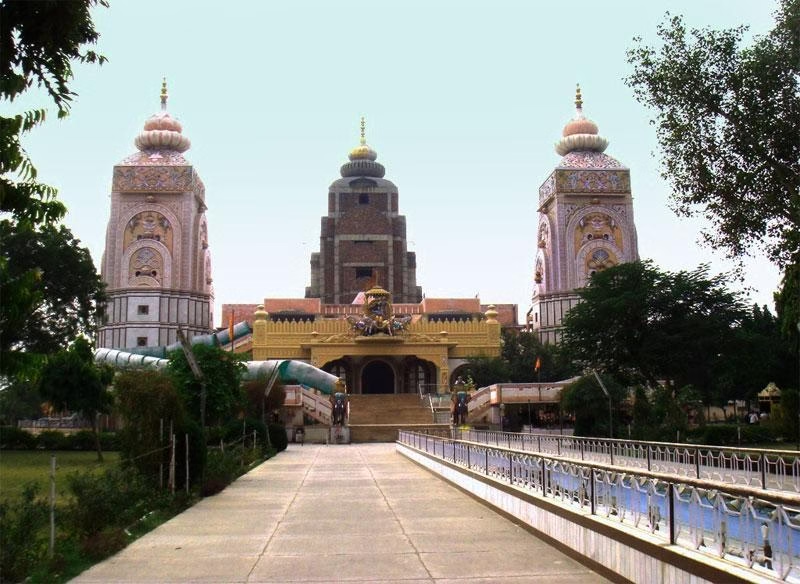
Located in the historic district of Hisar, Haryana, Agroha Dham stands as a monumental testament to the faith and cultural heritage of the Aggarwal community. Established in the late 20th century, this sprawling temple complex is not merely a structure of stone and mortar but a spiritual epicenter dedicated to the twin ideals of wealth and wisdom. The primary deity of the sanctum is Mahalakshmi, the Goddess of Prosperity, revered here in her full glory. However, the spiritual significance of Agroha Dham extends far beyond the presiding deity; it is also the eternal abode of Maharaja Agrasen, the legendary king whose principles of equitable trade and non-violence continue to inspire millions.
According to scriptural traditions, Maharaja Agrasen was an incarnation of Lord Vishnu, and his life was dedicated to the upliftment of the downtrodden. The temple complex encapsulates the essence of this legacy. For devotees, a visit to Agroha Dham is believed to wash away the sins of the past and cleanse ancestral karma. Phalaśruti (the spiritual benefits of worship) here is particularly potent for those seeking relief from financial distress and obstacles in their professional lives. The temple is unique in its integration of three distinct shrines—Mahalakshmi, Saraswati, and Agrasen Maharaj—allowing pilgrims to seek blessings for wealth, knowledge, and righteous leadership in a single circuit.
Historical Origins & Scriptural Legend
The history of Agroha Dham is a fascinating blend of ancient legend and modern devotion. While the site honors a legacy dating back thousands of years, the physical structure is a modern marvel. Tradition holds that the ancient city of Agroha was the capital of Maharaja Agrasen, established during the Dwapara Yuga. It is said that the original city was vast, with a population of 18 akhadas (military and trade divisions) and a central temple of Mahalakshmi that brought prosperity to the region.
According to temple records, the decision to construct the modern Agroha Dham was finalized at the All India Agarwal Representatives Conference in 1976. A charitable trust, the Agroha Vikas Trust, was formed under the leadership of Shri Krishna Modi and Rameshwar Das Gupta to oversee the project. The land was generously donated by Laxmi Narayan Gupta, and construction began under the supervision of Tilak Raj Agarwal. The main temple was completed and consecrated in 1984, marking a new era for Aggarwal cultural identity. Subsequent developments, including the construction of the Shakti Sarovar and amusement parks, continued under Subhash Goyal in 1985.
Architectural Marvels
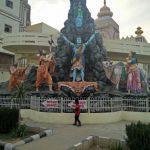
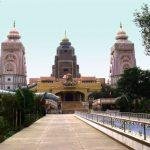
Agroha Dham is an architectural masterpiece that blends traditional Nagara style elements with the grandeur of a royal palace. The complex is designed according to the principles of Vastu Shastra, ensuring a harmonious flow of energy. The entrance is guarded by two massive, majestic elephant statues, symbolizing strength and welcome.
The complex is divided into three main sections, creating a triangular layout that allows for a seamless pilgrimage flow:
- The Central Shrine (Mahalakshmi): Located in the center, the sanctum houses the idol of Goddess Mahalakshmi. The shikhara (spire) rises high, adorned with intricate carvings that reflect divine grace.
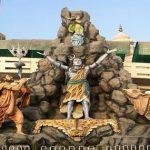
- The Eastern Wing (Maharaja Agrasen): Dedicated to the progenitor, this shrine features a bronze statue of Maharaja Agrasen. The architecture here is robust, symbolizing the protective nature of the king.
- The Western Wing (Goddess Saraswati): Facing west, the shrine of Saraswati is designed with open spaces to allow natural light, representing clarity and knowledge.
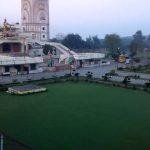
The premises are connected by distinct staircases, giving the complex a multi-tiered, palace-like appearance. A significant feature is the Shakti Sarovar (a large tank) behind the temple. In 1988, water was ceremoniously brought from 41 holy rivers of India to fill this tank, symbolizing the confluence of national spirituality. The complex also features a natural medical center for yoga-based treatment and an amusement park with boating facilities, making it a holistic destination for families.
Darshan & Ritual Logistics
Visiting Agroha Dham requires an understanding of the daily rituals and festival schedules. The temple maintains a strict adherence to Vedic timings.
Daily Darshan Timings (2026 Schedule)
| Session | Timings |
|---|---|
| Morning Opening | 06:00 AM |
| Morning Aarti | 08:00 AM |
| Midday Break | 12:00 PM – 04:00 PM (Temple Closed) |
| Evening Opening | 04:00 PM |
| Evening Aarti | 07:00 PM |
| Night Closing | 08:30 PM |
Key Sevas and Booking
Devotees can perform several sevas (services) to express devotion. The most popular are:
- Mahalakshmi Abhishekam: Ritual bathing of the deity with milk, honey, and ghee.
- Sri Agrasen Maharaj Archana: Recitation of the king’s lineage and virtues.
- Shanti Paath: A peace ceremony performed for family well-being.
Online Seva Booking: To facilitate devotees worldwide, the Agroha Vikas Trust has digitized bookings. Visit the official agroha.org portal (or designated trust website) to book specific dates. For the 2026 season, special attention should be paid to the following festivals:
- Agroha Maha Kumbh (Sharad Purnima): October 6, 2026. This is the annual festival featuring a grand procession and Vedic rituals.
- Maharaja Agrasen Jayanti: September 20, 2026 (Date varies by Hindu calendar).
- Diwali & Lakshmi Puja: October 21, 2026.
Practical Visitor Guidance
To ensure a spiritually fulfilling and hassle-free experience, please adhere to the following guidelines:
- Dress Code: Traditional Indian attire is highly recommended (Dhoti/Saree/Kurta-Pajama). Western clothing like shorts or sleeveless tops is discouraged out of respect for the sanctity of the temple.
- Photography: Photography is strictly prohibited inside the inner sanctum (Garbhagriha). Permitted in the outer courtyards, but flash must be disabled.
- Mobile Lockers: Electronic items and leather goods are not allowed inside the shrine. Free lockers are available at the entrance security office.
- Crowd Management: The temple sees heavy footfall during weekends and festivals. The best hours for a peaceful darshan are 6:00 AM – 7:30 AM or 4:00 PM – 5:30 PM.
- Seasonal Advice: Summers in Hisar (May–June) are extremely hot; carry a water bottle and head covering. Winters (Dec–Jan) are pleasant but require light woolens.
Pilgrimage Connectivity
How to Reach Agroha Dham
By Air: The nearest airport is Hisar Airport (HSS), approximately 15 km away. For better connectivity, Indira Gandhi International Airport (DEL) in New Delhi is about 170 km distant. Taxis and cabs are readily available from both.
By Rail: Hisar Junction Railway Station (HSR) is the nearest major railhead, well-connected to Delhi, Jaipur, and Mumbai. From the station, the temple is a 30-minute drive via NH 52.
By Road: Agroha is situated on the National Highway 52 (NH 52), connecting Delhi to Rajasthan. Regular state-run buses and private taxis ply to Agroha from Hisar city center and other major Haryana towns.
Nearby Sacred Sites
Enhance your pilgrimage by visiting these nearby spiritual destinations:
- Barsi Gate (Hisar): An ancient historical gate dating back to the Mughal era, located roughly 15 km away.
- Feroz Shah Palace Complex (Hisar): A historic site featuring a Lat (Ashokan Pillar) and mosque, 18 km from Agroha.
- Humad Temple (Bhiwani): An ancient sandstone temple dedicated to Lord Shiva, located about 40 km away, showcasing early medieval architecture.
Frequently Asked Questions (FAQs)
1. Is there a VIP darshan entry available at Agroha Dham?
Yes, the temple trust offers a special entry pass for elderly citizens and differently-abled visitors. VIP darshan can be arranged by contacting the trust office in advance or via the online booking portal during major festivals.
2. What is the significance of the water in the Shakti Sarovar?
The Shakti Sarovar contains water collected from 41 holy rivers of India. It is considered highly purifying. Devotees often take a dip here (where permitted) or carry the water home for religious rituals.
3. Are there accommodation facilities at Agroha Dham?
While the temple complex itself focuses on darshan and day activities, there are numerous hotels and Dharamshalas in Hisar city (15-20 km away). The trust occasionally provides guest rooms for senior pilgrims; inquiries should be made at the administration office.
4. Is the temple accessible for wheelchair users?
Yes, the central temple complex has ramps and smooth pathways. However, the upper floors or specific shrines might have stairs. Assistance is available at the entrance.
5. What is the best time to visit Agroha Dham?
The ideal months are October to March when the weather in Haryana is cool and pleasant. The most spiritually vibrant time is during the Agroha Maha Kumbh in October (Sharad Purnima).
Photo Gallery

Contact Details
Official Address:
Agroha Dham, Agroha, District Hisar,
Haryana 125047, India.
Managed by: Agroha Vikas Trust
Map & Location
Recent Posts

Shri Kaamkoteeshwar Mandir, Varanasi – History & Significance
In the heart of Kashi, the eternal city of Lord Shiva, where the Ganges flows with celestial grace, stands the Shri Kaamkoteeshwar Mandir. This sacred Sannidhi is not merely a temple but a profound spiritual bridge between the Northern…

ओ सांवरे तूने ही मुझको संभाला – Lyrics & Meaning
ओ सांवरे तूने ही मुझको संभाला – A Prayer to Shyam Origin & Spiritual Essence Why This Bhajan Resonates Devotees chant this when overwhelmed by life’s storms—the refrain ‘तूने ही मुझको संभाला’ is the soul’s sigh of relief: “You…

कथा ये है महाराज मेरे की – Lyrics & Meaning
कथा ये है महाराज मेरे की छत्रपति संभाजी महाराज – A Prayer to Chhatrapati Sambhaji Maharaj Origin & Spiritual Essence Why This Bhajan Resonates Devotees chant this when their spirit feels tested—its powerful refrain “महाराज मेरे” is a soul’s…

Rigveda Samhita Yathartha Anuvada (ऋग्वेद संहिता यथार्थ अनुवाद) – Complete Set with Anvayartha & Hindi/English Translation
The Rigveda is the oldest surviving scripture of humanity and the foundational text of Sanātana Dharma. For serious students, scholars, UPSC aspirants studying ancient Indian history, Sanskrit learners, and spiritual seekers, a precise and grammatically structured translation is indispensable.…

आना भी अकेला है जाना भी अकेला है – Lyrics & Meaning | BharatTemples
आना भी अकेला है जाना भी अकेला है – A Prayer to the Divine Witness Origin & Spiritual Essence Why This Bhajan Resonates Devotees turn to this bhajan in moments of deep reflection—when life’s attachments begin to ache. The…

माता शेरावाली के द्वार जो भी जाता है – Lyrics & Meaning
माता शेरावाली के द्वार जो भी जाता है – A Prayer to Maa Sherawali Origin & Spiritual Essence Why This Bhajan Resonates Devotees turn to this bhajan in times of fear or uncertainty—its promise that no one leaves Maa’s…

मार लेना सपणी उबार लेणा भवरा – Lyrics & Meaning
मार लेना सपणी उबार लेणा भवरा – A Prayer to the Divine Beloved Origin & Spiritual Essence Why This Bhajan Resonates Devotees chant this in moments of deep vulnerability—its cry of “मार लेना सपणी, उबार लेणा भवरा” is the…

हमें श्याम सुंदर भरोसा तुम्हारा – Lyrics & Meaning
हमें श्याम सुंदर भरोसा तुम्हारा – A Prayer to Shyam Sundar Origin & Spiritual Essence Why This Bhajan Resonates Devotees chant this when feeling alone—its refrain ‘de do sahara’ is the soul’s cry for divine support. Lyrics in Hindi…

Mere Satguru Ne Di Thi Davai Lyrics in Hindi & Meaning
Mere Satguru Ne Di Thi Davai: Invoking the Guru’s Liberating Wisdom This soul-stirring bhajan venerates the Satguru (True Spiritual Master) as the divine physician who dispenses the only remedy for life’s deepest sufferings. Composed by Sant Karmaveer Tufani, it…

Janm Diyo Thari Maa Dukh Dekhiyo Lyrics in Hindi & Meaning
जन्म दियो थारी माँ दुख देखियो (Maa’s Grief Upon Birthing You) This soul-stirring Chetavani Bhajan (admonitory hymn) is addressed to the Divine Mother (Maa) – a call for repentance when children forget their filial duties in the dark age…