
Contents
- 1 Introduction & Spiritual Essence: The Cosmic Witness of Daksha Yaga
- 2 Historical Origins & Scriptural Legend: The Site of the Daksha Yaga
- 3 Architectural Marvels: Wilderness and Ritual
- 4 Darshan & Ritual Logistics
- 5 Practical Visitor Guidance
- 6 Pilgrimage Connectivity: Reaching the Sacred Valley
Introduction & Spiritual Essence: The Cosmic Witness of Daksha Yaga
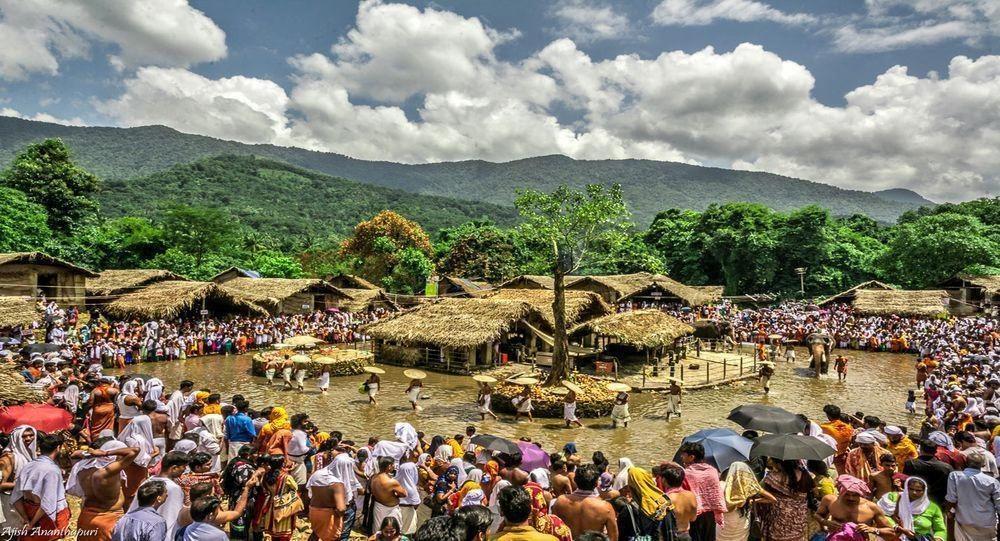
The Kottiyoor Temple, located in the lush Kannur district of Kerala, is not merely a shrine but a cosmic witness to the primal conflict between creation and ego. Known anciently as Vadakkeshwaram or Thruchherumana Kshetram, this temple complex is uniquely bifurcated by the Bavali River, creating a duality that reflects the divine masculine and feminine energies of Shiva and Parvati.
The primary deity here is a Swayambhu Lingam (self-manifested), revered as Lord Vadakkeshwaram (Shiva). Unlike constructed idols, this form represents the unmanifested consciousness rising from the earth. Adjacent to the Shiva Linga is the Ammarakkallu, a sacred heap worshipped as Goddess Parvati. This unique dual presence signifies the inseparable union of Purusha and Prakriti.
Phalaśruti: Why Devotees Visit
Tradition holds that visiting Kottiyoor cleanses ancestral karma. Because the temple is associated with the Daksha Yaga—where Sati Devi immolated herself—pilgrims believe that prayers here help ancestors attain Moksha (liberation). Furthermore, it is considered one of the five most sacred Shiva temples in Kerala, granting spiritual stability and protection from negative energies.
Historical Origins & Scriptural Legend: The Site of the Daksha Yaga
The history of Kottiyoor is rooted in the Sthala Purana (local lore) and Vedic scriptures. According to local legend, the eastern bank of the Bavali River—known as Akkare Kottiyoor—is the exact location of the Daksha Yaga. It was here that Daksha insulted Lord Shiva, leading to Sati Devi’s self-immolation. When Shiva carried her body and performed the Rudra Tandava, the energy of the event permeated this land.
While the exact date of the temple’s construction remains unrecorded due to its antiquity, the permanent structure on the western bank (Ikkare Kottiyoor) has stood for centuries, managed by the Malabar Devaswom Board. The temple is nestled within a sacred grove spanning 80 acres, maintaining a dense forest cover that preserves the primitive atmosphere of the mythological era. In recent times, the temple gained national attention following the Supreme Court’s 2019 verdict allowing women of all age groups entry into the sanctum, emphasizing its role as a beacon of progressive spirituality and constitutional rights.
Architectural Marvels: Wilderness and Ritual
Unlike the grand stone edifices typical of Dravidian architecture, Kottiyoor’s architecture is distinctively Kerala Style embedded within a Kavu (sacred grove). The temple complex is not built with imposing gopurams but rather merges with the Sahya mountain range valley.
Key Architectural Elements:
- The Sacred Groves: The temple is surrounded by dense vegetation, adhering to ancient Vastu Shastra principles where the structure harmonizes with nature rather than dominating it.
- The Twin Shrines: The layout is divided by the river. The western bank (Ikkare) houses the permanent Shiva Lingam, while the eastern bank (Akkare) transforms into a temporary hermitage (Yaga Shala) only during the Vysakha festival. This temporary structure mimics the ancient sacrificial altars of the Vedic period.
- The Altar (Ammarakkal Tara): A focal point of the architecture, this altar is where massive amounts of firewood are burned during the festival, yet the ash is never removed—a tradition maintained for centuries, signifying the eternal nature of the divine.
The temple does not possess ASI or UNESCO status, as it remains a living, active place of worship with traditions strictly governed by the Malabar Devaswom Board and local Brahmin families, preserving its purity against modern structural alterations.
Darshan & Ritual Logistics
The temple operates on a strict schedule, opening for only 27 days annually during the Vysakha Mahotsavam, except for daily rituals from the western bank.
Daily Timings (Western Bank – Ikkare Kottiyoor)
Note: During the Vysakha Festival (April-May), the temple remains open almost 24 hours.
| Session | Timings |
|---|---|
| Morning Opening | 5:00 AM |
| Afternoon Closure | 12:00 PM – 3:00 PM |
| Evening Opening | 3:00 PM |
| Night Closure | 8:00 PM |
Key Sevas and Online Booking
Devotees can book sevas through the official Malabar Devaswom Board website. Popular rituals include:
- Abhishekam: Performed with milk, ghee, and tender coconut water.
- Archana: Chanting of Shiva Sahasranamam.
- Kalam Kaliyamana Pooja: A special ritual performed during the Vysakha festival.
2026 Festival Dates:
The Vysakha Mahotsavam typically begins on the day of Vishu (April 14) and lasts for 27 days. For 2026, the festival is expected to start on April 14, 2026, concluding with the Kalam Kaliyamana ceremony.
Practical Visitor Guidance
Visiting Kottiyoor requires preparation due to its location within a dense forest.
- Dress Code: Traditional attire is mandatory. Men must wear Mundu (dhoti), and women must wear sarees or full-length traditional dresses. Modern clothing is strictly prohibited.
- Photography: Strictly prohibited inside the inner sanctum and the ritual areas. Photography is allowed in outer courtyards but restricts the use of cameras during the abhishekam.
- Crowd Management: The temple sees massive crowds during the festival. The best time for a quiet darshan is early morning (5:00 AM – 6:00 AM) on regular days. During the festival, weekdays are slightly less crowded than weekends.
- Seasonal Advice: The region is humid and prone to sudden rain. Carry water (May is hot), and use eco-friendly rain gear during the monsoon.




Pilgrimage Connectivity: Reaching the Sacred Valley
The temple is situated in Kottiyoor, Kannur district, Kerala.
How to Reach
- By Air: The nearest airport is Kannur International Airport (approx. 70 km). Kozhikode International Airport (CCJ) is about 85 km away.
- By Rail: The nearest railway stations are Thalassery (approx. 40 km) and Kannur (approx. 50 km). From the station, taxis and buses are available to Kottiyoor.
- By Road: The temple is accessible via NH 66. From Kannur, take the road toward Kuthuparamba and then proceed to Kottiyoor. The drive through the lush Western Ghats is scenic but involves narrow forest roads.
Nearby Sacred Sites
Enhance your pilgrimage by visiting these nearby shrines:
- Tirunelli Maha Vishnu Temple (Wayanad): Located about 54 km away. This ancient temple is deeply connected to Kottiyoor; historically, rice was exchanged between these two temples for the Vysakha festival.
- Sree Muthappan Temple (Parassini Kadavu): Famous for its unique ritualistic performing art, Theyyam, located near Kannur.
- Ezhimala Temple: An ancient site near Payyanur, known for its coastal significance and medicinal caves.
Frequently Asked Questions (FAQ)
1. Is there a VIP darshan entry available?
Yes, the temple offers a “Special Darshan” ticket system during the Vysakha festival to manage crowds. However, during peak rituals (like the Kalam Kaliyamana), general queues and special queues often merge for safety reasons.
2. Can we take a dip in the Bavali River?
While the river flows beside the temple, bathing is not permitted directly at the temple steps due to the depth and forest terrain. Devotees usually perform purification rituals using the river water at designated safe spots before entering the temple.
3. Is the Akkare Kottiyoor open year-round?
No. The shrine on the eastern bank (Akkare Kottiyoor) opens only during the 27-day Vysakha festival. The permanent temple (Ikkare Kottiyoor) on the western bank remains open throughout the year (except during specific ritual closures).
4. Is mobile network coverage available?
Network coverage is weak to non-existent within the forest area. It is advisable to inform family members beforehand and rely on landlines available at the administrative office.
5. Are there accommodation facilities near the temple?
Basic guest houses are available at Kottiyoor managed by the Devaswom Board. However, due to high demand during the festival, it is recommended to book accommodations in Kannur or Thalassery in advance.
Recent Posts

Shri Kaamkoteeshwar Mandir, Varanasi – History & Significance
In the heart of Kashi, the eternal city of Lord Shiva, where the Ganges flows with celestial grace, stands the Shri Kaamkoteeshwar Mandir. This sacred Sannidhi is not merely a temple but a profound spiritual bridge between the Northern…

ओ सांवरे तूने ही मुझको संभाला – Lyrics & Meaning
ओ सांवरे तूने ही मुझको संभाला – A Prayer to Shyam Origin & Spiritual Essence Why This Bhajan Resonates Devotees chant this when overwhelmed by life’s storms—the refrain ‘तूने ही मुझको संभाला’ is the soul’s sigh of relief: “You…

कथा ये है महाराज मेरे की – Lyrics & Meaning
कथा ये है महाराज मेरे की छत्रपति संभाजी महाराज – A Prayer to Chhatrapati Sambhaji Maharaj Origin & Spiritual Essence Why This Bhajan Resonates Devotees chant this when their spirit feels tested—its powerful refrain “महाराज मेरे” is a soul’s…

Rigveda Samhita Yathartha Anuvada (ऋग्वेद संहिता यथार्थ अनुवाद) – Complete Set with Anvayartha & Hindi/English Translation
The Rigveda is the oldest surviving scripture of humanity and the foundational text of Sanātana Dharma. For serious students, scholars, UPSC aspirants studying ancient Indian history, Sanskrit learners, and spiritual seekers, a precise and grammatically structured translation is indispensable.…

आना भी अकेला है जाना भी अकेला है – Lyrics & Meaning | BharatTemples
आना भी अकेला है जाना भी अकेला है – A Prayer to the Divine Witness Origin & Spiritual Essence Why This Bhajan Resonates Devotees turn to this bhajan in moments of deep reflection—when life’s attachments begin to ache. The…

माता शेरावाली के द्वार जो भी जाता है – Lyrics & Meaning
माता शेरावाली के द्वार जो भी जाता है – A Prayer to Maa Sherawali Origin & Spiritual Essence Why This Bhajan Resonates Devotees turn to this bhajan in times of fear or uncertainty—its promise that no one leaves Maa’s…

मार लेना सपणी उबार लेणा भवरा – Lyrics & Meaning
मार लेना सपणी उबार लेणा भवरा – A Prayer to the Divine Beloved Origin & Spiritual Essence Why This Bhajan Resonates Devotees chant this in moments of deep vulnerability—its cry of “मार लेना सपणी, उबार लेणा भवरा” is the…

हमें श्याम सुंदर भरोसा तुम्हारा – Lyrics & Meaning
हमें श्याम सुंदर भरोसा तुम्हारा – A Prayer to Shyam Sundar Origin & Spiritual Essence Why This Bhajan Resonates Devotees chant this when feeling alone—its refrain ‘de do sahara’ is the soul’s cry for divine support. Lyrics in Hindi…

Mere Satguru Ne Di Thi Davai Lyrics in Hindi & Meaning
Mere Satguru Ne Di Thi Davai: Invoking the Guru’s Liberating Wisdom This soul-stirring bhajan venerates the Satguru (True Spiritual Master) as the divine physician who dispenses the only remedy for life’s deepest sufferings. Composed by Sant Karmaveer Tufani, it…

Janm Diyo Thari Maa Dukh Dekhiyo Lyrics in Hindi & Meaning
जन्म दियो थारी माँ दुख देखियो (Maa’s Grief Upon Birthing You) This soul-stirring Chetavani Bhajan (admonitory hymn) is addressed to the Divine Mother (Maa) – a call for repentance when children forget their filial duties in the dark age…