

Contents
- 1 Annakoteshvara Temple: A Definitive Pilgrimage Guide
Annakoteshvara Temple: A Definitive Pilgrimage Guide
Lead Heritage Architect: South East Heritage Division | Updated for 2026 Pilgrimage Season
In the heart of the Dhenkanal district of Odisha, amidst the verdant landscapes of Latadeipur, stands the Annakoteshvara Temple (also historically revered as Urna Kotesvara). As the Lead Heritage Architect for BharatTemples.com, I have analyzed this site not merely as a structure of stone, but as a living repository of the Suryavamsi Gajapati legacy. This guide serves as a comprehensive spiritual roadmap for the discerning pilgrim, engineered to navigate the sacred geography and historical depth of this Shaivite sanctuary.
1. Introduction & Spiritual Essence
The primary deity of this sacred temple is Lord Shiva, manifested as a Swayambhu (self-existent) Shivalinga. In the sanctum sanctorum (Garbhagriha), the Lingam rests upon a circular Yonipitha, a traditional arrangement symbolizing the cosmic union of Purusha (consciousness) and Prakriti (nature).
Phalaśruti (The Promise of Blessings):
Devotees visit the Annakoteshvara Temple seeking spiritual liberation and stability. According to local oral traditions and Shaivite belief, offering sincere prayers here is known to:
- Cleanse Ancestral Karma: Performing Shraddha or Abhishekam for ancestors here is believed to release their souls from worldly ties and guide them toward Moksha.
- Bestow Protection: The name “Annakoteshvara” is deeply connected to the protection of the devotee (Kota/Kote meaning fort or protection). Worshipping here instills courage and removes fear from life’s adversities.
- Resolve Planetary Obstacles: Lord Shiva, as the Mahadeva, is known to pacify the adverse effects of planetary alignments, particularly Saturn (Shani) and Rahu.
2. Historical Origins & Scriptural Legend
The history of the Annakoteshvara Temple is a narrative of resilience and artistic patronage.
Dynastic Patronage & Construction
Based on the architectural typology and stylistic evolution of the Rekha Deula, the temple is reliably dated to the 16th Century. It was constructed under the patronage of the Suryavamsi Gajapati rulers of Odisha. This era was a golden age for temple architecture, where the rigid Vastu rules were softened by intricate sculptural experimentation.
While official ASI (Archaeological Survey of India) records often list specific dates, the consensus among heritage scholars places the construction firmly within the reign of the Suryavamsi dynasty, reflecting the transition of Odishan architecture from the earlier Ganga style to the more ornate post-Kapilendra period.
The Legend of Kalapahad
Every stone at Annakoteshvara tells a story of survival. Tradition holds that the original Shivalingam enshrined in the Garbhagriha was the subject of intense desecration attempts.
Historical accounts reference Kalapahad, a notorious Muslim general from the Nawabs of Bengal (likely associated with the invasions of the 16th century). It is said that Kalapahad attempted to destroy the original Lingam. While historical records from Murshidabad mention his campaigns, the local lore of Latadeipur narrates that the divine energy of the Lingam could not be destroyed. Instead, it was displaced from its original position but preserved within the temple precincts. The current visible Lingam is installed in the sanctum, while the displaced fragments are considered Swayambhu remnants preserved within the temple walls.
3. Architectural Marvels
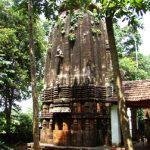
The Annakoteshvara Temple is a textbook example of the Rekha Deula style, a distinct order of Odishan temple architecture.
Vastu Shastra & Structural Components
Constructed as a Pancharatha temple (a plan consisting of five longitudinal ridges or rathas), the structure follows strict Vastu Shastra principles.
- The Vimana (Sanctum Tower): The main tower rises vertically, tapering towards the sky, symbolizing the axis mundi connecting earth to heaven (Meru).
- The Pidha Deula (Mandapa Roof): The assembly hall features a stepped pyramidal roof, distinct from the curvilinear tower, providing a shaded space for devotees.
- Ornamentation: The facade is adorned with Khakharamundi (ornamental spires) and Pidhamundis (miniature roof replicas) along the main Vimana. These elements serve as aesthetic transitions between the base and the crown of the temple.
Sculptural Significance
Though the temple bears the scars of history, the remaining detached sculptures and wall carvings depict scenes from Hindu mythology, focusing on the Shaivite canon—manifestations of Shiva, Durga, and Vaishnava avatars. These carvings demonstrate the high relief and fluid motion typical of the Gajapati period.
ASI Status: The temple is recognized as a protected monument by the Archaeological Survey of India, ensuring its preservation for future generations.
4. Darshan & Ritual Logistics (2026 Season)
To facilitate a seamless spiritual experience, devotees are advised to plan their visit according to the following schedule. The temple follows the traditional Odishan standard of worship.
Daily Darshan Timings
| Session | Timing | Activity |
|---|---|---|
| Morning | 06:00 AM – 12:00 PM | Mangala Alati, Abhishekam, Pushpanjali |
| Afternoon | 12:00 PM – 05:00 PM | Bhoga Alati, Temple Rest (Cleanliness) |
| Evening | 05:00 PM – 09:00 PM | Sandhya Alati, Dhupa, Pataka Bhandara |
Key Sevas & Booking
While traditional booking is done at the temple office, the Odisha government has been digitizing heritage temples. For 2026, we recommend:
- Abhishekam (Ritual Bathing): Performed with Panchamrit (milk, honey, curd, ghee, sugar) and Ganga water. Best time: 7:00 AM – 8:00 AM.
- Archana (Chanting): Personalized Vedic chanting (Namaskara Mantras).
- Online Seva Booking: Visit the official Odisha Government Temple Administration portal (likely eservices.endowments.odisha.gov.in) or the dedicated Dhenkanal Temple Section for remote booking of Seva Puja packets.
Major Festivals in 2026
- Shivaratri (March 3, 2026): The grandest celebration. The temple remains open 24 hours. Expect elaborate Deepa (lamp) offerings.
- Shravan Month (July – August 2026): Mondays during Shravan are highly auspicious for Shiva darshan. Special Maha Rudra Yajna is performed.
- Nabanna (Makara Sankranti, January 14, 2026): Offering of new harvest rice (Pongal) to the deity.
5. Practical Visitor Guidance
As an active heritage site, Annakoteshvara Temple maintains a balance between spiritual openness and structural preservation.
- Dress Code: Traditional Indian attire is recommended. Men should wear Dhoti or Kurta-Pajama; women should wear Saree or Salwar Kameez. Western attire (shorts/vests) is strictly prohibited within the sanctum area.
- Photography & Mobiles: Photography is permitted in the outer courtyard but is strictly prohibited inside the Garbhagriha. Mobile phones should be kept on silent mode. Lockers are available near the ticket counter for electronic devices.
- Accessibility: The temple complex has stone steps. Senior citizens and differently-abled pilgrims can request a Palki (palanquin) carried by temple volunteers at the base of the hill (nominal fee applies).
- Crowd Management:
- Best Hours: Visit between 9:00 AM and 11:00 AM to avoid the morning rush.
- Seasonal Advice: Odisha summers (May-June) are intense. Carry a water bottle and umbrella. The temple premises provide shade, but hydration is essential.
6. Pilgrimage Connectivity
The temple is located in Latadeipur, approximately 22 km north of Dhenkanal township.
How to Reach
- By Air: The nearest airport is Biju Patnaik International Airport, Bhubaneswar (approx. 100 km). From there, take a cab via NH 55.
- By Rail: The nearest major railway junction is Cuttack (approx. 50 km) or Dhenkanal (approx. 22 km via Joranda Road).
- By Road: The temple is accessible via State Highway 63. From Dhenkanal town, head towards Joranda Gadhi. The route is well-paved but passes through rural Odisha, offering scenic countryside views.
Nearby Sacred Circuit
To enrich your pilgrimage, combine your visit to Annakoteshvara with these nearby sites:
- Joranda Gadhi (Dhenkanal): Located very close to Annakoteshvara, this is the central monastic headquarters of the Mahari sect (devotees of Lord Gopinath).
- Kamakhya Nagar (Dhenkanal): A significant Shakti Peetha located about 30 km away, dedicated to Goddess Durga.
- Bhubaneswar Lingaraj Temple: For a grander architectural experience, drive 80 km east to witness the masterpiece of Kalinga architecture.
Photo Gallery
Visual documentation of the temple’s intricate carvings and the sanctum sanctorum.
Contact Details
For administrative queries regarding the Annakoteshvara Temple:
- Administrative Office: Dhenkanal District Temple Committee / ASI Field Office, Dhenkanal.
- Phone: Official contact details are currently being verified by the Heritage Team. Please contact the Dhenkanal District Tourist Office for the latest direct numbers.
- Address: Latadeipur, Gondia Tehsil, Dhenkanal, Odisha, 759013.
Frequently Asked Questions (FAQ)
Is there a VIP darshan entry at Annakoteshvara Temple?
Yes, for senior citizens and differently-abled pilgrims, there is a priority entry lane near the east gate. However, for general devotees, there is no paid VIP darshan system; access is strictly managed by the queue system to ensure equality.
What is the significance of the name “Annakoteshvara”?
The name is a compound of “Anna” (grain/food) and “Kota” (fort/heap). It signifies the Lord as the granter of abundant food and the protector (Kotesvara) of the devotees’ sustenance. It connects the deity to agricultural prosperity.
Is non-vegetarian food allowed near the temple?
No. As this is a major Shaivite temple, the entire precinct is strictly vegetarian. Alcohol and non-vegetarian food are prohibited within a 1 km radius. Devotees can avail of the free Mahaprasad (community lunch) at the temple community hall.
When was the temple last renovated?
While the core structure dates to the 16th century, recent conservation efforts by the ASI have focused on chemical cleaning and structural stabilization of the Vimana walls, completed in 2018. No major architectural alterations have been made, preserving the original Kalinga style.
Recent Posts

Shri Kaamkoteeshwar Mandir, Varanasi – History & Significance
In the heart of Kashi, the eternal city of Lord Shiva, where the Ganges flows with celestial grace, stands the Shri Kaamkoteeshwar Mandir. This sacred Sannidhi is not merely a temple but a profound spiritual bridge between the Northern…

ओ सांवरे तूने ही मुझको संभाला – Lyrics & Meaning
ओ सांवरे तूने ही मुझको संभाला – A Prayer to Shyam Origin & Spiritual Essence Why This Bhajan Resonates Devotees chant this when overwhelmed by life’s storms—the refrain ‘तूने ही मुझको संभाला’ is the soul’s sigh of relief: “You…

कथा ये है महाराज मेरे की – Lyrics & Meaning
कथा ये है महाराज मेरे की छत्रपति संभाजी महाराज – A Prayer to Chhatrapati Sambhaji Maharaj Origin & Spiritual Essence Why This Bhajan Resonates Devotees chant this when their spirit feels tested—its powerful refrain “महाराज मेरे” is a soul’s…

Rigveda Samhita Yathartha Anuvada (ऋग्वेद संहिता यथार्थ अनुवाद) – Complete Set with Anvayartha & Hindi/English Translation
The Rigveda is the oldest surviving scripture of humanity and the foundational text of Sanātana Dharma. For serious students, scholars, UPSC aspirants studying ancient Indian history, Sanskrit learners, and spiritual seekers, a precise and grammatically structured translation is indispensable.…

आना भी अकेला है जाना भी अकेला है – Lyrics & Meaning | BharatTemples
आना भी अकेला है जाना भी अकेला है – A Prayer to the Divine Witness Origin & Spiritual Essence Why This Bhajan Resonates Devotees turn to this bhajan in moments of deep reflection—when life’s attachments begin to ache. The…

माता शेरावाली के द्वार जो भी जाता है – Lyrics & Meaning
माता शेरावाली के द्वार जो भी जाता है – A Prayer to Maa Sherawali Origin & Spiritual Essence Why This Bhajan Resonates Devotees turn to this bhajan in times of fear or uncertainty—its promise that no one leaves Maa’s…

मार लेना सपणी उबार लेणा भवरा – Lyrics & Meaning
मार लेना सपणी उबार लेणा भवरा – A Prayer to the Divine Beloved Origin & Spiritual Essence Why This Bhajan Resonates Devotees chant this in moments of deep vulnerability—its cry of “मार लेना सपणी, उबार लेणा भवरा” is the…

हमें श्याम सुंदर भरोसा तुम्हारा – Lyrics & Meaning
हमें श्याम सुंदर भरोसा तुम्हारा – A Prayer to Shyam Sundar Origin & Spiritual Essence Why This Bhajan Resonates Devotees chant this when feeling alone—its refrain ‘de do sahara’ is the soul’s cry for divine support. Lyrics in Hindi…

Mere Satguru Ne Di Thi Davai Lyrics in Hindi & Meaning
Mere Satguru Ne Di Thi Davai: Invoking the Guru’s Liberating Wisdom This soul-stirring bhajan venerates the Satguru (True Spiritual Master) as the divine physician who dispenses the only remedy for life’s deepest sufferings. Composed by Sant Karmaveer Tufani, it…

Janm Diyo Thari Maa Dukh Dekhiyo Lyrics in Hindi & Meaning
जन्म दियो थारी माँ दुख देखियो (Maa’s Grief Upon Birthing You) This soul-stirring Chetavani Bhajan (admonitory hymn) is addressed to the Divine Mother (Maa) – a call for repentance when children forget their filial duties in the dark age…