
Contents
Introduction & Spiritual Essence
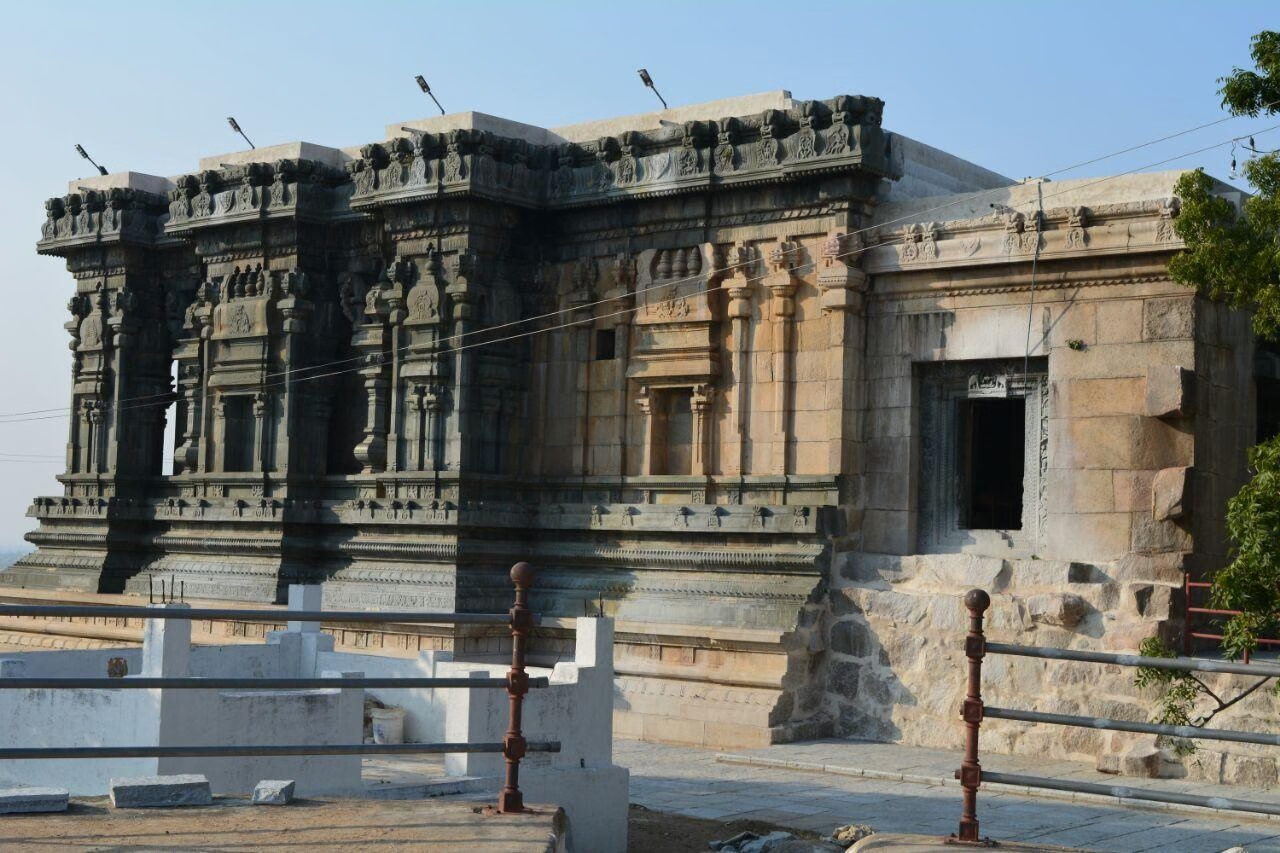
The Dichpally Ramalayam, also revered as the Khilla Ramalayam, stands as a silent sentinel of faith in the heart of Nizamabad, Telangana. Dedicated to Lord Rama, the presiding deity here is a Swayambhu (self-manifested) idol believed to have originated from the Treta Yuga. Unlike typical temple idols, the murti is depicted in a unique Dakshina Mukha (south-facing) posture, which holds deep significance in Vedic traditions.
Phalaśruti (Spiritual Benefits): Why do pilgrims flock here? According to local lore and the Sthala Purana, visiting this temple aids in Pitru Dosha Nivarana (alleviating ancestral afflictions) and Shani Dosha (Saturn’s malefic effects). Devotees believe that offering prayers here cleanses accumulated karma and grants peace of mind.
Historical Origins & Scriptural Legend
Builder: The temple was constructed in the 14th century during the glorious reign of the Kakatiya Dynasty, historically associated with the reign of King Prataparudra II (c. 1295–1323 CE).
Scriptural Context: While the epic Ramayana does not mention this specific site, the Sthala Purana (local oral tradition) narrates a legend linking the region to the Vanavasa (forest exile) of Lord Rama. It is believed that the sage Vishwamitra performed severe penance here, and the Lord manifested to bless him.
Renovations: While the structure has stood for over 700 years, it has undergone several restorations by local chieftains and modern state authorities to preserve its intricate carvings. The white lime mortar used in repairs is a blend of ancient recipe and modern preservation techniques.
Architectural Marvels
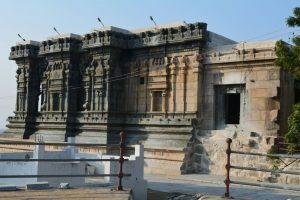
The Dichpally Ramalayam is a masterpiece of the Dravida style of temple architecture, infused with distinct Kakatiya innovations. It is famously dubbed the “Indoors Khajuraho” or “Nizamabad Khajuraho” due to its exquisitely detailed erotic carvings, similar to the temples of Madhya Pradesh, but with a unique South Indian signature.
- Material: Built predominantly with black and white basalt stone (Chalka and Veldanga), which creates a striking visual contrast against the arid landscape.
- The Mandapas: The temple features a sprawling Maha Mandapa (great hall) and an Artha Mandapa (vestibule). The ceiling of the main hall is supported by massive pillars, each carved with intricate floral motifs, deities, and geometric patterns.
- The 105 Steps: A defining feature is the monumental flight of 105 steps leading to the sanctum, protected by a formidable wall, hence the name Khilla (Fort).
- Carvings: The exterior walls are adorned with sculptures of celestial nymphs (Apsaras), animals like elephants and lions, and mythological demons (Yalis), showcasing the zenith of medieval stone craftsmanship.
Darshan & Ritual Logistics
The temple follows the standard Panchakala ritual structure (five daily rituals). However, timings may vary during festivals.
Daily Timings
| Session | Timings |
|---|---|
| Morning Darshan | 05:30 AM – 12:30 PM |
| Break | 12:30 PM – 03:00 PM |
| Evening Darshan | 03:00 PM – 08:30 PM |
| Abhishekam | 06:00 AM – 07:30 AM (Daily) |
Key Sevas & Online Booking
The temple trust manages Sevas (ritual services) primarily on-site, but for major festivals, limited services may be available via the local district administration portal.
- Rudrabhishekam: Performed on Mondays and Saturdays.
- Sri Rama Navami Kalyanotsavam: The annual wedding ceremony of Lord Rama.
- Booking: While fixed online portals are currently limited for this specific temple, devotees can contact the Executive Officer, Sri Ramalayam Trust, Nizamabad for pre-booking Sevas.
2026 Major Festival Dates
- Sri Rama Navami: April 6, 2026 (Sunday) – A grand procession and Sahasra Homa are expected.
- Vaikuntha Ekadashi: January 10, 2026
- Deepavali: October 21, 2026 – Special Alanalu (offering) is distributed.
Practical Visitor Guidance
Dress Code: Traditional Indian attire is strictly recommended. Men should wear Dhoti or trousers with a shirt; women should wear Saree, Salwar Kameez, or full-length skirts. Strictly no shorts or sleeveless tops.
Photography: Photography is permitted in the outer mandapas but is strictly prohibited inside the sanctum sanctorum (Garbhagriha).
Crowd Management:
- Best Hours: Weekday mornings (6 AM – 9 AM) are ideal for peaceful Darshan.
- Avoid: Sunday evenings and Rama Navami when the temple sees massive crowds.
- Seasonal Advice: Nizamabad can get hot in May. Carry a water bottle and an umbrella; white clothing reflects heat better.
Pilgrimage Connectivity
How to Reach
The temple is located in the Dichpally village area, approximately 8-10 km from Nizamabad city center.
- By Air: The nearest airport is Rajiv Gandhi International Airport, Hyderabad (approx. 210 km).
- By Rail: Nizamabad Junction (NZB) is the nearest railway station, well-connected to Hyderabad and Mumbai.
- By Road: Located just off the NH 65 (Hyderabad-Nagpur Highway). It is easily accessible via the Nizamabad-Adilabad State Highway. Local buses and auto-rickshaws are available from the main bus stand.
Nearby Sacred Sites
Expand your pilgrimage circuit with these nearby destinations:
- Neelakanteswara Temple: Located in Nizamabad city, a unique temple dedicated to Lord Shiva with a naturally formed Lingam.
- Domakonda Fort Temple: A historic fort complex housing ancient temples, located about 20 km away.
- Kotagiri Venkateshwara Swamy Temple: A hilltop temple offering panoramic views of the Godavari basin.
Photo Gallery
Official Contact
Executive Officer
Sri Ramalayam Trust
Dichpally, Nizamabad District, Telangana
Phone: +91 08462-245XXX (Office)
Frequently Asked Questions (FAQ)
1. Is there a VIP or Special Entry Darshan available?
Currently, the Dichpally Ramalayam operates on a general darshan system. While there is no designated VIP entry like major Tirupati shrines, devotees can purchase special tickets for Abhishekam to gain closer access to the deity during the ritual.
2. What is the historical significance of the erotic carvings?
The carvings, similar to Khajuraho, are characteristic of medieval Indian temple art. Historically, they represent a celebration of life and human desires, often interpreted as a spiritual lesson to transcend the physical plane. They are also attributed to the Tantric traditions prevalent during the Kakatiya era.
3. Is the temple accessible for the elderly and differently-abled?
While the temple maintains its historical integrity, the 105-step ascent can be challenging. The temple trust has installed handrails. For wheelchair access, it is advisable to contact the temple office in advance to arrange assistance via the rear service paths if available.
4. Where can I stay near the temple?
The best accommodation options are in Nizamabad city, which has numerous lodges ranging from budget to three-star hotels. Government Tourism Guest Houses (Haritha resorts) are also available nearby.
5. Is non-vegetarian food allowed near the temple?
No. The temple precincts are a strictly vegetarian zone. The local area has small stalls serving vegetarian snacks (prasadam), but for full meals, head to Nizamabad city where pure vegetarian restaurants are abundant.
Recent Posts

Shri Kaamkoteeshwar Mandir, Varanasi – History & Significance
In the heart of Kashi, the eternal city of Lord Shiva, where the Ganges flows with celestial grace, stands the Shri Kaamkoteeshwar Mandir. This sacred Sannidhi is not merely a temple but a profound spiritual bridge between the Northern…

ओ सांवरे तूने ही मुझको संभाला – Lyrics & Meaning
ओ सांवरे तूने ही मुझको संभाला – A Prayer to Shyam Origin & Spiritual Essence Why This Bhajan Resonates Devotees chant this when overwhelmed by life’s storms—the refrain ‘तूने ही मुझको संभाला’ is the soul’s sigh of relief: “You…

कथा ये है महाराज मेरे की – Lyrics & Meaning
कथा ये है महाराज मेरे की छत्रपति संभाजी महाराज – A Prayer to Chhatrapati Sambhaji Maharaj Origin & Spiritual Essence Why This Bhajan Resonates Devotees chant this when their spirit feels tested—its powerful refrain “महाराज मेरे” is a soul’s…

Rigveda Samhita Yathartha Anuvada (ऋग्वेद संहिता यथार्थ अनुवाद) – Complete Set with Anvayartha & Hindi/English Translation
The Rigveda is the oldest surviving scripture of humanity and the foundational text of Sanātana Dharma. For serious students, scholars, UPSC aspirants studying ancient Indian history, Sanskrit learners, and spiritual seekers, a precise and grammatically structured translation is indispensable.…

आना भी अकेला है जाना भी अकेला है – Lyrics & Meaning | BharatTemples
आना भी अकेला है जाना भी अकेला है – A Prayer to the Divine Witness Origin & Spiritual Essence Why This Bhajan Resonates Devotees turn to this bhajan in moments of deep reflection—when life’s attachments begin to ache. The…

माता शेरावाली के द्वार जो भी जाता है – Lyrics & Meaning
माता शेरावाली के द्वार जो भी जाता है – A Prayer to Maa Sherawali Origin & Spiritual Essence Why This Bhajan Resonates Devotees turn to this bhajan in times of fear or uncertainty—its promise that no one leaves Maa’s…

मार लेना सपणी उबार लेणा भवरा – Lyrics & Meaning
मार लेना सपणी उबार लेणा भवरा – A Prayer to the Divine Beloved Origin & Spiritual Essence Why This Bhajan Resonates Devotees chant this in moments of deep vulnerability—its cry of “मार लेना सपणी, उबार लेणा भवरा” is the…

हमें श्याम सुंदर भरोसा तुम्हारा – Lyrics & Meaning
हमें श्याम सुंदर भरोसा तुम्हारा – A Prayer to Shyam Sundar Origin & Spiritual Essence Why This Bhajan Resonates Devotees chant this when feeling alone—its refrain ‘de do sahara’ is the soul’s cry for divine support. Lyrics in Hindi…

Mere Satguru Ne Di Thi Davai Lyrics in Hindi & Meaning
Mere Satguru Ne Di Thi Davai: Invoking the Guru’s Liberating Wisdom This soul-stirring bhajan venerates the Satguru (True Spiritual Master) as the divine physician who dispenses the only remedy for life’s deepest sufferings. Composed by Sant Karmaveer Tufani, it…

Janm Diyo Thari Maa Dukh Dekhiyo Lyrics in Hindi & Meaning
जन्म दियो थारी माँ दुख देखियो (Maa’s Grief Upon Birthing You) This soul-stirring Chetavani Bhajan (admonitory hymn) is addressed to the Divine Mother (Maa) – a call for repentance when children forget their filial duties in the dark age…