
Contents
- 1 Introduction & Spiritual Essence
- 2 Historical Origins & Scriptural Legend
- 3 Architectural Marvels
- 4 Darshan & Ritual Logistics (2026)
- 5 Practical Visitor Guidance
- 6 Pilgrimage Connectivity
- 7 Frequently Asked Questions (FAQs)
- 7.1 1. Is there a VIP darshan entry at Veera Mangala Anjaneya Temple?
- 7.2 2. What is the significance of the lotus bud held by the deity?
- 7.3 3. Can we perform housewarming (Griha Pravesh) puja here?
- 7.4 4. Is accommodation available near the temple?
- 7.5 5. What is unique about the Saneeswara shrine here?
- 8 Photo Gallery
- 9 Contact Details
Introduction & Spiritual Essence
Nestled on the serene banks of the Kusasthalai River in the Thiruvallur district lies the Veera Mangala Anjaneya Temple in Nallathur. Dedicated to Lord Hanuman, known here as Veera Anjaneya or Bala Anjaneya, this shrine is a treasure trove of spiritual energy and ancient history.
The primary deity, a Swayambhu (self-manifested) idol carved from a single slab of stone, faces North towards the sacred abode of Lord Venkateswara at Tirupati. Unlike the typical depiction of Hanuman, here he is revered as “Bala” Anjaneya because his features resemble that of a child, yet he radiates immense valor.
Phalaśruti: The Spiritual Benefits
Devotees flock to this temple for specific spiritual and material benefits:
- Cleansing Ancestral Karma: It is believed that worshiping here washes away the sins of one’s lineage.
- Relief from Shani Dosha: With Lord Saneeswara (Saturn) facing Anjaneya in this temple, the malefic effects of Saturn are significantly pacified.
- Success in endeavors: The “Vijaya” aspect of the deity ensures success in legal matters and career advancements.
Historical Origins & Scriptural Legend
While the current temple structure reflects Dravidian architectural sensibilities, the site’s spiritual roots stretch back to the Tretha Yuga (the era of the Ramayana).
Sthala Purana & Ancient Penance
According to temple records and oral traditions, this holy land existed long before the stone idols were carved. It is said that Sage Jamadagni, the father of Lord Parasurama (the sixth avatar of Lord Vishnu), performed intense penance here. The energy of hisTapasya is believed to infuse the soil, making it a potent ground for spiritual growth.
The idol is described in the Parasara Samhita, an ancient text attributed to Sage Parasara (grandfather of Lord Krishna). The text details nine specific forms of Anjaneya, and Veera Anjaneya of Nallathur is one of them.
Architectural Marvels
The temple is a masterpiece of Dravidian architecture, adhering to the strict guidelines of Vaikanasa Agama and Pancharatna Agama.
The Moolavar (Main Deity)
The stone idol is a study in intricate detail:
- Direction: Facing North (Uttara Mukhi), directing energy toward Tirupati.
- Mudras: The right hand displays the Abhaya Mudra (gesture of fearlessness) with lotus petals, while the left holds a lotus bud close to the chest.
- Symbolism: The lotus represents Gyana (knowledge), Aishwarya (wealth), and Vijaya (victory), symbolizing Goddesses Saraswati, Lakshmi, and Durga.
- Unique Features: The tail is raised with a bell tied to the end. Over his head is a small carving of Lord Rama. On his chest is a silver carving of Sita-Rama.
- Divine Adornments: He wears the Vaishnava Thiruman on his forehead, Saligramam (fossil stone from Nepal) garlands, and Panchamukha Kundalas (earrings depicting five faces).
Vimana and Shrines
- Single-Tier Vimana: Dedicated to the Moolavar, flanked by images of Sudarsana (Chakra) and Panchajanya (Shanka).
- Southern Side: Yoga Anjaneya with Sangu (Conch) and Chakra.
- Eastern Side: Bhakta Anjaneya.
- Western Side: Panchamukha Anjaneya (five faces, ten hands).
- Northern Side: Veera Anjaneya with the right hand lifted toward the sky.
Other Shrines
- Lord Rama: A two-tier vimana housing Rama, Sita, Lakshmana, and Hanuman in a “Panchatva” pose.
- Navagrahas: A separate shrine where Saneeswara (Saturn) faces Anjaneya, ensuring benevolence for devotees.
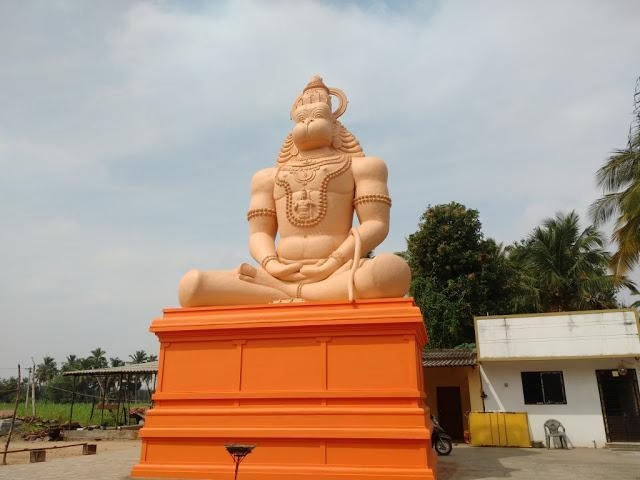
- Giant Murti: A 42-ft high sitting Sudhai (masonry) image of Anjaneya at the entrance, crafted by sthapathis of Mahabalipuram.
Darshan & Ritual Logistics (2026)
Temple rituals are conducted according to the Vaikanasa Agama. The Maha Kumbabishekam was last performed on July 7, 1998.
Daily Timings
| Session | Timings |
|---|---|
| Morning Darshan | 06:00 AM – 12:00 PM |
| Afternoon Recess | 12:00 PM – 04:00 PM |
| Evening Darshan | 04:00 PM – 08:30 PM |
Key Sevas & Booking
Devotees can perform several Sevas to enhance their spiritual experience:
- Abhishekam: Ritual bathing of the deity (usually performed in early mornings).
- Archana: Recitation of names with specific offerings.
- Deepa Aradhana: Lamp offering.
Online Booking: While the temple is managed by the Shri Veera Anjaneya Bhaktha Samaj, devotees are advised to contact the temple administration directly for advance booking of special Sevas.
2026 Festival Calendar
Mark your calendars for these major celebrations:
- Hanuman Jayanti: Date to be confirmed based on the Hindu calendar (typically March/April 2026).
- Rama Navami: Celebration of Lord Rama’s birth (April 6, 2026).
- Deepavali: Special abhishekam and pujas (November 2026).
- Pongal (Harvest Festival): January 2026.
Practical Visitor Guidance
To ensure a smooth darshan experience at Veera Mangala Anjaneya Temple:
Dress Code & Etiquette
- Attire: Traditional dress is mandatory. Men should wear dhotis or pants with shirts; women should wear sarees, salwar kameez, or skirts. Avoid shorts and t-shirts.
- Photography: Photography is generally restricted inside the inner sanctum (Garbhagriha). It is permitted in the outer courtyards and around the 42-ft giant statue.
- Mobile Phones: Usage is discouraged inside the shrine. Lockers are available at the entrance to store electronics.
Accessibility & Crowd Management
- Best Time to Visit: Early mornings (6:00 AM – 7:30 AM) on weekdays are least crowded. Tuesdays and Saturdays witness higher footfall due to Hanuman and Saturn worship.
- Seasonal Advice:
- Summer (May): Thiruvallur gets quite hot. Carry a water bottle and wear a hat.
- Monsoon (Oct-Dec): The Kusasthalai river flows nearby; carry an umbrella.
- Footwear: There is a designated paid footwear storage facility near the entrance.
Pilgrimage Connectivity
The temple is strategically located near Thiruthani, making it a vital stop on the Tirupati pilgrimage circuit.
How to Reach
- By Air: Chennai International Airport (MAA) is approximately 85 km away.
- By Rail: Thiruthani Railway Station is the nearest railhead (approx. 14 km). Alternatively, Thiruvallur Railway Station is 37 km away.
- By Road: The temple is located on the Chennai – Tiruvallur – Thiruthani route (connecting to NH 40). It is about 15 km from Thiruthani. From Tiruvallur, take the fork towards Thiruthani; look for signage indicating the 12 km diversion to Nallathur.
Nearby Sacred Sites
- Thiruthani Murugan Temple: One of the six abodes (Arupadaiveedu) of Lord Murugan, located about 16 km away.
- Tirupati Balaji Temple: The world-renowned Venkateswara Swamy temple is just 66 km from Nallathur.
- Thiruvallur Veeraraghava Swamy Temple: A major Vishnu temple dedicated to the healer of the universe, located 37 km away.
Frequently Asked Questions (FAQs)
1. Is there a VIP darshan entry at Veera Mangala Anjaneya Temple?
Yes, the temple administration facilitates special darshan for dignitaries and elderly devotees upon prior request. However, standard queuing systems apply for general devotees.
2. What is the significance of the lotus bud held by the deity?
The left hand holds a lotus bud close to the chest, symbolizing purity, spiritual awakening, and the heart filled with devotion for Lord Rama.
3. Can we perform housewarming (Griha Pravesh) puja here?
The temple priests conduct specific rituals. It is recommended to call the temple administration in advance to schedule any specialized external rituals like Griha Pravesh or Satyanarayana Puja.
4. Is accommodation available near the temple?
While the temple does not have its own guest house, several private lodges and choultries are available in Thiruthani and Thiruvallur, catering to pilgrims.
5. What is unique about the Saneeswara shrine here?
In this temple, Lord Saneeswara (Saturn) is positioned facing Lord Anjaneya. It is believed that Anjaneya’s benevolent gaze neutralizes the harsh effects of Saturn, offering relief from Shani Dosha.
Photo Gallery

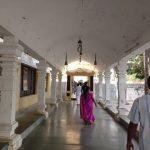
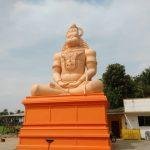
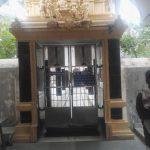
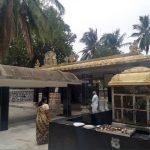
Contact Details
Official Address:
Veera Mangala Anjaneya Temple,
Nallathur Village,
Thiruthani Taluk, Thiruvallur District,
Tamil Nadu – 602003.
Recent Posts

Shri Kaamkoteeshwar Mandir, Varanasi – History & Significance
In the heart of Kashi, the eternal city of Lord Shiva, where the Ganges flows with celestial grace, stands the Shri Kaamkoteeshwar Mandir. This sacred Sannidhi is not merely a temple but a profound spiritual bridge between the Northern…

ओ सांवरे तूने ही मुझको संभाला – Lyrics & Meaning
ओ सांवरे तूने ही मुझको संभाला – A Prayer to Shyam Origin & Spiritual Essence Why This Bhajan Resonates Devotees chant this when overwhelmed by life’s storms—the refrain ‘तूने ही मुझको संभाला’ is the soul’s sigh of relief: “You…

कथा ये है महाराज मेरे की – Lyrics & Meaning
कथा ये है महाराज मेरे की छत्रपति संभाजी महाराज – A Prayer to Chhatrapati Sambhaji Maharaj Origin & Spiritual Essence Why This Bhajan Resonates Devotees chant this when their spirit feels tested—its powerful refrain “महाराज मेरे” is a soul’s…

Rigveda Samhita Yathartha Anuvada (ऋग्वेद संहिता यथार्थ अनुवाद) – Complete Set with Anvayartha & Hindi/English Translation
The Rigveda is the oldest surviving scripture of humanity and the foundational text of Sanātana Dharma. For serious students, scholars, UPSC aspirants studying ancient Indian history, Sanskrit learners, and spiritual seekers, a precise and grammatically structured translation is indispensable.…

आना भी अकेला है जाना भी अकेला है – Lyrics & Meaning | BharatTemples
आना भी अकेला है जाना भी अकेला है – A Prayer to the Divine Witness Origin & Spiritual Essence Why This Bhajan Resonates Devotees turn to this bhajan in moments of deep reflection—when life’s attachments begin to ache. The…

माता शेरावाली के द्वार जो भी जाता है – Lyrics & Meaning
माता शेरावाली के द्वार जो भी जाता है – A Prayer to Maa Sherawali Origin & Spiritual Essence Why This Bhajan Resonates Devotees turn to this bhajan in times of fear or uncertainty—its promise that no one leaves Maa’s…

मार लेना सपणी उबार लेणा भवरा – Lyrics & Meaning
मार लेना सपणी उबार लेणा भवरा – A Prayer to the Divine Beloved Origin & Spiritual Essence Why This Bhajan Resonates Devotees chant this in moments of deep vulnerability—its cry of “मार लेना सपणी, उबार लेणा भवरा” is the…

हमें श्याम सुंदर भरोसा तुम्हारा – Lyrics & Meaning
हमें श्याम सुंदर भरोसा तुम्हारा – A Prayer to Shyam Sundar Origin & Spiritual Essence Why This Bhajan Resonates Devotees chant this when feeling alone—its refrain ‘de do sahara’ is the soul’s cry for divine support. Lyrics in Hindi…

Mere Satguru Ne Di Thi Davai Lyrics in Hindi & Meaning
Mere Satguru Ne Di Thi Davai: Invoking the Guru’s Liberating Wisdom This soul-stirring bhajan venerates the Satguru (True Spiritual Master) as the divine physician who dispenses the only remedy for life’s deepest sufferings. Composed by Sant Karmaveer Tufani, it…

Janm Diyo Thari Maa Dukh Dekhiyo Lyrics in Hindi & Meaning
जन्म दियो थारी माँ दुख देखियो (Maa’s Grief Upon Birthing You) This soul-stirring Chetavani Bhajan (admonitory hymn) is addressed to the Divine Mother (Maa) – a call for repentance when children forget their filial duties in the dark age…