
Contents
Introduction & Spiritual Essence
Nestled amidst the serene Khandesh region of Maharashtra, the Shri Ramtek Temple stands as a timeless testament to faith and legend. The primary deity here is Lord Rama, revered in his form as Pranav Deo. This temple is not merely a stone structure; it is the physical manifestation of a sacred vow (Tek). According to local lore, this is the precise spot where Lord Rama, during his 14-year exile, took a vow to remain unmarried until his return from the forest—giving the town its name, Ramtek.
For devotees, visiting this temple is a profound spiritual act. The Phalaśruti (spiritual benefits) associated with circumambulating the Ramtek hill is believed to be equal to visiting Kashi (Varanasi) itself. It is said that a pilgrimage here cleanses one of the sins of past lives and resolves ancestral karma, granting peace to departed souls.
Historical Origins & Scriptural Legend
The origins of the Ramtek Temple are deeply rooted in mythology and reinforced by documented history. Scriptural legends and the local Sthala Purana suggest that this area was once the hermitage of the revered sage Agastya, whom Lord Rama visited. While the specific stone lingam worshipped today is ancient, the grand temple structure visible today reflects the patronage of the Bhonsale Dynasty of Nagpur.
According to historical records, the current temple complex was largely built in the mid-18th century by Raghuji Bhonsale I, the Maratha ruler of Nagpur, following his victory over the fort of Deogarh in Chhindwara around 1742. Over the centuries, the temple has undergone renovations, but it retains its historical grandeur, managed by the Shri Ramtek Ram Mandir Trust (established in 1956).
Architectural Marvels
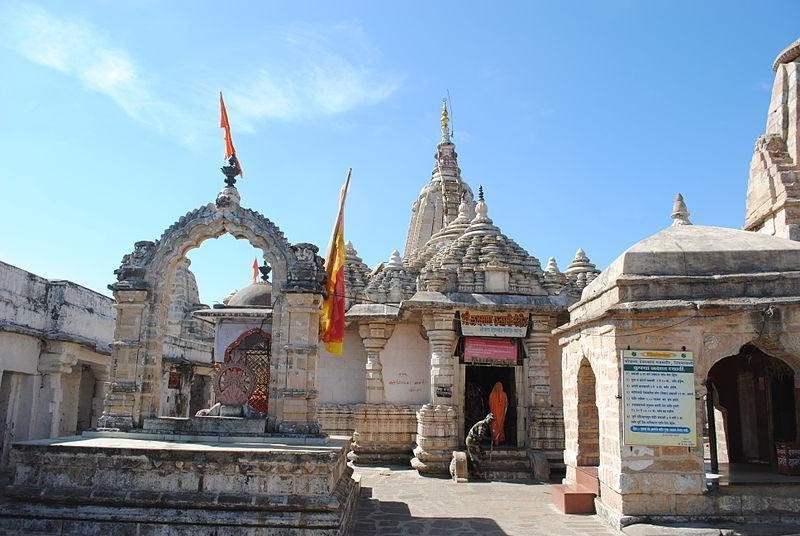
The architecture of Ramtek Temple is a stunning example of the Nagara style, infused with local Hemadpanti elements (characterized by black stone and lime mortar). The temple complex is situated on a hillock, requiring devotees to ascend a flight of steps, symbolizing the spiritual ascent.
The Shikhara (tower) rises gracefully, adorned with intricate carvings and sculptures depicting scenes from the Ramayana. The Mandapa (hall) features robust pillars, each carved with deities and floral motifs. Within the sanctum, the idol of Lord Rama is depicted with four arms, holding the bow and arrow, embodying his role as the protector of righteousness. While the temple is not a UNESCO site, it holds immense protected heritage status under the State Archaeology Department.


Darshan & Ritual Logistics
To ensure a seamless spiritual experience, devotees should plan their visit according to the temple’s strict schedule. Below are the daily timings and key services for 2026.
Daily Temple Timings
| Session | Timings |
|---|---|
| Morning Darshan | 06:00 AM – 12:00 PM |
| Midday Break (Cleaning) | 12:00 PM – 04:00 PM |
| Evening Darshan | 04:00 PM – 09:00 PM |
| Aarti (Sandhya) | 07:30 PM (Daily) |
Key Sevas & 2026 Festivals
Devotees can book specific rituals. The temple is particularly famous for Abhishekam (ritual bathing of the deity) and Archana (offering of flowers and mantras).
- Booking Procedure: Visit the official Shri Ramtek Ram Mandir Trust website or the ticket counter at the temple entrance. Online booking typically opens 30 days prior to the festival dates.
- Major 2026 Festival Dates:
- Ram Navami: April 6, 2026 (Grand celebrations with Maha Aarti).
- Diwali (Vijayadashami): October 2, 2026 (Special night-long chanting).
- Maha Shivaratri: February 26, 2026 (Celebrated at the adjacent Shiva temple).
Practical Visitor Guidance
Adhering to the spiritual atmosphere requires following certain protocols.
- Dress Code: Traditional attire is mandatory. Men must wear Dhoti or trousers with a shirt (no shorts/t-shirts). Women should wear sarees, salwar kameez, or traditional skirts.
- Photography & Mobiles: Photography is strictly prohibited inside the sanctum (Garbhagriha). Mobile phones and cameras are permitted in the courtyard but must be kept on silent mode.
- Lockers: Free and paid locker facilities are available at the entrance for valuables and electronics.
- Crowd Management: The temple witnesses massive crowds on weekends and festivals. Best hours to visit are 8:00 AM – 10:00 AM on weekdays. During summers (May), the granite steps become hot; it is advisable to carry a water bottle and wear protective footwear.
Pilgrimage Connectivity
Ramtek is well-connected to major cities, making it accessible for pilgrims across India.
How to Reach
- By Air: The nearest airport is Dr. Babasaheb Ambedkar International Airport (NAG) in Nagpur, approximately 45 km away.
- By Rail: Nagpur Railway Station is the major junction (40 km). Local trains are available to Ramtek station, though taxis are faster.
- By Road: Located on NH-752 (Old NH-7). Regular state transport buses and private taxis ply from Nagpur’s ‘Sitabuldi’ bus stand.
Nearby Sacred Sites
Complete your pilgrimage by visiting these nearby holy spots:
- Mansar Temple Complex: Located just 1 km from Ramtek, this is an ancient temple dedicated to Lord Shiva and Shakti. It is believed that Rama worshipped here to gain strength.
- Deekshabhoomi: 40 km away in Nagpur, this is a massive Buddhist stupa and a significant pilgrimage site for Navayana Buddhism.
- Pench National Park: Located nearby, it is considered the forest area mentioned in the Ramayana (Dandakaranya), offering a nature-yatra experience.
Frequently Asked Questions (FAQs)
Is there a VIP darshan entry available?
Yes, the temple trust offers a paid VIP pass for faster darshan, especially during peak festivals. These can be purchased at the trust office or online.
Can non-Hindus visit the temple?
While the temple is primarily for Hindu devotees, entry for non-Hindus is generally permitted in the outer courtyard. However, entry into the inner sanctum (Garbhagriha) is restricted.
What is the best time of year to visit?
The ideal time is between October and March when the weather in Nagpur is pleasant. However, for a unique spiritual vibrancy, visiting during Ram Navami (April) is highly recommended.
Is accommodation available near the temple?
Yes, the temple trust runs guest houses, and there are private hotels in Ramtek town. For a more rustic experience, the inspection bungalows of the Forest Department are also available nearby.
Are there any dietary restrictions for visitors?
Strictly vegetarian food is allowed within the temple premises. Meat, alcohol, and tobacco are strictly prohibited. Free Prasad is distributed after evening Aarti.
Recent Posts

Shri Kaamkoteeshwar Mandir, Varanasi – History & Significance
In the heart of Kashi, the eternal city of Lord Shiva, where the Ganges flows with celestial grace, stands the Shri Kaamkoteeshwar Mandir. This sacred Sannidhi is not merely a temple but a profound spiritual bridge between the Northern…

ओ सांवरे तूने ही मुझको संभाला – Lyrics & Meaning
ओ सांवरे तूने ही मुझको संभाला – A Prayer to Shyam Origin & Spiritual Essence Why This Bhajan Resonates Devotees chant this when overwhelmed by life’s storms—the refrain ‘तूने ही मुझको संभाला’ is the soul’s sigh of relief: “You…

कथा ये है महाराज मेरे की – Lyrics & Meaning
कथा ये है महाराज मेरे की छत्रपति संभाजी महाराज – A Prayer to Chhatrapati Sambhaji Maharaj Origin & Spiritual Essence Why This Bhajan Resonates Devotees chant this when their spirit feels tested—its powerful refrain “महाराज मेरे” is a soul’s…

Rigveda Samhita Yathartha Anuvada (ऋग्वेद संहिता यथार्थ अनुवाद) – Complete Set with Anvayartha & Hindi/English Translation
The Rigveda is the oldest surviving scripture of humanity and the foundational text of Sanātana Dharma. For serious students, scholars, UPSC aspirants studying ancient Indian history, Sanskrit learners, and spiritual seekers, a precise and grammatically structured translation is indispensable.…

आना भी अकेला है जाना भी अकेला है – Lyrics & Meaning | BharatTemples
आना भी अकेला है जाना भी अकेला है – A Prayer to the Divine Witness Origin & Spiritual Essence Why This Bhajan Resonates Devotees turn to this bhajan in moments of deep reflection—when life’s attachments begin to ache. The…

माता शेरावाली के द्वार जो भी जाता है – Lyrics & Meaning
माता शेरावाली के द्वार जो भी जाता है – A Prayer to Maa Sherawali Origin & Spiritual Essence Why This Bhajan Resonates Devotees turn to this bhajan in times of fear or uncertainty—its promise that no one leaves Maa’s…

मार लेना सपणी उबार लेणा भवरा – Lyrics & Meaning
मार लेना सपणी उबार लेणा भवरा – A Prayer to the Divine Beloved Origin & Spiritual Essence Why This Bhajan Resonates Devotees chant this in moments of deep vulnerability—its cry of “मार लेना सपणी, उबार लेणा भवरा” is the…

हमें श्याम सुंदर भरोसा तुम्हारा – Lyrics & Meaning
हमें श्याम सुंदर भरोसा तुम्हारा – A Prayer to Shyam Sundar Origin & Spiritual Essence Why This Bhajan Resonates Devotees chant this when feeling alone—its refrain ‘de do sahara’ is the soul’s cry for divine support. Lyrics in Hindi…

Mere Satguru Ne Di Thi Davai Lyrics in Hindi & Meaning
Mere Satguru Ne Di Thi Davai: Invoking the Guru’s Liberating Wisdom This soul-stirring bhajan venerates the Satguru (True Spiritual Master) as the divine physician who dispenses the only remedy for life’s deepest sufferings. Composed by Sant Karmaveer Tufani, it…

Janm Diyo Thari Maa Dukh Dekhiyo Lyrics in Hindi & Meaning
जन्म दियो थारी माँ दुख देखियो (Maa’s Grief Upon Birthing You) This soul-stirring Chetavani Bhajan (admonitory hymn) is addressed to the Divine Mother (Maa) – a call for repentance when children forget their filial duties in the dark age…