
Contents
Introduction & Spiritual Essence
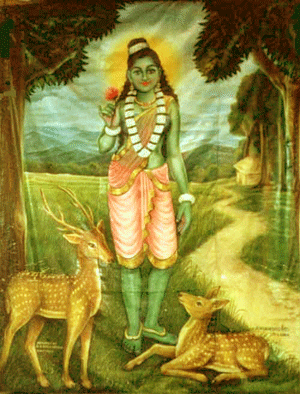
The Valli Temple in Palani is a sacred sanctuary dedicated to Goddess Valli, the divine consort of Lord Murugan (Skanda). Located on the foothills of the Palani Malai, this temple serves as a spiritual gateway for devotees ascending to the main Palani Murugan Temple. While the primary deity of Palani is Dhandayuthapani Swamy, the presence of Valli Amman is essential to the mythological narrative of Murugan’s union.
Deity and Form
Unlike the ascetic form of Lord Murugan in Palani, Goddess Valli is worshipped in her gentle, protective form. She is considered an incarnation of the Vedic Goddess Devasena. The murti (idol) here is often depicted in a stucco niche or a small shrine, radiating maternal warmth. Devotees refer to her as Valli Amman or Valli Nachiyar.
Phalaśruti: The Benefits of Visiting
According to ancient beliefs and temple folklore, worshipping Goddess Valli at Palani bestows specific blessings:
- Removal of Obstacles: Valli is revered for clearing hurdles in marriage and family life.
- Ancestral Blessings: Offering prayers here is believed to resolve ancestral disputes and bring peace to departed souls.
- Divine Union: Unmarried devotees visit to seek a righteous partner, emulating the sacred marriage between Murugan and Valli.
Historical Origins & Scriptural Legend
The Legend of Valli and Murugan
The Valli Temple in Palani is deeply intertwined with the Skanda Purana. Legend holds that while Lord Murugan resided atop the hill as Dhandayuthapani, Goddess Valli (born as a hunter princess in the Palani region) performed intense penance to unite with him.
Tradition holds that this temple marks the spot where Valli meditated and eventually met Murugan. Unlike the main temple, which reflects the austerity of a sannyasi, this shrine celebrates the gentle and familial aspects of the divine.
Architectural Heritage
According to temple records, the steps leading to the main temple were completed in 1925, and the Valli Temple structure reflects the traditional Tamil architecture prevalent in the region. While the exact dynastic builder is less documented than the main Dhandayuthapani temple (attributed to the Pandyas and Cholas), local lore suggests the temple was expanded and maintained by philanthropists during the early 20th century.
Architectural Marvels
Style and Structure
The Valli Temple exhibits elements of Dravidian architecture. It is typically a small but profound structure, often built into the hillside or located in a Mandapa (hall) along the ascending path.
Notable Sculptures and Features
The temple complex is famous for its stucco work and niche sculptures:
- Stucco Niche: The sanctum often features a stucco relief of Valli, visually distinct and vibrant.
- Associated Deities: In the front mandapa, you will find idols of Lord Vinayaga (Ganesha) and sometimes two mortal figures, believed to be Valli’s relatives or protective spirits.
- The Elephant Track: The path separates near the Siddi Vinayagar and Chera Vinayagar temples. This area contains beautiful stucco figures and animal motifs carved into the rock face.
Darshan & Ritual Logistics
The Valli Temple is generally open during the main temple timings, though specific hours may vary slightly based on seasonal rituals.
Daily Timings (2026 Schedule)
| Session | Timing | Activity |
|---|---|---|
| Morning | 06:00 AM – 12:00 PM | Opening, Morning Abhishekam |
| Afternoon | 12:00 PM – 04:00 PM | Temple Rest / Decoration |
| Evening | 04:00 PM – 08:00 PM | Evening Darshan, Deeparadhana |
Key Sevas and Offerings
While the primary Abhishekam is performed for Lord Murugan, devotees offer special prayers to Valli Amman:
- Archana: Recitation of the Thiruppugazh and Amman mantras.
- Thangal Abhishekam: Offering of sacred threads (usually yellow) for wishes.
- Special Prasadam: Panchamritam and Kumkum are offered.
Online Seva Booking
Devotees can book general darshan and special sevas for the main Palani temple via the official website. While the Valli Temple is part of the same complex, ensure you select “General Darshan” or “Special Entry” tickets that cover the hill path where the Valli Temple is located.
2026 Important Festival Dates
- Thai Poosam: January 2026
- Panguni Uthiram: March 2026 (Highly significant for Murugan-Valli union)
- Skanda Shashti: October/November 2026
- Aadi Krithigai: July/August 2026
Practical Visitor Guidance
Dress Code and Etiquette
As with all Palani temples, strict dress codes apply. Men should wear Dhotis or Pajamas (no trousers), and Women should wear Sarees or Salwar Kameezes. Shorts and sleeveless tops are prohibited.
Photography and Mobiles
Photography is strictly prohibited inside the sanctum. Mobile phones are generally allowed on the walking path, but devotees are encouraged to use lockers before ascending the hill to maintain spiritual focus.
Crowd Management
- Best Time to Visit: Early mornings (6 AM – 8 AM) are the least crowded.
- Seasonal Advice: During summer (April-June), the granite steps become extremely hot; carry a water bottle and wear protective footwear until the designated removal point.
- Accessibility: While walking up the steps is traditional, a winch (cable car) and a tractor facility are available to bypass the initial steps, though the Valli Temple is specifically located along the walking path.
Pilgrimage Connectivity
How to Reach Palani
Palani is located in the Dindigul district of Tamil Nadu and is well-connected by rail, road, and air.
By Air
The nearest airport is Coimbatore International Airport, approximately 100 km away. Coimbatore has regular flights from major cities including Chennai, Bangalore, Hyderabad, and Mumbai.
By Train
Palani Railway Station is a terminal station well-connected to Madurai, Coimbatore, and Chennai. The Palani Express (Chennai Central – Palani) is a popular route.
By Road
Palani is situated on the NH-85. State transport (SETC) and private buses ply frequently from Coimbatore, Madurai, Tiruchirappalli, and Dindigul.
Nearby Sacred Sites (Pilgrimage Circuit)
- Idumban Koil: Located on the foothills, this temple is dedicated to Idumban (the asura who carried the hills) and is a mandatory stop for Murugan devotees.
- Kumaragiri Hill (Kuzhandaichelvan Temple): A smaller hill temple nearby, also part of the Murugan pilgrimage circuit.
- Thiru Avinankudi: The Nava Pani Kundai temple at the base of Palani, representing the foot of Lord Murugan.
Frequently Asked Questions (FAQ)
1. Is there a VIP Darshan entry for the Valli Temple?
Since the Valli Temple is located on the path to the main temple, VIP darshan tickets for the main Palani temple grant you faster access to the hill, allowing easier access to the Valli shrine.
2. Can we offer special milk Abhishekam to Valli Amman?
Generally, Abhishekam is performed for the main deity (Lord Murugan). However, specific offerings like yellow threads or archana can be performed at the Valli shrine.
3. Is the temple accessible for senior citizens?
Yes. While walking the steps is traditional, the winch (cable car) service is available for those who cannot climb. The Valli Temple can be accessed from the side of the path.
4. What is the significance of the Stucco figures on the steps?
The stucco figures represent various deities and folk legends, serving as visual distractions to help devotees endure the physical strain of the ascent while remaining immersed in mythology.
5. What is the specialty of the Valli spring?
Located near the Valli Temple area, the natural spring is considered sacred. Historically, it provided water to the devotees climbing the hill.
Recent Posts

Shri Kaamkoteeshwar Mandir, Varanasi – History & Significance
In the heart of Kashi, the eternal city of Lord Shiva, where the Ganges flows with celestial grace, stands the Shri Kaamkoteeshwar Mandir. This sacred Sannidhi is not merely a temple but a profound spiritual bridge between the Northern…

ओ सांवरे तूने ही मुझको संभाला – Lyrics & Meaning
ओ सांवरे तूने ही मुझको संभाला – A Prayer to Shyam Origin & Spiritual Essence Why This Bhajan Resonates Devotees chant this when overwhelmed by life’s storms—the refrain ‘तूने ही मुझको संभाला’ is the soul’s sigh of relief: “You…

कथा ये है महाराज मेरे की – Lyrics & Meaning
कथा ये है महाराज मेरे की छत्रपति संभाजी महाराज – A Prayer to Chhatrapati Sambhaji Maharaj Origin & Spiritual Essence Why This Bhajan Resonates Devotees chant this when their spirit feels tested—its powerful refrain “महाराज मेरे” is a soul’s…

Rigveda Samhita Yathartha Anuvada (ऋग्वेद संहिता यथार्थ अनुवाद) – Complete Set with Anvayartha & Hindi/English Translation
The Rigveda is the oldest surviving scripture of humanity and the foundational text of Sanātana Dharma. For serious students, scholars, UPSC aspirants studying ancient Indian history, Sanskrit learners, and spiritual seekers, a precise and grammatically structured translation is indispensable.…

आना भी अकेला है जाना भी अकेला है – Lyrics & Meaning | BharatTemples
आना भी अकेला है जाना भी अकेला है – A Prayer to the Divine Witness Origin & Spiritual Essence Why This Bhajan Resonates Devotees turn to this bhajan in moments of deep reflection—when life’s attachments begin to ache. The…

माता शेरावाली के द्वार जो भी जाता है – Lyrics & Meaning
माता शेरावाली के द्वार जो भी जाता है – A Prayer to Maa Sherawali Origin & Spiritual Essence Why This Bhajan Resonates Devotees turn to this bhajan in times of fear or uncertainty—its promise that no one leaves Maa’s…

मार लेना सपणी उबार लेणा भवरा – Lyrics & Meaning
मार लेना सपणी उबार लेणा भवरा – A Prayer to the Divine Beloved Origin & Spiritual Essence Why This Bhajan Resonates Devotees chant this in moments of deep vulnerability—its cry of “मार लेना सपणी, उबार लेणा भवरा” is the…

हमें श्याम सुंदर भरोसा तुम्हारा – Lyrics & Meaning
हमें श्याम सुंदर भरोसा तुम्हारा – A Prayer to Shyam Sundar Origin & Spiritual Essence Why This Bhajan Resonates Devotees chant this when feeling alone—its refrain ‘de do sahara’ is the soul’s cry for divine support. Lyrics in Hindi…

Mere Satguru Ne Di Thi Davai Lyrics in Hindi & Meaning
Mere Satguru Ne Di Thi Davai: Invoking the Guru’s Liberating Wisdom This soul-stirring bhajan venerates the Satguru (True Spiritual Master) as the divine physician who dispenses the only remedy for life’s deepest sufferings. Composed by Sant Karmaveer Tufani, it…

Janm Diyo Thari Maa Dukh Dekhiyo Lyrics in Hindi & Meaning
जन्म दियो थारी माँ दुख देखियो (Maa’s Grief Upon Birthing You) This soul-stirring Chetavani Bhajan (admonitory hymn) is addressed to the Divine Mother (Maa) – a call for repentance when children forget their filial duties in the dark age…