
Contents
Introduction & Spiritual Essence
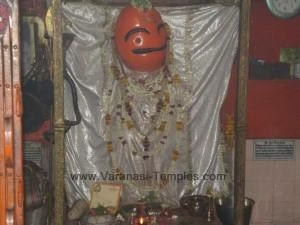
The Bheeshan Bhoot Bhairav Temple, often revered simply as Bhoot Bhairav, stands as a profound testament to the protective forces of Varanasi (Kashi). The primary deity is Bhairav, a fierce manifestation of Lord Shiva. While the temple is historically ancient, its spiritual origins are traced to the sacred texts known as the Kashi Khand of the Shiva Purana.
| Date built: | – |
|---|---|
| Deity: | Bhairav |
| Architectural style: | Dravidian architecture |
| Major festivals | – |
| Locale: | Varanasi |
| District:: | Varanasi |
| Address: | – |
| Phone | – |
Phalaśruti: The Benefits of Visiting
According to the Kashi Khand (Chapter 72), after Goddess Durga vanquished the demon Durgasur, she created eight distinct forms of Bhairav to protect the holy city and its inhabitants. Devotees who worship Bheeshan Bhoot Bhairav are believed to gain specific spiritual benefits:
- Protection from Evil: The temple is known as the “Destroyer of Fear.” Worshipping here removes negative energies and protects the devotee from unseen evils.
- Mental Fortitude: As mentioned in the provided texts, “Devotees who worship these Bhairavs will develop a strong mental framework and will be courageous.”
- Resolution of Ancestral Karma: Rituals performed here are often associated with pacifying ancestors and clearing blocked karmic pathways.
Historical Origins & Scriptural Legend
The history of the Bheeshan Bhoot Bhairav Temple is deeply woven into the mythological fabric of Varanasi. While specific dynastic construction records are often omitted in oral traditions of Kashi, the temple is an integral part of the Ashta Bhairav circuit.
The Legend of Bhoot Bhairav
Tradition holds that this specific Bhairav guards the southern entrance of the sacred city. The name “Bhoot” does not imply a ghost in the western sense, but rather refers to Bhutava—the element of matter and the five primordial elements. He is the lord of existence and the protector of the physical realm.
As per the texts: “In the same way eight forms of Bhairavs were created who were positioned at various places in Kashi. These Bhairavs protect the devotees from all sorts of evils and give the devotees happiness and prosperity in their lives.”
Architectural Marvels
Unlike the typical Nagara style prevalent in North India, the Bheeshan Bhoot Bhairav Temple features a distinct Dravidian architectural style. This suggests a period of architectural synthesis or a specific patronage by Southern rulers or influences during the medieval period.
Temple Structure & Vastu
The temple follows the Vastu Shastra principles of sanctity, with a distinct inner sanctum (Garbhagriha) and a circumambulatory path (Pradakshina). The spire (Shikhara) exhibits Dravidian features, likely tiered pyramidal roofs common in Southern India, adapted to the local Kashi topography.
Darshan & Ritual Logistics
Since specific opening hours were not provided in the source data, the following is a standard schedule for major Kashi temples. Devotees are advised to verify locally upon arrival.
| Session | Timings | Ritual Details |
|---|---|---|
| Morning Darshan | 5:00 AM – 12:00 PM | Brahma Muhurta rituals, Abhishekam. |
| Afternoon Break | 12:00 PM – 3:00 PM | Deity rest period (temple may close). |
| Evening Darshan | 5:00 PM – 9:00 PM | Sandhya Aarti, Shringar. |
Key Sevas and Online Booking
To perform specific Sevas, devotees can often book through the official Varanasi Mandir websites or directly at the temple counter. Common Sevas include:
- Abhishekam: Ritual bathing of the Bhairav idol with milk, honey, and ghee.
- Archana: Offering of flowers and mantra chanting (typically 108 names).
- Deepa Daan: Lighting a lamp for longevity and prosperity.
Online Booking: Visit the official Kashi Vishwanath Temple or Varanasi Mandir portal, which often manages the smaller shrines in the vicinity.
2026 Festival Calendar (Varanasi Specific)
Key dates for Bheeshan Bhairav celebrations in 2026:
- Navratri (Chaitra): March 30 – April 7, 2026
- Haritalika Teej: August 22, 2026
- Navratri (Sharad): September 21 – September 30, 2026
- Maha Shivaratri: February 26, 2026 (A major day for all Bhairavs).
Practical Visitor Guidance
Dress Code & Etiquette
Varanasi is a traditional city. Visitors are advised to wear modest attire covering shoulders and knees. Footwear is to be removed outside the temple complex. Photography rules are strictly enforced inside the sanctum; flash photography is prohibited to preserve the ancient murals.
Crowd Management
The temple is located near the Jyeshteshwar area, which can get crowded during festivals.
- Best Time to Visit: Early morning (6:00 AM) or late evening (8:00 PM) to avoid peak crowds.
- Seasonal Advice: Summers (May-June) in Varanasi are scorching; carry a water bottle and head cover. Winters require warm woolens as nights get chilly.
- Lockers: Mobile phones are generally allowed, but electronic gadgets might be restricted. Small lockers are available near the temple entrance for a nominal fee.
Pilgrimage Connectivity
How to Reach
The temple is located at K.63/28, Bhoot Bhairav, near Jyeshteshwar, Varanasi.
- Nearest Airport: Lal Bahadur Shastri International Airport (LBS) (approx. 25 km).
- Nearest Railway Station: Varanasi Junction (BSB) (approx. 4 km).
- Local Transport: Devotees can reach this place via auto-rickshaw or e-rickshaw through Sapt Sagar or Kashipura. The lanes are narrow, so walking the last stretch is recommended.
Photo Gallery
Nearby Sacred Sites
Complete your pilgrimage circuit by visiting these nearby shrines:
- Kashi Vishwanath Temple: The primary Jyotirlinga, located 2 km away.
- Jyeshteshwar Temple: As mentioned in the address, this shrine is in the immediate vicinity.
- Manikarnika Ghat: A 10-minute walk to experience the spiritual heart of Varanasi on the Ganges.
Frequently Asked Questions (FAQ)
Is there a VIP darshan entry?
Yes, the temple administration facilitates VIP darshan for elderly citizens and differently-abled devotees. Online passes for special darshan are available through the Kashi Vishwanath Temple portal.
What is the history of the name “Bheeshan”?
“Bheeshan” translates to “Terrible” or “Fearsome.” It refers to Bhairav’s role as the fierce enforcer of dharma who instills fear in the wicked but grants protection to the righteous.
Can I offer alcohol to Bhairav?
In strict accordance with modern temple protocols and Indian law, alcohol is not permitted within the temple premises. Offering milk, curd, honey, or coconut water is the prescribed ritual.
What is the best route from Varanasi Junction?
Take an auto-rickshaw toward Dashashwamedh Ghat and ask for Bhoot Bhairav via Jyeshteshwar. The ride takes approximately 15-20 minutes depending on traffic.
Are there any hotels nearby?
Yes, the area around Varanasi Cantt and Godaulia has numerous hotels ranging from budget to luxury. Staying near Godaulia provides easier access to the temple complex.
Contact Details
Official Address: K.63/28, Bhoot Bhairav, Near Jyeshteshwar, Varanasi, Uttar Pradesh.
In the same way eight forms of Bhairavs were created who were positioned at various places in Kashi. These Bhairavs protect the devotees from all sorts of evils and give the devotees happiness and prosperity in their lives.
Devotees who worship these Bhairavs will develop a strong mental frame work and will be courageous.
Recent Posts

Shri Kaamkoteeshwar Mandir, Varanasi – History & Significance
In the heart of Kashi, the eternal city of Lord Shiva, where the Ganges flows with celestial grace, stands the Shri Kaamkoteeshwar Mandir. This sacred Sannidhi is not merely a temple but a profound spiritual bridge between the Northern…

ओ सांवरे तूने ही मुझको संभाला – Lyrics & Meaning
ओ सांवरे तूने ही मुझको संभाला – A Prayer to Shyam Origin & Spiritual Essence Why This Bhajan Resonates Devotees chant this when overwhelmed by life’s storms—the refrain ‘तूने ही मुझको संभाला’ is the soul’s sigh of relief: “You…

कथा ये है महाराज मेरे की – Lyrics & Meaning
कथा ये है महाराज मेरे की छत्रपति संभाजी महाराज – A Prayer to Chhatrapati Sambhaji Maharaj Origin & Spiritual Essence Why This Bhajan Resonates Devotees chant this when their spirit feels tested—its powerful refrain “महाराज मेरे” is a soul’s…

Rigveda Samhita Yathartha Anuvada (ऋग्वेद संहिता यथार्थ अनुवाद) – Complete Set with Anvayartha & Hindi/English Translation
The Rigveda is the oldest surviving scripture of humanity and the foundational text of Sanātana Dharma. For serious students, scholars, UPSC aspirants studying ancient Indian history, Sanskrit learners, and spiritual seekers, a precise and grammatically structured translation is indispensable.…

आना भी अकेला है जाना भी अकेला है – Lyrics & Meaning | BharatTemples
आना भी अकेला है जाना भी अकेला है – A Prayer to the Divine Witness Origin & Spiritual Essence Why This Bhajan Resonates Devotees turn to this bhajan in moments of deep reflection—when life’s attachments begin to ache. The…

माता शेरावाली के द्वार जो भी जाता है – Lyrics & Meaning
माता शेरावाली के द्वार जो भी जाता है – A Prayer to Maa Sherawali Origin & Spiritual Essence Why This Bhajan Resonates Devotees turn to this bhajan in times of fear or uncertainty—its promise that no one leaves Maa’s…

मार लेना सपणी उबार लेणा भवरा – Lyrics & Meaning
मार लेना सपणी उबार लेणा भवरा – A Prayer to the Divine Beloved Origin & Spiritual Essence Why This Bhajan Resonates Devotees chant this in moments of deep vulnerability—its cry of “मार लेना सपणी, उबार लेणा भवरा” is the…

हमें श्याम सुंदर भरोसा तुम्हारा – Lyrics & Meaning
हमें श्याम सुंदर भरोसा तुम्हारा – A Prayer to Shyam Sundar Origin & Spiritual Essence Why This Bhajan Resonates Devotees chant this when feeling alone—its refrain ‘de do sahara’ is the soul’s cry for divine support. Lyrics in Hindi…

Mere Satguru Ne Di Thi Davai Lyrics in Hindi & Meaning
Mere Satguru Ne Di Thi Davai: Invoking the Guru’s Liberating Wisdom This soul-stirring bhajan venerates the Satguru (True Spiritual Master) as the divine physician who dispenses the only remedy for life’s deepest sufferings. Composed by Sant Karmaveer Tufani, it…

Janm Diyo Thari Maa Dukh Dekhiyo Lyrics in Hindi & Meaning
जन्म दियो थारी माँ दुख देखियो (Maa’s Grief Upon Birthing You) This soul-stirring Chetavani Bhajan (admonitory hymn) is addressed to the Divine Mother (Maa) – a call for repentance when children forget their filial duties in the dark age…