
Contents
- 1 Devi Jagadambi Temple, Khajuraho: The Jewel of the Chandella Dynasty
Devi Jagadambi Temple, Khajuraho: The Jewel of the Chandella Dynasty
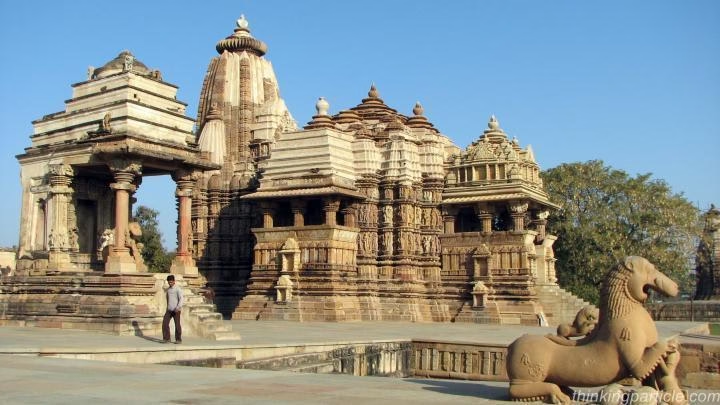
Welcome to the spiritual sanctuary of the Devi Jagadambi Temple in Khajuraho, Madhya Pradesh. As a UNESCO World Heritage Site, this temple is not merely a stone structure but a living testament to the devotion of the Chandella dynasty. In this comprehensive guide, we navigate the ancient history, architectural splendor, and practical logistics for a transformative pilgrimage in 2026.
1. Introduction & Spiritual Essence
The Devi Jagadambi Temple is dedicated to the Jagadamba (Mother of the Universe), a manifestation of the Divine Feminine. While often associated with Goddess Parvati, the central deity here is a formidable, dark-hued form of Mata Durga. The temple serves as a profound center for Shakti worship.
Phalaśruti: Why Devotees Visit
According to ancient traditions, the Phalaśruti (spiritual benefits) of worshipping at this temple are immense. Devotees flock here seeking:
- Protection (Raksha): Devi Jagadambi is believed to shield devotees from negative energies and malevolent planetary influences.
- Cleansing of Karma: Rituals performed here are said to help cleanse ancestral karma and liberate the soul from past sins.
- Material & Spiritual Abundance: As the Adi Shakti, she grants both worldly prosperity and spiritual evolution.
2. Historical Origins & Scriptural Legend
The temple dates back to the mid-11th century, a period of peak artistic expression for the Chandella Dynasty. While the broader Khajuraho complex was built between the 10th and 12th centuries, the Jagadambi temple stands out for its intricate evolution.
The Dynastic Legacy
According to temple records and historical inscriptions, the Chandella kings were patrons of the arts and dedicated to establishing Khajuraho as a center of spiritual learning. The temple was originally likely dedicated to Lord Vishnu before being rededicated to the Goddess, as evidenced by the transitional architecture.
Local Legends
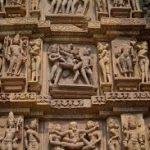
Tradition holds that the Sthala Purana (local legend) surrounding the temple involves the cosmic play of the Goddess. The temple is considered the “Womb of the Universe.” The erotic sculptures on the outer walls are often interpreted not just as Tantric symbols, but as a representation of the liberation of the soul from material attachment and the celebration of life in its entirety.
3. Architectural Marvels
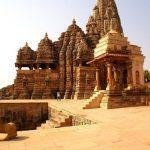
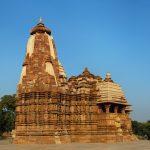
The Devi Jagadambi Temple is a masterpiece of Nagara Style architecture. Unlike later temples, it avoids heavy enclosure walls, opting instead for a raised plinth (Jagati) that lifts the structure towards the heavens.
Key Architectural Elements
- The Shikhara (Spire): The temple features a graceful, curvilinear spire that rises sharply, culminating in a finial. It is proportionate and visually lighter than the Kandariya Mahadeva temple, giving it a distinct elegance.
- The Mandapa (Pillared Hall): The interior consists of a sanctum (Garbhagriha), a vestibule, and a pillared hall. The ceiling of the mandapa features a stunning, intricate lotus design that draws the eye upward.
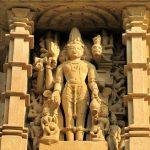
- Three-Tiered Sculptures: The exterior walls are adorned with three distinct bands of carvings. While the lower tier depicts deities, the middle and upper tiers display celestial beings, musicians, and the famous sensual couples. Notably, the outermost band of sculptures is deeper and more prominent than in any other Khajuraho temple.
4. Darshan & Ritual Logistics (2026 Update)
Visitors are encouraged to check the official website for real-time changes. The following timetable reflects the standard schedule for 2026.
Daily Timings
| Session | Timing | Activity |
|---|---|---|
| Morning | 05:00 AM – 12:00 PM | Mangala Aarti & General Darshan |
| Afternoon | 12:00 PM – 04:00 PM | Sanstha (Break for Deity Rest) |
| Evening | 04:00 PM – 09:00 PM | Shayan Aarti & Closing |
Key Sevas & Online Booking
To participate in specific rituals, devotees can book services through the official Madhya Pradesh Tourism portal or the temple administration counter.
- Abhishekam: Performed on Tuesdays and Fridays. Booking opens 30 days in advance.
- Archana: Available daily. Can be booked online by providing the Jatakam (astrological chart).
- VIP Darshan Entry: A dedicated lane is available for senior citizens and specially-abled devotees (ID proof required).
Festival Calendar 2026
- Navratri (Chaitra): April 6 – April 14, 2026. (Peak crowd: Nightly Aarti).
- Diwali: October 21, 2026. The temple is illuminated with thousands of earthen lamps.
- Maha Shivaratri: February 26, 2026. While dedicated to Shiva, the adjacent complex sees massive footfall; Jagadambi temple hosts special Vedic chanting.
5. Practical Visitor Guidance
To ensure a seamless experience at this heritage site, adhering to local protocols is essential.
Rules & Etiquette
- Dress Code: Modest attire is mandatory. Shoulders and knees must be covered. Traditional Indian wear (Saree/Salwar Kameez/Dhoti) is recommended.
- Photography: Photography is permitted in the outer courtyards and exteriors. It is strictly prohibited inside the sanctum (Garbhagriha) and near the inner shrines.
- Electronics: Mobile phones are allowed but must be silenced. Tripods are not permitted without prior permission from the ASI (Archaeological Survey of India).
- Lockers: Free mobile storage facilities are available at the main entrance near the ticket counter.
Crowd Management & Seasonal Advice
- Best Hours: The optimal time for darshan is between 6:00 AM and 8:00 AM, or after 6:00 PM when the evening aarti begins.
- Seasonal Tips: During the summer months (May–June), temperatures in Khajuraho can exceed 40°C. Carry a water bottle, wear a hat, and utilize shaded areas in the complex.
6. Pilgrimage Connectivity
How to Reach
- By Air: The nearest airport is Khajuraho Airport (HJR), located approximately 5 km from the temple complex. Taxis and auto-rickshaws are readily available.
- By Rail: The nearest major railway junction is Jhansi Junction (JHS) (approx. 175 km). From Jhansi, take a train to Khajuraho Railway Station or a taxi via National Highway 39.
- By Road:NH 39 and SH 10. Regular buses ply from Jhansi, Bhopal, and Satna.
Nearby Sacred Sites
To deepen your pilgrimage, visit these adjacent sites within the Khajuraho complex:
- Kandariya Mahadeva Temple: Located just south of Jagadambi, this is the largest temple dedicated to Lord Shiva.
- Lakshmana Temple: One of the oldest and best-preserved temples, dedicated to Lord Vishnu.
- Parsvanatha Temple: The largest Jain temple in the complex, showcasing distinct Jain iconography.
7. Frequently Asked Questions (FAQ)
Is there a VIP darshan entry?
Yes, the temple administration provides a priority lane for senior citizens (above 65 years), differently-abled visitors, and military personnel. Please carry valid identification.
What is the entry fee for Devi Jagadambi Temple?
Entry is included in the composite Khajuraho Group of Monuments ticket. For Indian nationals, the fee is nominal (approx. INR 40), while foreign nationals pay INR 600. Entry is free for children below 15 years.
Can I book the Abhishekam Seva online?
Yes, most Sevas can be booked via the MP Online portal or the official tourism website. It is advisable to book at least 3 days in advance during the peak season.
Are guides available at the temple?
Yes, government-licensed guides are available at the entrance. We strongly recommend hiring a certified guide to understand the nuances of the Tantric symbolism and history.
What is the best time of year to visit?
The ideal time is between October and March when the weather is pleasant and the winter festival season is in full swing.
Contact Details
Official Address: Rajnagar Rd, Sevagram, Khajuraho, Madhya Pradesh 471606
Contact: {Phone}
Recent Posts

ओ सांवरे तूने ही मुझको संभाला – Lyrics & Meaning
ओ सांवरे तूने ही मुझको संभाला – A Prayer to Shyam Origin & Spiritual Essence Why This Bhajan Resonates Devotees chant this when overwhelmed by life’s storms—the refrain ‘तूने ही मुझको संभाला’ is the soul’s sigh of relief: “You…

कथा ये है महाराज मेरे की – Lyrics & Meaning
कथा ये है महाराज मेरे की छत्रपति संभाजी महाराज – A Prayer to Chhatrapati Sambhaji Maharaj Origin & Spiritual Essence Why This Bhajan Resonates Devotees chant this when their spirit feels tested—its powerful refrain “महाराज मेरे” is a soul’s…

Rigveda Samhita Yathartha Anuvada (ऋग्वेद संहिता यथार्थ अनुवाद) – Complete Set with Anvayartha & Hindi/English Translation
The Rigveda is the oldest surviving scripture of humanity and the foundational text of Sanātana Dharma. For serious students, scholars, UPSC aspirants studying ancient Indian history, Sanskrit learners, and spiritual seekers, a precise and grammatically structured translation is indispensable.…

आना भी अकेला है जाना भी अकेला है – Lyrics & Meaning | BharatTemples
आना भी अकेला है जाना भी अकेला है – A Prayer to the Divine Witness Origin & Spiritual Essence Why This Bhajan Resonates Devotees turn to this bhajan in moments of deep reflection—when life’s attachments begin to ache. The…

माता शेरावाली के द्वार जो भी जाता है – Lyrics & Meaning
माता शेरावाली के द्वार जो भी जाता है – A Prayer to Maa Sherawali Origin & Spiritual Essence Why This Bhajan Resonates Devotees turn to this bhajan in times of fear or uncertainty—its promise that no one leaves Maa’s…

मार लेना सपणी उबार लेणा भवरा – Lyrics & Meaning
मार लेना सपणी उबार लेणा भवरा – A Prayer to the Divine Beloved Origin & Spiritual Essence Why This Bhajan Resonates Devotees chant this in moments of deep vulnerability—its cry of “मार लेना सपणी, उबार लेणा भवरा” is the…

हमें श्याम सुंदर भरोसा तुम्हारा – Lyrics & Meaning
हमें श्याम सुंदर भरोसा तुम्हारा – A Prayer to Shyam Sundar Origin & Spiritual Essence Why This Bhajan Resonates Devotees chant this when feeling alone—its refrain ‘de do sahara’ is the soul’s cry for divine support. Lyrics in Hindi…

Mere Satguru Ne Di Thi Davai Lyrics in Hindi & Meaning
Mere Satguru Ne Di Thi Davai: Invoking the Guru’s Liberating Wisdom This soul-stirring bhajan venerates the Satguru (True Spiritual Master) as the divine physician who dispenses the only remedy for life’s deepest sufferings. Composed by Sant Karmaveer Tufani, it…

Janm Diyo Thari Maa Dukh Dekhiyo Lyrics in Hindi & Meaning
जन्म दियो थारी माँ दुख देखियो (Maa’s Grief Upon Birthing You) This soul-stirring Chetavani Bhajan (admonitory hymn) is addressed to the Divine Mother (Maa) – a call for repentance when children forget their filial duties in the dark age…
Bhadi Sabha Mein Thane Manaun Lyrics in Hindi & Meaning
Bhadi Sabha Mein Thane Manaun: Invoking the Spear-Wielding Mother Mata Bhawani (श्री ज्वाला भवानी), the fiery manifestation of Shakti worshipped as the Protector of Dharma in Her Dhaulagarh sanctum. Origin & Spiritual Essence Composed in Rajasthani folk tradition by…