
Contents
Introduction & Spiritual Essence
Amidst the sacred chaos of Kashi (Varanasi), the Durg Vinayak Temple stands as a serene fortress of devotion to Lord Ganesha. Located near the famous Durga Kund, this temple is dedicated to Durg Vinayak, a form of Lord Ganesha revered specifically for his ability to remove obstacles and grant success in every undertaking.
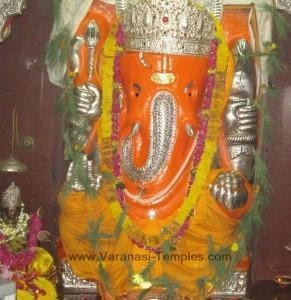
Often referred to locally as Kundodar Ganesh, the presiding deity here is a Swayambhu (self-manifested) idol. Unlike the common iconography of a single-tusked Ganesha, Durg Vinayak is depicted with a pot-bellied form, symbolizing abundance and satisfaction.
Phalaśruti: The Spiritual Benefit
According to popular belief and the oral tradition of Kashi, worshipping Durg Vinayak is equivalent to worshipping all eight forms of Ganapati simultaneously. The primary spiritual benefits include:
- Removal of Obstacles: Devotees visit before starting new ventures, marriages, or construction projects to ensure success.
- Cleansing Ancestral Karma: Rituals performed here are believed to pacify Pitru Dosha (ancestral afflictions).
- Removing Negative Energies: The temple is said to be charged with protective vibrations, warding off negativity.
Historical Origins & Scriptural Legend
While specific stone inscriptions regarding the exact century are scarce in public records, the Durg Vinayak Temple is historically anchored in the medieval temple architecture boom of Varanasi.
The Sthala Purana
Local legend holds that this specific form of Ganesh was discovered by Adi Shankaracharya in the 8th century during his campaign to re-establish Hindu dharma. It is believed that Adi Shankaracharya enshrined the idol to secure the eastern quadrant of Kashi.
Tradition holds that the name “Durg Vinayak” derives from its proximity to the Durga Kund and its association with the protective energy of Goddess Durga. It is believed that those who cannot travel to the Maha Ganapati temple due to physical constraints are granted equal merit by offering prayers to Durg Vinayak.
Architectural Marvels
The temple showcases a classic blend of Nagara and Orissan styles, adapted to the riverine geography of Varanasi.
Structure and Vastu
The Shikhara (spire) of the temple is relatively modest but intricately carved, rising above the main sanctum (Garbhagriha). The temple is designed with high surrounding walls, creating a closed courtyard that enhances the acoustic quality of the Vedic chants.
Inside the sanctum, the idol of Durg Vinayak is placed on a raised platform, facing east. The walls of the temple complex feature carved panels depicting scenes from the Puranas, specifically the Ganesha Purana, showcasing his battles with demons and his role as the remover of hurdles.
Darshan & Ritual Logistics
The temple follows a rigorous schedule of daily Aartis. The atmosphere shifts from the contemplative stillness of the Mangala Aarti to the vibrant energy of evening Sandhya Aarti.
Daily Darshan Timings (2026 Schedule)
| Ritual / Session | Timing |
|---|---|
| Morning Opening | 05:00 AM |
| Mangala Aarti | 05:00 AM – 05:30 AM |
| Midday Bhog | 12:00 PM (Noon) |
| Temple Closure (Afternoon) | 12:00 PM – 04:00 PM |
| Evening Opening | 04:00 PM |
| Sandhya Aarti | 07:00 PM |
| Shayan Aarti (Closing) | 10:00 PM |
Sevas & Online Booking
While the temple does not have an advanced online portal similar to major state-funded temples, standard Sevas can be arranged through the designated Poojaries (Head Priests), including Shri Santosh Mishra.
- Abhishekam: Ritual bathing of the idol (usually performed during morning hours).
- Archana: Recitation of the 108 names of Ganesh.
- Sankalpam: Personal vows taken for the success of projects.
Note: For 2026 festivals like Ganesh Chaturthi (August/September) and Akshaya Tritiya (April), devotees should contact the temple management directly or visit upon arrival in Varanasi to book specific slots.
Practical Visitor Guidance
Visitor Etiquette & Rules
- Dress Code: Traditional attire is preferred. Men should wear dhotis or trousers with shirts; women should wear sarees or salwar kameez. Modest clothing is required.
- Photography: Strictly prohibited inside the inner sanctum (Garbhagriha). Photography of the outer architecture is permitted in designated areas.
- Mobile & Lockers: It is advisable to switch off mobile phones before entering the sanctum. While there is no high-tech locker system, most devotees leave footwear at the designated counters (free or nominal charge) near the entrance.
Crowd Management & Seasonal Advice
Best Hours: For a peaceful Darshan, visit between 8:00 AM and 10:00 AM or just before the Sandhya Aarti (6:00 PM).
Seasonal Tips:
- May-June (Summer): Temperatures in Varanasi can soar. Carry a water bottle and a head covering; the stone floors become hot.
- July-Sept (Monsoon): Humidity is high. The area around Durga Kund can get waterlogged; wear waterproof footwear.
- Dec-Jan (Winter): Mornings are foggy. Carry a light jacket; visiting during the morning Aarti offers a mystical experience.
Pilgrimage Connectivity
How to Reach Durg Vinayak Temple
The temple is a prominent landmark in the Durg Kund area of Varanasi.
- Address: No. 27/1, Durg Kund, Varanasi, Uttar Pradesh 221001.
- By Air: Lal Bahadur Shastri International Airport (LBS) is approximately 25 km away. Taxis and pre-paid cabs are available.
- By Rail: Varanasi Junction (BSB) is about 5-7 km from the temple. Auto-rickshaws are the most common mode of transport.
- By Road: The temple is located off the NH19 (Grand Trunk Road). Local transport (Cycle Rickshaw/Auto) from Durga Kund crossing is easily accessible.
Nearby Sacred Sites
Extend your pilgrimage circuit with these nearby locations:
- Durga Kund Temple (Maa Durga Temple): Just a few steps away, this vibrant red-hued temple is dedicated to Goddess Durga.
- Sankat Mochan Hanuman Temple: Located 2 km away, famous for the “Bada Hanuman” and the ritual of applying vermilion.
- Shri Kashi Vishwanath Temple: The holiest site in Kashi, located approximately 4 km away (requires crossing the Ganges via boat or road).
Frequently Asked Questions (FAQ)
1. What is the significance of the name “Durg Vinayak”?
The name is derived from the location (near Durga Kund) and the epithet “Vinayak” for Lord Ganesha. It symbolizes the unity between the protective energy of Goddess Durga and the obstacle-removing power of Lord Ganesha.
2. Is there a VIP Darshan entry available?
The temple management generally maintains an egalitarian approach for devotees. However, during major festivals or if you are coordinating a large group/puja, contacting the head priest in advance can facilitate a smoother entry. Standard entry is free for all.
3. Are online seva bookings available?
Currently, the Durg Vinayak Temple relies on on-premise bookings for Sevas and Pujas. It is recommended to visit the temple office upon arrival to schedule your rituals. Future updates for 2026 may include digital integration, but physical booking remains the standard.
4. What is the best time to visit with family?
The shoulder months of October-November and February-March offer the most pleasant weather in Varanasi. Early mornings (6:00 AM – 8:00 AM) are best to avoid crowds and experience the morning Aarti.
5. Is the temple accessible for elderly devotees?
The temple has a few steps at the entrance. While it is manageable, it is not fully wheelchair accessible by modern standards. Auto-rickshaws can get you very close to the gate, minimizing the walking distance from the main road.
[h2]Photo Gallery[/h2]
[h2]Contact Details[/h2]
Official Address: 27/1, Durg Kund, Varanasi, Uttar Pradesh 221001
Note: For the most up-to-date contact information, please consult the local temple trust or Varanasi tourism board upon arrival.
Recent Posts

ओ सांवरे तूने ही मुझको संभाला – Lyrics & Meaning
ओ सांवरे तूने ही मुझको संभाला – A Prayer to Shyam Origin & Spiritual Essence Why This Bhajan Resonates Devotees chant this when overwhelmed by life’s storms—the refrain ‘तूने ही मुझको संभाला’ is the soul’s sigh of relief: “You…

कथा ये है महाराज मेरे की – Lyrics & Meaning
कथा ये है महाराज मेरे की छत्रपति संभाजी महाराज – A Prayer to Chhatrapati Sambhaji Maharaj Origin & Spiritual Essence Why This Bhajan Resonates Devotees chant this when their spirit feels tested—its powerful refrain “महाराज मेरे” is a soul’s…

Rigveda Samhita Yathartha Anuvada (ऋग्वेद संहिता यथार्थ अनुवाद) – Complete Set with Anvayartha & Hindi/English Translation
The Rigveda is the oldest surviving scripture of humanity and the foundational text of Sanātana Dharma. For serious students, scholars, UPSC aspirants studying ancient Indian history, Sanskrit learners, and spiritual seekers, a precise and grammatically structured translation is indispensable.…

आना भी अकेला है जाना भी अकेला है – Lyrics & Meaning | BharatTemples
आना भी अकेला है जाना भी अकेला है – A Prayer to the Divine Witness Origin & Spiritual Essence Why This Bhajan Resonates Devotees turn to this bhajan in moments of deep reflection—when life’s attachments begin to ache. The…

माता शेरावाली के द्वार जो भी जाता है – Lyrics & Meaning
माता शेरावाली के द्वार जो भी जाता है – A Prayer to Maa Sherawali Origin & Spiritual Essence Why This Bhajan Resonates Devotees turn to this bhajan in times of fear or uncertainty—its promise that no one leaves Maa’s…

मार लेना सपणी उबार लेणा भवरा – Lyrics & Meaning
मार लेना सपणी उबार लेणा भवरा – A Prayer to the Divine Beloved Origin & Spiritual Essence Why This Bhajan Resonates Devotees chant this in moments of deep vulnerability—its cry of “मार लेना सपणी, उबार लेणा भवरा” is the…

हमें श्याम सुंदर भरोसा तुम्हारा – Lyrics & Meaning
हमें श्याम सुंदर भरोसा तुम्हारा – A Prayer to Shyam Sundar Origin & Spiritual Essence Why This Bhajan Resonates Devotees chant this when feeling alone—its refrain ‘de do sahara’ is the soul’s cry for divine support. Lyrics in Hindi…

Mere Satguru Ne Di Thi Davai Lyrics in Hindi & Meaning
Mere Satguru Ne Di Thi Davai: Invoking the Guru’s Liberating Wisdom This soul-stirring bhajan venerates the Satguru (True Spiritual Master) as the divine physician who dispenses the only remedy for life’s deepest sufferings. Composed by Sant Karmaveer Tufani, it…

Janm Diyo Thari Maa Dukh Dekhiyo Lyrics in Hindi & Meaning
जन्म दियो थारी माँ दुख देखियो (Maa’s Grief Upon Birthing You) This soul-stirring Chetavani Bhajan (admonitory hymn) is addressed to the Divine Mother (Maa) – a call for repentance when children forget their filial duties in the dark age…
Bhadi Sabha Mein Thane Manaun Lyrics in Hindi & Meaning
Bhadi Sabha Mein Thane Manaun: Invoking the Spear-Wielding Mother Mata Bhawani (श्री ज्वाला भवानी), the fiery manifestation of Shakti worshipped as the Protector of Dharma in Her Dhaulagarh sanctum. Origin & Spiritual Essence Composed in Rajasthani folk tradition by…