Harikeshwar Temple Varanasi: History, Darshan Timings & Kashi Khand Legends
Receive daily temple updates, divine darshan, and morning bhajans directly on WhatsApp.
Contents
- 1 Introduction & Spiritual Essence: The Lord of Hair (Harikeseshwar)
- 2 Historical Origins & Scriptural Legend
- 3 Darshan & Ritual Logistics
- 4 Practical Visitor Guidance
- 5 Pilgrimage Connectivity
- 6 Frequently Asked Questions (FAQ)
Introduction & Spiritual Essence: The Lord of Hair (Harikeseshwar)
Nestled within the sacred bylanes of Varanasi (Kashi), the Harikesheshwar Temple stands as a potent spiritual anchor within the Antargrihi Yatra—the innermost pilgrimage circuit of Kashi. Dedicated to Lord Shiva in his form as Harikesheshwar (literally “Lord of Hair”), this ancient shrine is a testament to the belief that divine energy permeates every aspect of creation.
Phalaśruti: The Spiritual Benefit
According to the sacred Kashi Khand (Chapter 100) of the Skanda Purana, worshiping Harikesheshwar is essential for the completion of the Antargrihi Yatra.
The Promise: Devotees who perform this Yatra and offer prayers here are said to attain all forms of happiness in this life and ultimately achieve Moksha (liberation from the cycle of birth and death).
Historical Origins & Scriptural Legend
While the exact century of the temple’s initial construction is deeply rooted in antiquity and often obscured by the city’s evolving landscape, its spiritual authority is derived from ancient scripture rather than mere architecture.
📖 Related: Nakshatreswar Temple History & Darshan Timings: Varanasi Temple Guide
The Kashi Khand Connection
Tradition holds that the temple is mentioned in the Kashi Khand of the Skanda Purana. The text prescribes the Antargrihi Yatra—a religious tour covering deities within the innermost divine circle of Kashi. Among the various deities listed, Harikesheshwar is situated in the vicinity of Agasthyeshwar.
Architectural Marvels
Although the provided data lists the style as general “Hindu Temple architecture,” the structure exhibits characteristics of the Nagara style prevalent in North India, adapted to the compact urban fabric of Varanasi.
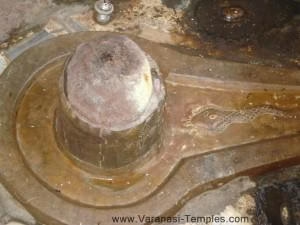
- The Sanctum (Garbhagriha): Houses the Swayambhu (self-manifested) Murti of Lord Harikesheshwar. The deity is enshrined in a manner that facilitates intimate Darshan (viewing).
- Local Aesthetics: The temple structure blends seamlessly with the traditional Kotwan (urban residential) architecture of Varanasi, characterized by narrow approach paths and a sudden opening into the sacred courtyard.
Note: The temple is a significant heritage site of Varanasi, preserving the oral traditions of the city’s inner sanctum.
Darshan & Ritual Logistics
To ensure a seamless pilgrimage experience, devotees are advised to follow the standard timings. As this is a traditional temple within the city, timings may vary slightly based on local priest schedules and festival seasons.
Daily Timings (Darshan Schedule)
| Session | Timing | Activity |
|---|---|---|
| Morning | 05:00 AM – 12:00 PM | Mangala Aarti, Shringar Darshan |
| Afternoon | 12:00 PM – 04:00 PM | Rest Period (Temple may remain partially closed) |
| Evening | 04:00 PM – 09:00 PM | Aarti, Shayan Darshan |
Key Sevas and Online Booking
While specific online portals may vary for smaller heritage temples in Varanasi, the following Sevas are traditionally performed:
- Abhishekam: Ritual bathing of the Shiva Linga with water, milk, and honey.
- Archana: Individual prayer offerings (typically “Om Namah Shivaya”).
Online Booking: For specific Sevas, devotees can often utilize the official Kashi Vishwanath Temple trust portals or local Varanasi temple administration websites. It is recommended to verify availability for Harikesheshwar via local priests on-site.
📖 Related: Vamadeveshwar Temple: Kashi Khand Legend, Darshan Timings & Guide
2026 Festival Calendar Highlights
- Shivratri (Feb 26, 2026): Special night-long vigil and Rudrabhishek.
- Maha Shivratri (Aug 2026 – Pradosh Vrat): Special evening Darshan.
- Shravan Month (July-Aug 2026): Morning Abhishekam begins at 4:00 AM. Expect heavy crowds.
Practical Visitor Guidance
Visiting the inner sanctum of Varanasi requires preparation regarding logistics and respect for local customs.
Dress Code & Etiquette
- Attire: Traditional Indian wear is preferred. Men should wear Dhoti/Pants and Shirt. Women should wear Saree/Salwar Kameez.
- Footwear: Shoes must be removed before entering the temple premises. There is usually a designated footwear stand (often a paid service).
- Photography: Strictly prohibited inside the sanctum. Discretion advised in outer courtyards.
Crowd Management & Accessibility
- Best Hours: 6:00 AM (early morning) or 7:00 PM (post-evening Aarti) for a peaceful Darshan.
- Seasonal Advice:
- Summer (May-June): Carry water bottles; the lanes can get extremely hot.
- Monsoon (July-Sept): Roads become slippery; wear closed-toe shoes with good grip.
- Winter (Dec-Jan): Carry light woolens as mornings are foggy but days are pleasant.
- Mobile/Baggage: There are no official lockers in smaller temples. Carry minimal luggage. Many shops near the temple offer paid bag storage.
Pilgrimage Connectivity
Harikesheshwar Temple is located in the heart of Varanasi, specifically in the Khari Kuan area.
How to Reach
- By Air: Lal Bahadur Shastri International Airport (LBS) Varanasi is the nearest airport (approx. 30 mins by taxi).
- By Rail: Varanasi Junction (BSB) and Maduadih Railway Station are the nearest railheads. Auto-rickshaws are readily available.
- By Road (NH & Streets): The temple is located off the main Varanasi-Ghazipur Road (NH 19). However, due to the narrow bylanes of the Old City, it is best to walk from Godowlia or hire an e-rickshaw to the nearest drop point.
📖 Related: Shukreshwar Temple Varanasi: History, Darshan Timings & Guide
Nearby Sacred Sites (Pilgrimage Circuit)
Since Harikesheshwar is part of the Antargrihi Yatra, it is highly recommended to visit the following nearby shrines:
- Agasthyeshwar Temple: Located in the same vicinity, mentioned alongside Harikesheshwar in the Kashi Khand.
- Surya Dev Temple (Vimal Aditya): A short walk away, located near Vimal Aditya, dedicated to the Sun God.
- Manikarnika Ghat: Approximately 15-20 minutes walk, one of the most sacred ghats of Varanasi.
Frequently Asked Questions (FAQ)
Is there a VIP Darshan entry at Harikesheshwar Temple?
Being a traditional heritage temple within the narrow lanes, there are typically no formal VIP tickets. However, early morning access (before 7:00 AM) allows for a swift and peaceful Darshan without the crowds.
How does this temple relate to the Kashi Vishwanath Temple?
Harikesheshwar is part of the Antargrihi Yatra, which is distinct from the main Parikrama of Kashi Vishwanath. It represents the innermost spiritual circle of Kashi and is considered equally powerful for attaining Moksha.
Are mobile lockers available?
No, the temple does not have formal cloakrooms or lockers. It is advisable to leave valuables at your hotel or accommodation.
What is the history behind the name “Harikeshwar”?
The name is often interpreted as “Lord of Hair” or “Lord of the Peacock Feather,” referring to Lord Krishna (an avatar of Vishnu), or alternatively, in the Shaivite context of Kashi, it represents the Lord who resides within the body’s microscopic elements (Kesh). In Varanasi, it is worshiped as a form of Lord Shiva.
Is the temple open year-round?
Yes. The temple remains open daily, though hours may be extended during festivals like Shivratri and Shravan.