

Contents
Bharat Temples welcomes you to the spiritual heart of Auroville’s Heritage Town. This comprehensive guide explores the Kamatchi Amman Temple, a sanctuary where the divine feminine is worshipped in her benevolent yet powerful form.
1. Introduction & Spiritual Essence
Of the various pilgrimage sites in the spiritual landscape of Puducherry, Kamatchi Amman Temple stands as a beacon of Shakta devotion. Located in the historic Heritage Town, this shrine is the primary place of worship for the Goddess Durga.
The Deity and Form
The presiding deity is Goddess Kamatchi (an epithet of Parvati), revered as the Goddess of Beauty and Prosperity. Unlike fierce manifestations, the Murti here is a Swayambhu (self-manifested) idol carved from saltwater rock, depicting the Goddess seated in a serene posture, symbolizing the balance of creation and protection.
Phalaśruti: The Benefit of Darshan
According to temple lore and devotee experiences, visiting Kamatchi Amman offers specific spiritual benefits:
- Ancestral Karma Cleansing: Rituals performed here are believed to alleviate pitru dosha (ancestral afflictions).
- Mental Peace: The vibration of the Swayambhu murti aids in meditation and alleviating anxiety.
- Blessings for Unions: Unmarried devotees visit to seek blessings for a suitable partner, as Kamatchi represents the ideal consort.
2. Historical Origins & Scriptural Legend
Antiquity and Builders: With a history spanning over 500 years, the temple predates the French colonial era of Pondicherry. Built during the Vijayanagara period, the structure reflects the patronage of Nayak rulers who were ardent devotees of the Goddess. While specific inscriptions on royal grants are faint due to time, the architectural vocabulary confirms this timeline.
The Sthala Purana: Tradition holds that the Goddess manifested here to protect the local villagers from a severe drought. It is said that a farmer, while tilling his land, struck a rock that bled milk—a sign of the divine presence. Upon excavation, the Swayambhu murti was discovered. Unlike the grand temples of Kanchipuram, this shrine was kept relatively simple to maintain the meditative silence of the region.
3. Architectural Marvels
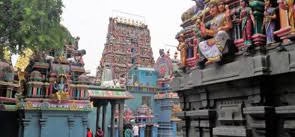
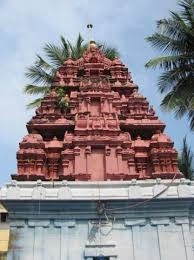
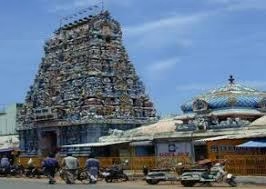
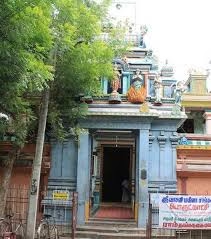
Despite being bereft of the gilded gopurams often seen in Tamil Nadu, the Kamatchi Amman Temple is a fine exemplar of Dravidian Architecture with a unique austerity that reflects the spiritual ethos of Pondicherry.
Style and Vastu
The temple follows the Ekakshara Vastu principles, focusing on a central axis connecting the earth to the divine. The layout is a simple rectangle leading to the Garbhagriha (sanctum sanctorum).
Structural Highlights
- The Sanctum (Garbhagriha): The inner chamber is cool and dimly lit, enhancing the mystical atmosphere. The walls are unadorned, directing all focus to the deity.
- The Mandapa: The pillared hall features stone columns depicting various avatars of the Goddess, though weathered by centuries of salt-laden sea breeze.
- Distinctive Features: The temple lacks a towering Rajagopuram (main gateway), a deliberate choice to symbolize humility before the divine.
Archaeological Note: While not a UNESCO site, the temple is protected under the local heritage conservation mandates of Puducherry.
4. Darshan & Ritual Logistics
Devotees flock here to witness the daily rituals which maintain the sanctity of the space. The priests perform standard Agamic rituals, strictly adhering to traditional timings.
Daily Temple Timings
| Session | Timing | Details |
|---|---|---|
| Morning Darshan | 7:00 AM – 12:00 PM | Opens with Thiruvanthi. Best time: 8:30 AM. |
| Afternoon Recess | 12:00 PM – 4:30 PM | Temple closed for cleaning. |
| Evening Darshan | 4:30 PM – 8:30 PM | Includes Deeparadhana. |
Seva (Ritual Offerings) & Booking
Key Sevas include Abhishekam (sacred bathing of the deity) and Archana (recitation of names).
Online Booking: While the temple maintains a traditional approach, specific Sevas for major festivals can be booked via the Tamil Nadu HR&CE official portal.
2026 Festival Schedule
- Navratri (Sep 22 – Oct 1, 2026): The temple is adorned with flowers; special Annadhanam (free meals) is provided daily.
- Deepavali (Oct 21, 2026): Early morning special darshan at 5:00 AM with oil lamp lighting.
- Pongal (Jan 14, 2026): Traditional Sakkarai Pongal offering to the Goddess.
5. Practical Visitor Guidance
Dress Code & Etiquette
Modesty is strictly enforced. Men are advised to wear dhotis or formal trousers; women should wear sarees, salwars, or long skirts. Shorts and sleeveless tops are not permitted.
Photography & Mobiles
Photography is strictly prohibited inside the sanctum. Mobile phones should be switched to silent mode. Locker facilities are available near the entrance for bags and electronics.
Crowd Management & Accessibility
- Best Hours: Weekday mornings (8 AM – 10 AM) offer the most peaceful Darshan. Weekends and Festival days see heavy crowds.
- Seasonal Advice: Pondicherry can be humid. Carry a handkerchief and water bottle (plastic bottles are discouraged; bring a reusable flask).
- Accessibility: The sanctum requires climbing 5 steps. A ramp is available for wheelchair access to the Mandapa, but the inner sanctum may be difficult to access.
6. Pilgrimage Connectivity
How to Reach
The temple is centrally located in Heritage Town, making it accessible via the main arterial roads.
- Nearest Airport: Puducherry Airport (PNY) – 5 km (approx. 15 mins).
- Nearest Railway Station: Puducherry Railway Station – 2.5 km.
- By Road: Located off Rue Victor Simonel. From Chennai, take NH 32; from Chennai, it is a 3.5-hour drive.
Nearby Sacred Sites (The Pilgrimage Circuit)
Extend your spiritual journey by visiting these nearby landmarks:
- Varadaraja Perumal Temple: Located just 1 km away, this 12th-century temple is a classic example of Pallava architecture.
- Manakula Vinayagar Temple: A 0.5 km distance, famous for its golden chariot and Ganesh worship.
- Sea Shore Temple (Promenade Beach): While not a traditional temple, the rock-carved statues facing the ocean offer a meditative sunset spot.
Photo Gallery
7. Frequently Asked Questions (FAQ)
Unlike larger state-run temples, Kamatchi Amman Temple operates on a first-come, first-served basis. There is no formal VIP entry ticket. However, devotees performing specific Pujas (Archana) are given priority access during the ritual time.
Local legends state that the rock from which the Goddess is carved has a high salt content, which is why the surrounding soil remained fertile despite the proximity to the sea. It is considered a self-manifested (Swayambhu) idol.
While the temple does not have a massive kitchen, Annadhanam (free meals) is distributed during festivals and on special request for groups. For regular meals, the Heritage Town area is filled with traditional vegetarian eateries.
Yes, provided they adhere to the dress code (removing shoes and wearing modest clothing). Non-Hindus are welcome to view the architecture and offer prayers, though entry into the Garbhagriha is a personal choice based on local customs.
Address
Bharathi St, Heritage Town, Puducherry, 605001
Recent Posts

Shri Kaamkoteeshwar Mandir, Varanasi – History & Significance
In the heart of Kashi, the eternal city of Lord Shiva, where the Ganges flows with celestial grace, stands the Shri Kaamkoteeshwar Mandir. This sacred Sannidhi is not merely a temple but a profound spiritual bridge between the Northern…

ओ सांवरे तूने ही मुझको संभाला – Lyrics & Meaning
ओ सांवरे तूने ही मुझको संभाला – A Prayer to Shyam Origin & Spiritual Essence Why This Bhajan Resonates Devotees chant this when overwhelmed by life’s storms—the refrain ‘तूने ही मुझको संभाला’ is the soul’s sigh of relief: “You…

कथा ये है महाराज मेरे की – Lyrics & Meaning
कथा ये है महाराज मेरे की छत्रपति संभाजी महाराज – A Prayer to Chhatrapati Sambhaji Maharaj Origin & Spiritual Essence Why This Bhajan Resonates Devotees chant this when their spirit feels tested—its powerful refrain “महाराज मेरे” is a soul’s…

Rigveda Samhita Yathartha Anuvada (ऋग्वेद संहिता यथार्थ अनुवाद) – Complete Set with Anvayartha & Hindi/English Translation
The Rigveda is the oldest surviving scripture of humanity and the foundational text of Sanātana Dharma. For serious students, scholars, UPSC aspirants studying ancient Indian history, Sanskrit learners, and spiritual seekers, a precise and grammatically structured translation is indispensable.…

आना भी अकेला है जाना भी अकेला है – Lyrics & Meaning | BharatTemples
आना भी अकेला है जाना भी अकेला है – A Prayer to the Divine Witness Origin & Spiritual Essence Why This Bhajan Resonates Devotees turn to this bhajan in moments of deep reflection—when life’s attachments begin to ache. The…

माता शेरावाली के द्वार जो भी जाता है – Lyrics & Meaning
माता शेरावाली के द्वार जो भी जाता है – A Prayer to Maa Sherawali Origin & Spiritual Essence Why This Bhajan Resonates Devotees turn to this bhajan in times of fear or uncertainty—its promise that no one leaves Maa’s…

मार लेना सपणी उबार लेणा भवरा – Lyrics & Meaning
मार लेना सपणी उबार लेणा भवरा – A Prayer to the Divine Beloved Origin & Spiritual Essence Why This Bhajan Resonates Devotees chant this in moments of deep vulnerability—its cry of “मार लेना सपणी, उबार लेणा भवरा” is the…

हमें श्याम सुंदर भरोसा तुम्हारा – Lyrics & Meaning
हमें श्याम सुंदर भरोसा तुम्हारा – A Prayer to Shyam Sundar Origin & Spiritual Essence Why This Bhajan Resonates Devotees chant this when feeling alone—its refrain ‘de do sahara’ is the soul’s cry for divine support. Lyrics in Hindi…

Mere Satguru Ne Di Thi Davai Lyrics in Hindi & Meaning
Mere Satguru Ne Di Thi Davai: Invoking the Guru’s Liberating Wisdom This soul-stirring bhajan venerates the Satguru (True Spiritual Master) as the divine physician who dispenses the only remedy for life’s deepest sufferings. Composed by Sant Karmaveer Tufani, it…

Janm Diyo Thari Maa Dukh Dekhiyo Lyrics in Hindi & Meaning
जन्म दियो थारी माँ दुख देखियो (Maa’s Grief Upon Birthing You) This soul-stirring Chetavani Bhajan (admonitory hymn) is addressed to the Divine Mother (Maa) – a call for repentance when children forget their filial duties in the dark age…