

Contents
Introduction & Spiritual Essence
Matri Mandir, also revered historically as Ramna Kalibari, stands as a profound spiritual anchor on the hillocks of Shillong in Meghalaya. Dedicated to Goddess Kali, this ancient sanctuary serves as a beacon for devotees seeking protection and liberation. The presiding deity is worshipped in her fierce yet benevolent form, often recognized locally as a powerful manifestation of divine motherhood. Unlike modern constructions, the temple is believed to be a Swayambhu (self-manifested) shrine or dates back over a millennium, anchoring it deeply in the region’s spiritual fabric.
Phalaśruti (Spiritual Benefits): Devotees visit Matri Mandir to alleviate negative karma and seek spiritual purification. It is widely believed that offering prayers here helps in cleansing ancestral karma and removing obstacles (Vighnas) from one’s life path. The evening Arati is particularly potent for devotees seeking the Goddess’s fierce grace to overcome fear and adversity.
Historical Origins & Scriptural Legend
The history of Matri Mandir is shrouded in the mists of time, blending scriptural lore with local tradition. Tradition holds that the temple is as old as a thousand years, predating many modern structures in the region. While specific dynastic records are scarce due to the temple’s antiquity, local lore suggests it was a vital center of Shakta worship in the Khasi hills.
Sthala Purana (Local Legend): According to local oral legends, the temple is linked to the ancient spiritual geography of the area. There is a longstanding belief that the temple’s spiritual energy was historically positioned on the outskirts of what is now Dhaka (in neighboring Bangladesh), signifying the trans-boundary devotion to the Goddess. The current structure has withstood centuries of weather and history, serving as a testament to the resilience of faith in the region.
Architectural Marvels
Matri Mandir is an architectural gem that blends indigenous Khasi influences with traditional Hindu temple geometry. The structure is characterized by its unique architecture, featuring a towering spire that dominates the skyline of the Shillong hills. The walls are adorned with magnificent artistic carvings depicting various forms of the Goddess and mythological scenes, showcasing the craftsmanship of a bygone era.
The temple complex utilizes traditional Vastu Shastra principles, orienting the sanctum sanctorum to harness the natural energy of the hillock. The exterior features a fusion of the Nagara style (evident in the curvilinear tower) adapted to the local climate and materials, creating a distinct aesthetic that is both imposing and inviting. The use of stone and wood reflects the region’s resources, blending seamlessly with the verdant landscape of Shillong.
Photo Gallery


Darshan & Ritual Logistics
The daily rituals at Matri Mandir are conducted with strict adherence to Vedic traditions. The temple is famous for its late-night Grand Puja dedicated to Goddess Kali, which attracts devotees from across the state.
Daily Darshan Timings
| Session | Timing | Activity |
|---|---|---|
| Morning | 06:00 AM – 12:00 PM | Mangala Arati & Abhishekam |
| Afternoon | 12:00 PM – 04:00 PM | Temple Cleaning & Rest |
| Evening | 04:00 PM – 08:00 PM | Sandhya Arati & Archana |
| Late Night | 09:00 PM – 10:00 PM | Grand Kali Puja (Special Days) |
Seva & Online Booking
Devotees can book specific Sevas to enhance their spiritual experience. While walk-in bookings are accepted, the temple administration encourages online seva booking to manage crowd flow.
- Abhishekam: Ritual bathing of the deity (requires prior notice).
- Archana: Recitation of 108 names of Goddess Kali.
- Special Puja: Conducted during full moons and Tuesdays.
Note: As we advance into 2026, the temple is likely to roll out a dedicated web portal for seva bookings. For the time being, inquiries can be made via the contact details provided below.
2026 Major Festival Dates
- Kali Puja: October 22, 2026 (Aligning with Amavasya in the month of Kartik).
- Navaratri: March 30 – April 7, 2026 (Special morning Abhishekam).
- Diwali: October 21, 2026.
Practical Visitor Guidance
Code of Conduct & Facilities
- Dress Code: Traditional attire is recommended. Men should wear dhoti or trousers (no shorts), and women should wear sarees, salwar kameez, or full-length dresses.
- Photography: Photography is strictly prohibited inside the sanctum sanctorum. However, the exterior architecture and the panoramic views of Shillong are photogenic and permitted.
- Mobile Lockers: Due to security protocols, electronic devices and mobile phones are not allowed inside the inner sanctum. Free locker facilities are available at the temple entrance.
- Accessibility: The temple is situated on a hillock. While the approach road is motorable, there are stairs leading to the main shrine. Accessibility for differently-abled devotees is limited to the base level; assistance from volunteers is available upon request.
Crowd Management
Best Hours: To experience a peaceful darshan, visit between 07:00 AM – 09:00 AM or 05:00 PM – 06:00 PM.
Seasonal Advice: Shillong weather is unpredictable. During the summer months (May–June), carry a water bottle and an umbrella as humidity can rise. During monsoons (July–September), carry rain gear as the steps can become slippery.
Pilgrimage Connectivity
How to Reach
- By Air: The nearest airport is Shillong Airport (Umroi), located about 30 km from the city. Alternatively, Lokpriya Gopinath Bordoloi International Airport in Guwahati, Assam, is the nearest major hub (approx. 120 km).
- By Rail: The nearest railway station is Guwahati Railway Station (approx. 105 km). From there, one can hire a taxi or take a bus to Shillong.
- By Road: Matri Mandir is located in the heart of Shillong at Polo-Lawmali. It is easily accessible via NH 6 (connecting Guwahati to Shillong). Local taxis (Black & Yellow) are readily available from Police Bazar and the main bus stand.
How to Reach:
Nearby Sacred Sites
To enhance your pilgrimage, consider visiting these nearby spiritual centers:
- Shillong Peak: Located just 10 minutes away, offering a vantage point with a small shrine dedicated to U Shillong (the city’s namesake deity).
- Jesus Saves Church (Cherrapunji): If venturing further, the historic church in Cherrapunji offers a contrast in spiritual architecture.
- Umiam Lake (Barapani): A serene spot for reflection, often visited after darshan for a peaceful retreat.
Address
Polo-Lawmali, Golf Links, Police Bazar, Shillong, East Khasi Hills, Meghalaya 793001, India
Contact Details
Temple Office: +91 0364-222XXXX (Please verify locally for current numbers)
Frequently Asked Questions (FAQ)
1. Is there a VIP darshan entry at Matri Mandir?
Currently, Matri Mandir operates on a standard darshan line for all devotees. However, for elderly citizens or those with medical emergencies, the temple administration often allows entry through a priority lane upon showing valid proof.
2. Can we offer non-vegetarian Prasad?
No. As a dedicated Kali temple, only vegetarian offerings are accepted inside the sanctum. Traditionally, Goddess Kali accepts symbolic animal sacrifices in the form of pumpkins or bananas, but these must be coordinated with the head priest.
3. Is the temple open during heavy rains?
Yes, Matri Mandir remains open year-round. However, during severe weather alerts or landslides (common in monsoons), it is advisable to check local advisories before heading to the hillock location.
4. Where can I stay near the temple?
Police Bazar is the nearest commercial hub with numerous hotels ranging from budget to luxury. Polo Ground also has several guesthouses and homestays within walking distance of the temple.
5. Are foreign tourists allowed?
Yes, Matri Mandir welcomes all visitors regardless of faith. Foreign tourists are requested to respect the sanctity of the temple by dressing modestly and observing silence inside the sanctum.
Recent Posts

माता शेरावाली के द्वार जो भी जाता है – Lyrics & Meaning
माता शेरावाली के द्वार जो भी जाता है – A Prayer to Maa Sherawali Origin & Spiritual Essence Why This Bhajan Resonates Devotees turn to this bhajan in times of fear or uncertainty—its promise that no one leaves Maa’s…

मार लेना सपणी उबार लेणा भवरा – Lyrics & Meaning
मार लेना सपणी उबार लेणा भवरा – A Prayer to the Divine Beloved Origin & Spiritual Essence Why This Bhajan Resonates Devotees chant this in moments of deep vulnerability—its cry of “मार लेना सपणी, उबार लेणा भवरा” is the…

हमें श्याम सुंदर भरोसा तुम्हारा – Lyrics & Meaning
हमें श्याम सुंदर भरोसा तुम्हारा – A Prayer to Shyam Sundar Origin & Spiritual Essence Why This Bhajan Resonates Devotees chant this when feeling alone—its refrain ‘de do sahara’ is the soul’s cry for divine support. Lyrics in Hindi…

Mere Satguru Ne Di Thi Davai Lyrics in Hindi & Meaning
Mere Satguru Ne Di Thi Davai: Invoking the Guru’s Liberating Wisdom This soul-stirring bhajan venerates the Satguru (True Spiritual Master) as the divine physician who dispenses the only remedy for life’s deepest sufferings. Composed by Sant Karmaveer Tufani, it…

Janm Diyo Thari Maa Dukh Dekhiyo Lyrics in Hindi & Meaning
जन्म दियो थारी माँ दुख देखियो (Maa’s Grief Upon Birthing You) This soul-stirring Chetavani Bhajan (admonitory hymn) is addressed to the Divine Mother (Maa) – a call for repentance when children forget their filial duties in the dark age…
Bhadi Sabha Mein Thane Manaun Lyrics in Hindi & Meaning
Bhadi Sabha Mein Thane Manaun: Invoking the Spear-Wielding Mother Mata Bhawani (श्री ज्वाला भवानी), the fiery manifestation of Shakti worshipped as the Protector of Dharma in Her Dhaulagarh sanctum. Origin & Spiritual Essence Composed in Rajasthani folk tradition by…
श्याम सुन्दरवा छोटे छोटे कनुवा Lyrics & Meaning
श्याम सुन्दरवा छोटे छोटे कनुवा (Shyam Sundarva Chhote Chhote Kanuva) is a heartfelt invocation to Lord Krishna in his most enchanting form—Shyam Sundar (the dark, beautiful one). This bhajan is a plea for the divine child Kanha to grace…
Maat Meri Chintapurni Lyrics in Hindi & Meaning
Maat Meri Chintapurni is a heartfelt devotional prayer dedicated to Maa Chintapurni, a form of the Divine Mother. She is revered as the remover of worries and the granter of wishes, especially venerated in the Himalayan region of Himachal…
थारी रे नदियां का ढावा पे खीची राजा Lyrics & Meaning
खीची राजा का अद्भुत युद्ध: एक शौर्य गाथा यह भजन एक पौराणिक या ऐतिहासिक शूरवीर राजा की वीरता का वर्णन करता है, जो प्रायः गुजराती लोक संस्कृति में लोककथाओं का हिस्सा है। इसकी रचना दुर्गेश कटारा ने की है…
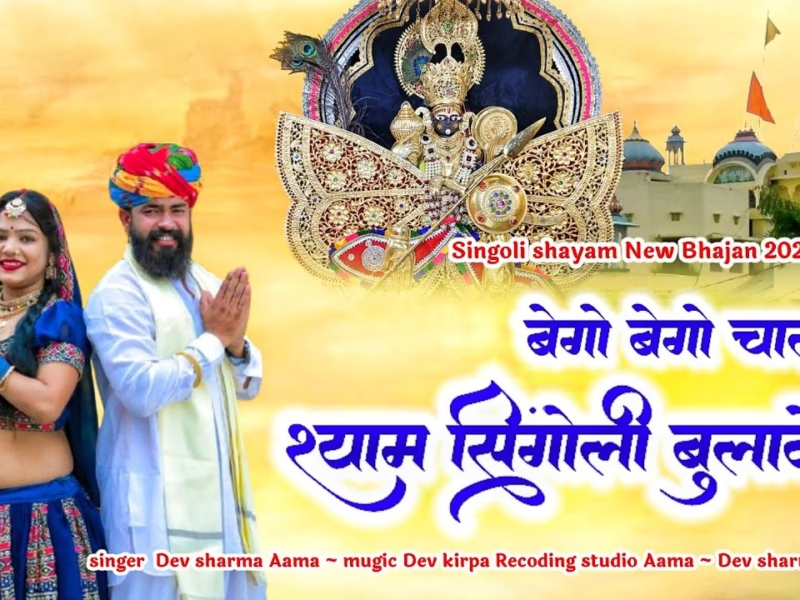
बेगो बेगो चाल श्याम सिंगोली बुलावे रे Lyrics in Hindi & Meaning
Bhajan Title & Deity This bhajan, बेगो बेगो चाल श्याम सिंगोली बुलावे रे, is dedicated to Lord Shyam, a revered form of Lord Krishna. Origin & Spiritual Essence The composer of this bhajan is not specified, but it is…