
Contents
Introduction & Spiritual Essence
Nestled in the heart of Vidarbha, the BAPS Swaminarayan Temple in Nagpur stands as a beacon of devotion and Vedic heritage. Formally known as a Shikharbaddh Mandir, this sacred space is dedicated to Bhagwan Swaminarayan. According to the Swaminarayan Sampradaya, this form of divinity is the Supreme Personality of Godhead (Narayana) incarnate. The temple serves as an abode of peace, where the central deity is installed in his glorious form, surrounded by panchavati (five forms) manifestations of the divine family.
Phalaśruti (Spiritual Benefits): Devotees visit this temple not merely for architectural appreciation but for spiritual rejuvenation. The temple is designed to foster satsang (spiritual association), which is believed to purify the heart and dispel ignorance. Specific benefits cited by regular visitors include:
- Mental Peace and Focus: The serene atmosphere, enhanced by the sanctified murtis, aids in meditation and stress reduction.
- Community Connection: With a strong emphasis on youth development and family values, the temple fosters a nurturing environment for spiritual growth.
- Merit Accumulation: Offering prayers and participating in darshan here is believed to cleanse negative karma and accrue spiritual merit.
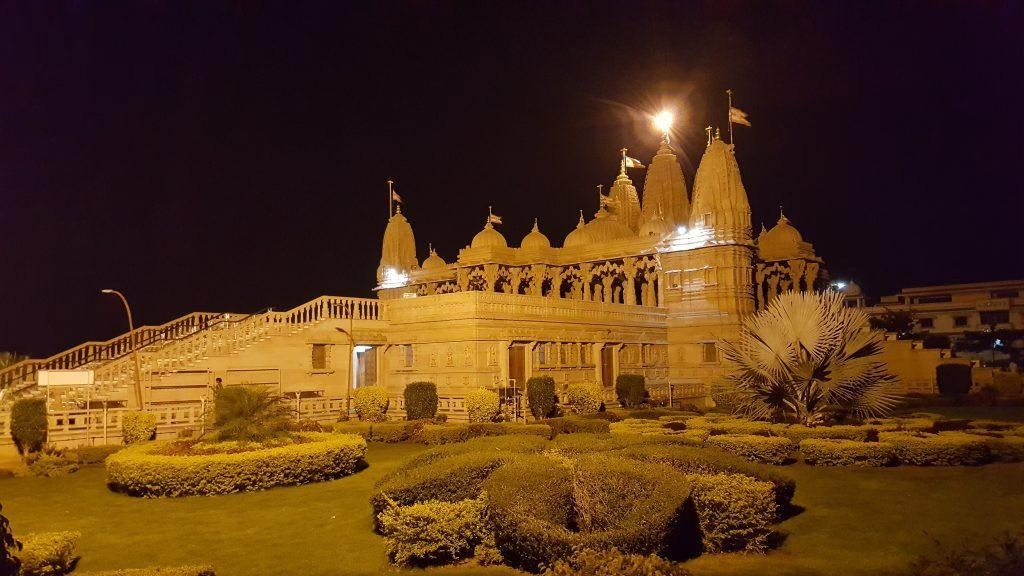
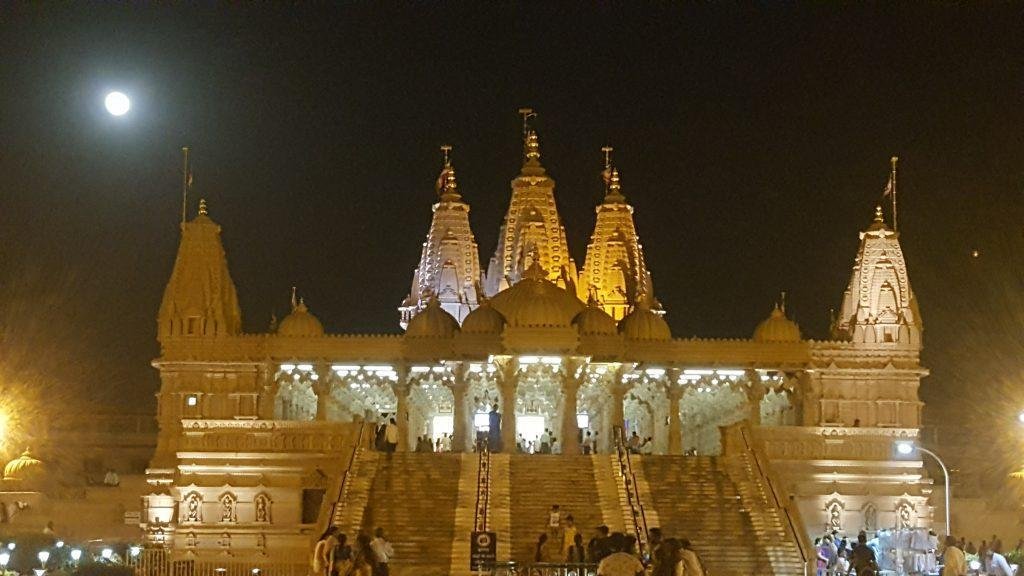
As evening descends upon the inner ring road of Nagpur, the temple illuminates, drawing a large number of devotees who seek the solace of divine satsang and the blessings of the Bhagwans.
Historical Origins & Scriptural Legend
While the current structure is a modern marvel, the roots of Swaminarayan devotion in Nagpur run deep, dating back to the spiritual tours of Pramukh Swami Maharaj. According to temple records and oral tradition, the spiritual seeds were sown in 1976 during the Vidarbha tour. Initially, a place of worship was established in Vardhamannagar, serving the local devotees for decades.
The journey toward the monumental Shikharbaddh Mandir in Wathoda began with the groundbreaking ceremony in 2004. This period marked a significant expansion of BAPS (Bochasanwasi Shri Akshar Purushottam Swaminarayan Sanstha) activities in the region, including the inauguration of the Swaminarayan School in 1997.
The temple reached its apex with the Murti-Pratishtha (consecration ceremony) in 2013. Traditionally, this ritual is not merely an installation but a divine awakening of the stone idols, performed by high-ranking sadhus (ascetics) following strict Vedic rituals. The temple serves as a testament to the vision of Pramukh Swami Maharaj, transforming the modest beginnings of 1976 into a grand spiritual complex in Wathoda.
Architectural Marvels
The BAPS Swaminarayan Temple is a masterpiece of Indian Nagara-style architecture. Unlike the towering South Indian Dravidian styles, Nagara architecture is characterized by a towering shikhara (spire) that rises in a curvilinear form, symbolizing the ascent of the soul toward the divine.

Key Structural Elements:
- The Shikhara (Spire): The central spire is intricately carved with motifs from nature and mythology. It represents Mount Meru, the cosmic axis of the universe.
- Mandapas (Halls): The temple features spacious mandapas designed to accommodate large congregations. The flooring and ceiling are adorned with precise geometric patterns (Vastu-compliant) that align the energy flow within the space.
- Sculpture and Material: The temple is built using pristine white stone, likely sandstone, carved with high relief. The exterior hosts intricate carvings of dikpalas (guardians of directions), floral motifs, and celestial beings.
Though the original content did not specify ASI or UNESCO status, BAPS temples are renowned for traditional craftsmanship where no metal fasteners are used in the structural joinery, relying instead on interlocking stone techniques—an ancient Vastu Shastra principle.

Darshan & Ritual Logistics
The temple follows a strict schedule of puja (worship) that aligns with the solar cycle. The daily rituals involve the awakening of the deity, offering food (Naivedyam), and the final sunset prayer (Sandhya Aarti).
Daily Timings
Please note: Temple timings may vary on festival days. It is advisable to arrive 15 minutes before the scheduled Aarti.
| Session | Timings |
|---|---|
| Morning Darshan | 6:30 AM – 10:30 AM |
| Afternoon Break | 10:30 AM – 1:00 PM |
| Afternoon Darshan | 1:00 PM – 4:00 PM |
| Evening Darshan | 4:00 PM – 8:30 PM |
| Shayan Aarti | 7:00 PM (Daily) |
Key Sevas and Online Booking
Devotees can participate in various ritual services. While some services are available on-site, online seva booking is recommended for major events.
- Mangla Aarti (Early Morning): Witnessing the awakening of the deities (Requires prior arrival).
- Abhishekam: Ritual bathing of the murti with water, milk, and honey (usually performed by resident priests).
- Annakut (Annapurna) Offering: As seen in the images, large-scale food offerings are made during festivals.

Annapurna Mahotsav at the BAPS Swminarayan Temple, Nagpur

To book online, visit the official BAPS website or the specific Nagpur temple page where dates are listed under the “Events” or “Seva” sections.
2026 Festival Calendar Highlights
- Maha Shivaratri (Feb 26, 2026): Special darshan and puja for Lord Shiva.
- Diwali & Annakut (Oct 20 – 24, 2026): The grandest celebration featuring the Annakut mountain of food offerings.
- Swaminarayan Jayanti (Apr 14, 2026): Celebrating the birth of Bhagwan Swaminarayan.
Practical Visitor Guidance
Rules and Etiquette
To maintain the sanctity of the dham, strict codes of conduct are observed:
- Dress Code: Modest clothing is mandatory. Men should wear shirts and trousers (avoid shorts); women should wear sarees, salwar kameez, or long skirts/dresses.
- Photography: Photography is generally restricted inside the main garbhagriha (sanctum sanctorum) but allowed in the outer courtyard. Flash photography is prohibited.
- Mobile Phones: Electronic devices should be kept silent. Lockers are available near the entrance to store phones, bags, and leather items (which are not allowed inside).
- Accessibility: The temple complex is wheelchair accessible with ramps and elevators (if multi-storied).
Crowd Management
Evenings attract the largest crowds due to the Satsang and Aarti. For a quieter darshan, it is best to visit on weekday mornings between 7:00 AM and 9:00 AM. During peak summer (May–June), carry a reusable water bottle, though water stations are usually available within the complex. Expect longer queues during public holidays and weekends.
Pilgrimage Connectivity
How to Reach
The BAPS Swaminarayan Mandir is centrally located in the Wathoda area of Nagpur.
- Address: Swaminarayan Marg, Middle Ring Road, Wathoda, Nagpur 440030.
- Nearest Airport: Dr. Babasaheb Ambedkar International Airport (NAG) is approximately 10–15 km away (25-30 mins by cab).
- Nearest Railway Station: Nagpur Junction (NGP) is about 7–8 km away. Auto-rickshaws and Ola/Uber services are readily available.
- By Road: Located directly on the Inner Ring Road, the temple is easily accessible from NH-47 and the Nagpur–Aurangabad Highway.
Nearby Sacred Sites
Expand your pilgrimage circuit by visiting these notable sites in Nagpur:
- Deekshabhoomi: The largest hollow stupa in the world, a major pilgrimage site for Buddhists, located about 10 km away.
- Shri Swaminarayan Temple (Vardhamannagar): The original temple established in the 1970s, offering a historical contrast to the new Wathoda complex.
- Shri Mahalakshmi Temple (Itwari): A historic temple in the bustling old city market area.
Frequently Asked Questions (FAQ)
1. Is there a VIP darshan entry available?
Yes, the BAPS organization often has specific arrangements for special entry darshan for senior citizens, differently-abled devotees, and large groups. It is recommended to contact the temple administration (+91 9561112403) prior to your visit to confirm availability.
2. How do I perform online seva booking for Nagpur temple?
You can book seva through the official BAPS website (www.baps.org). Select the Nagpur Mandir under the list of centers, choose your desired seva (such as Shayan Aarti or Festival seva), and complete the registration.
3. Is the temple open on all days?
Generally, yes. However, during specific festivals or maintenance periods, the darshan timings might be extended or restricted. It is advisable to check the latest notice on the temple website before planning your visit.
4. What is the significance of the deities inside the temple?
While the primary deity is Bhagwan Swaminarayan, the temple houses distinct murtis of various forms of divinity to represent the unity of the Hindu faith. Key figures include Shri Radha-Krishna (devotion), Shri Sita-Ram (duty and righteousness), and Shri Umapati-Mahadev (the divine consciousness). The installed gunatit swamis (saints) serve as ideal devotees guiding the path.
5. Is parking available at the Swaminarayan Temple Nagpur?
Yes, the temple on the Middle Ring Road in Wathoda provides dedicated parking space for visitors. However, during major festivals, parking can fill up quickly, so arriving via public transport or cabs is often more convenient.
Recent Posts

ओ सांवरे तूने ही मुझको संभाला – Lyrics & Meaning
ओ सांवरे तूने ही मुझको संभाला – A Prayer to Shyam Origin & Spiritual Essence Why This Bhajan Resonates Devotees chant this when overwhelmed by life’s storms—the refrain ‘तूने ही मुझको संभाला’ is the soul’s sigh of relief: “You…

कथा ये है महाराज मेरे की – Lyrics & Meaning
कथा ये है महाराज मेरे की छत्रपति संभाजी महाराज – A Prayer to Chhatrapati Sambhaji Maharaj Origin & Spiritual Essence Why This Bhajan Resonates Devotees chant this when their spirit feels tested—its powerful refrain “महाराज मेरे” is a soul’s…

Rigveda Samhita Yathartha Anuvada (ऋग्वेद संहिता यथार्थ अनुवाद) – Complete Set with Anvayartha & Hindi/English Translation
The Rigveda is the oldest surviving scripture of humanity and the foundational text of Sanātana Dharma. For serious students, scholars, UPSC aspirants studying ancient Indian history, Sanskrit learners, and spiritual seekers, a precise and grammatically structured translation is indispensable.…

आना भी अकेला है जाना भी अकेला है – Lyrics & Meaning | BharatTemples
आना भी अकेला है जाना भी अकेला है – A Prayer to the Divine Witness Origin & Spiritual Essence Why This Bhajan Resonates Devotees turn to this bhajan in moments of deep reflection—when life’s attachments begin to ache. The…

माता शेरावाली के द्वार जो भी जाता है – Lyrics & Meaning
माता शेरावाली के द्वार जो भी जाता है – A Prayer to Maa Sherawali Origin & Spiritual Essence Why This Bhajan Resonates Devotees turn to this bhajan in times of fear or uncertainty—its promise that no one leaves Maa’s…

मार लेना सपणी उबार लेणा भवरा – Lyrics & Meaning
मार लेना सपणी उबार लेणा भवरा – A Prayer to the Divine Beloved Origin & Spiritual Essence Why This Bhajan Resonates Devotees chant this in moments of deep vulnerability—its cry of “मार लेना सपणी, उबार लेणा भवरा” is the…

हमें श्याम सुंदर भरोसा तुम्हारा – Lyrics & Meaning
हमें श्याम सुंदर भरोसा तुम्हारा – A Prayer to Shyam Sundar Origin & Spiritual Essence Why This Bhajan Resonates Devotees chant this when feeling alone—its refrain ‘de do sahara’ is the soul’s cry for divine support. Lyrics in Hindi…

Mere Satguru Ne Di Thi Davai Lyrics in Hindi & Meaning
Mere Satguru Ne Di Thi Davai: Invoking the Guru’s Liberating Wisdom This soul-stirring bhajan venerates the Satguru (True Spiritual Master) as the divine physician who dispenses the only remedy for life’s deepest sufferings. Composed by Sant Karmaveer Tufani, it…

Janm Diyo Thari Maa Dukh Dekhiyo Lyrics in Hindi & Meaning
जन्म दियो थारी माँ दुख देखियो (Maa’s Grief Upon Birthing You) This soul-stirring Chetavani Bhajan (admonitory hymn) is addressed to the Divine Mother (Maa) – a call for repentance when children forget their filial duties in the dark age…

Bhadi Sabha Mein Thane Manaun Lyrics in Hindi & Meaning
Bhadi Sabha Mein Thane Manaun: Invoking the Spear-Wielding Mother Mata Bhawani (श्री ज्वाला भवानी), the fiery manifestation of Shakti worshipped as the Protector of Dharma in Her Dhaulagarh sanctum. Origin & Spiritual Essence Composed in Rajasthani folk tradition by…