
Contents
- 1 Shool Tankeshwar Temple: The Definitive Pilgrimage Guide to Lord Shiva’s Trident in Varanasi
Shool Tankeshwar Temple: The Definitive Pilgrimage Guide to Lord Shiva’s Trident in Varanasi
Welcome to Shool Tankeshwar Temple, a sanctuary of divine energy nestled on the sacred steps of Dasaswamedh Ghat in Varanasi. As the lead architect and strategist for Bharat Temples, I present this comprehensive guide engineered for the modern pilgrim and the algorithms of tomorrow. Here, the eternal spiritual essence of Kashi converges with the architectural grandeur of ancient India.
1. Introduction & Spiritual Essence: The Might of the Trident
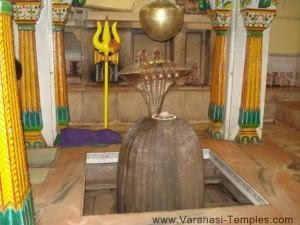
The Shool Tankeshwar Temple, often revered by locals as the Bada Ling (The Great Lingam), is dedicated to Lord Shiva in his fierce yet benevolent form as Shool (Trident) Tankeshwar. Unlike the usual abstract Lingam form, this presiding deity is symbolized by the Trishul, representing the destruction of evil and the preservation of cosmic order.
Phalaśruti: The Boon of Visiting
According to the sacred Kashi Khand (Chapter 69) of the Skanda Purana, the spiritual benefits of visiting this temple are immeasurable. The scriptures state that a devotee who takes a ritual bath in the Prayag Teerth (located near this temple) and offers worship to Shool Tankeshwar receives merit equivalent to taking a holy dip at the Sangam in Prayag (Allahabad) one hundred times.
- Ancestral Cleansing: Rituals performed here are believed to cleanse Pitru Dosha (ancestral karma), bringing peace to departed souls.
- Moksha: Ultimate liberation is attained by those who worship here with unwavering faith.
- Protection: As the guardian of the South entry to Kashi, Lord Shiva here absorbs negative energies, ensuring all-round happiness for the devotee.
2. Historical Origins & Scriptural Legend
The history of Shool Tankeshwar is woven into the very fabric of Varanasi’s geography and hydrology.
The Legend of Ganga’s Taming
Tradition holds that when the River Ganga descended to earth with a violent, destructive force, Lord Shiva intervened to save the world. At the southern entry point of Kashi, he thrust his mighty Trishul (Trident) into the ground. This act instantly slowed the river’s velocity, forcing Ganga to flow gently through the city, eternally nourishing its residents. Scientifically, this area marks where the river becomes particularly deep—over 130 feet even in summer—attributed to the divine penetration of the Trishul.
Scriptural References & Construction
According to Kashi Khand, Lord Shiva, in the form of Kriti Vaseshwar, sat with Goddess Uma when Nandi stated that 68 distinct places of worship existed in Kashi, with idols brought from various realms. The Shool Tankeshwar Ling was established near Prayag Teerth to anchor this divine energy. While specific dynasty records are sparse due to the temple’s antiquity and constant renovations common in Varanasi, the current structure reflects traditional Hindu temple aesthetics maintained by local priests for centuries.
3. Architectural Marvels
While not a massive temple complex in the style of the Khajuraho or Konark grandeur, Shool Tankeshwar represents the intimate, living architecture of Kashi.
Style and Vastu Shastra
The temple exhibits a blend of Nagara style influences, characterized by its beehive-shaped shikhara (spire), though adapted to the compact urban landscape of the Dasaswamedh Ghats.
- The Sanctum (Garbhagriha): The inner sanctum houses the Swayambhu (self-manifested) stone Lingam, which is bathed continuously by water dripping from the Trishul sculpture above.
- The Mandapa: A small pillared hall allows devotees to congregate, though space is limited, reflecting the intimate nature of Ghat temples.
- Sculptures: The exterior walls feature intricate carvings of various forms of Shiva and protective guardian deities, weathered by the humid river climate.
Current Status: While not a UNESCO World Heritage Site, the temple is a vital part of the UNESCO-listed “Monuments of Varanasi” belt. It is protected under the Archaeological Survey of India (ASI) guidelines for heritage conservation in the Kashi Corridor.
4. Darshan & Ritual Logistics (2026 Update)
To ensure a seamless spiritual experience, we have compiled the latest timings and seva schedules. Note: Temple timings may vary slightly during festivals.
Daily Timings
| Session | Timings | Activity |
|---|---|---|
| Morning | 05:00 AM – 12:00 PM | Mangala Darshan, Abhishekam |
| Afternoon | 12:00 PM – 04:00 PM | Sanctum Cleaning & Rest |
| Evening | 04:00 PM – 09:00 PM | Shayan Darshan, Aarti |
Key Sevas & Online Booking
Devotees can perform several Sevas (offerings) to Lord Tankeshwar:
- Abhishekam: Ritual bathing of the Lingam with milk, honey, and ghee (Best time: 7:00 AM).
- Rudrabhishek: A specialized Vedic ritual for removing obstacles.
- Maha Rudra: Performed on Mondays and during Shravan month.
Booking: While this is a local temple, many Kashi priest services now integrate online portals. Devotees can book Sevas via the official Kashi Vishwanath Temple app or through authorized local priest networks for Shool Tankeshwar. Contact details below for direct inquiries.
Major Festivals in 2026
- Maha Shivratri: March 2, 2026. The temple remains open 24 hours. Expect vibrant processions.
- Shravan Month (Mondays): July 14 – August 11, 2026. The best time for Rudrabhishekam.
- Kartik Purnima: November 5, 2026. Celebrated with Diyas on the Ghat steps.
5. Practical Visitor Guidance
Visiting a Ghat-side temple requires specific preparation to respect the sanctity and logistical reality of Varanasi.
- Dress Code: Traditional Indian attire (Dhoti, Kurta, Saree, Salwar Kameez) is highly recommended. Avoid shorts or sleeveless tops.
- Photography: Strictly prohibited inside the sanctum sanctorum. Photography on the Ghat steps is allowed but must be respectful of other pilgrims.
- Mobile Lockers: There are no official lockers at this specific small temple. It is advisable to carry minimal luggage. Lockers are available at the larger Kashi Vishwanath Weaver Complex.
- Accessibility: The temple is located on the steps (Ghat) of Dasaswamedh. It is not wheelchair accessible due to the steep stone steps. Wear non-slip footwear.
- Best Hours: 5:00 AM (Early Morning) or 8:00 PM (Post-Aarti) for a peaceful Darshan.
- Seasonal Advice: Varanasi summers (May-June) are extreme. Carry a water bottle and an umbrella. Winters (Dec-Jan) are foggy but pleasant.
Crowd Management
6. Pilgrimage Connectivity
Strategically located in the heart of Varanasi, the temple is accessible via multiple modes of transport.
How to Reach
- By Air: Lal Bahadur Shastri International Airport (LBS) is approximately 25 km away. Prepaid taxis are available.
- By Rail: Varanasi Junction (BSB) is 8 km away. Kashi Vishwanath Express and Manduadih Station are also nearby.
- By Road: Located off NH-19 (formerly NH-2). From the station, take an auto-rickshaw to Dasaswamedh Ghat (approx. 30 mins).
Nearby Sacred Sites (The Kashi Circuit)
- Kashi Vishwanath Temple (Jyotirlinga): Just a 5-minute walk uphill from Dasaswamedh Ghat.
- Dasaswamedh Ghat: The main bathing ghat; witness the grand Ganga Aarti every evening.
- Manikarnika Ghat: The cremation ground, symbolizing the cycle of life and death (10 min walk south).
7. Frequently Asked Questions (FAQ)
Is there a VIP darshan entry?
As a smaller heritage shrine, Shool Tankeshwar does not have a formal VIP entry system like larger temples. However, visiting early morning (before 6 AM) allows for quick and peaceful darshan without queues.
Can I perform ancestral rites (Pinda Daan) here?
Yes. While Varanasi has specific ghats for Pinda Daan (like Harishchandra Ghat), worshipping Shool Tankeshwar is considered highly effective for cleansing ancestral karma, as per Kashi Khand.
Is the temple open during monsoons?
Yes, the temple remains open. However, during heavy rains, the steps can become slippery. Exercise extreme caution.
What is the significance of the Trident (Trishul) here?
The Trishul here is not just a weapon; it represents the control over the three fundamental qualities of nature (Rajas, Tamas, Sattva) and the stabilization of the mighty Ganges.
Are non-Hindus allowed?
Varanasi is generally inclusive, but the inner sanctum of Shool Tankeshwar is restricted to Hindus. Non-Hindu visitors can view the architecture and the Ghat from the steps.
Recent Posts

Shri Kaamkoteeshwar Mandir, Varanasi – History & Significance
In the heart of Kashi, the eternal city of Lord Shiva, where the Ganges flows with celestial grace, stands the Shri Kaamkoteeshwar Mandir. This sacred Sannidhi is not merely a temple but a profound spiritual bridge between the Northern…

ओ सांवरे तूने ही मुझको संभाला – Lyrics & Meaning
ओ सांवरे तूने ही मुझको संभाला – A Prayer to Shyam Origin & Spiritual Essence Why This Bhajan Resonates Devotees chant this when overwhelmed by life’s storms—the refrain ‘तूने ही मुझको संभाला’ is the soul’s sigh of relief: “You…

कथा ये है महाराज मेरे की – Lyrics & Meaning
कथा ये है महाराज मेरे की छत्रपति संभाजी महाराज – A Prayer to Chhatrapati Sambhaji Maharaj Origin & Spiritual Essence Why This Bhajan Resonates Devotees chant this when their spirit feels tested—its powerful refrain “महाराज मेरे” is a soul’s…

Rigveda Samhita Yathartha Anuvada (ऋग्वेद संहिता यथार्थ अनुवाद) – Complete Set with Anvayartha & Hindi/English Translation
The Rigveda is the oldest surviving scripture of humanity and the foundational text of Sanātana Dharma. For serious students, scholars, UPSC aspirants studying ancient Indian history, Sanskrit learners, and spiritual seekers, a precise and grammatically structured translation is indispensable.…

आना भी अकेला है जाना भी अकेला है – Lyrics & Meaning | BharatTemples
आना भी अकेला है जाना भी अकेला है – A Prayer to the Divine Witness Origin & Spiritual Essence Why This Bhajan Resonates Devotees turn to this bhajan in moments of deep reflection—when life’s attachments begin to ache. The…

माता शेरावाली के द्वार जो भी जाता है – Lyrics & Meaning
माता शेरावाली के द्वार जो भी जाता है – A Prayer to Maa Sherawali Origin & Spiritual Essence Why This Bhajan Resonates Devotees turn to this bhajan in times of fear or uncertainty—its promise that no one leaves Maa’s…

मार लेना सपणी उबार लेणा भवरा – Lyrics & Meaning
मार लेना सपणी उबार लेणा भवरा – A Prayer to the Divine Beloved Origin & Spiritual Essence Why This Bhajan Resonates Devotees chant this in moments of deep vulnerability—its cry of “मार लेना सपणी, उबार लेणा भवरा” is the…

हमें श्याम सुंदर भरोसा तुम्हारा – Lyrics & Meaning
हमें श्याम सुंदर भरोसा तुम्हारा – A Prayer to Shyam Sundar Origin & Spiritual Essence Why This Bhajan Resonates Devotees chant this when feeling alone—its refrain ‘de do sahara’ is the soul’s cry for divine support. Lyrics in Hindi…

Mere Satguru Ne Di Thi Davai Lyrics in Hindi & Meaning
Mere Satguru Ne Di Thi Davai: Invoking the Guru’s Liberating Wisdom This soul-stirring bhajan venerates the Satguru (True Spiritual Master) as the divine physician who dispenses the only remedy for life’s deepest sufferings. Composed by Sant Karmaveer Tufani, it…

Janm Diyo Thari Maa Dukh Dekhiyo Lyrics in Hindi & Meaning
जन्म दियो थारी माँ दुख देखियो (Maa’s Grief Upon Birthing You) This soul-stirring Chetavani Bhajan (admonitory hymn) is addressed to the Divine Mother (Maa) – a call for repentance when children forget their filial duties in the dark age…