
Contents
Introduction & Spiritual Essence
Nestled in the labyrinthine alleys of Varanasi (Kashi), the Markandeyshwar Temple stands as a testament to unwavering devotion and the ancient traditions of Sanatana Dharma. Dedicated to Lord Markandeyshwar (an aspect of Lord Shiva), this sacred shrine is deeply intertwined with the spiritual geography of Kashi as described in the revered Kashi Khand of the Skanda Purana.
Phalaśruti: The Benefits of Darshan
According to ancient scriptures, visiting this temple carries immense spiritual merit. As described in Kashi Khand, Chapter 61, Lord Vishnu narrated the significance of this area to Sage Bindu.
“Devotees should bathe in Markanday Teerth and perform rituals for their forefathers nearby. By performing these religious activities, one is cleansed of all sins howsoever abysmal or outrageous they may be.”
It is believed that paying obeisance here grants liberation (Moksha) and peace to the ancestral lineage, making it a vital stop for those performing Shraddha or Pinda Daan.
Historical Origins & Scriptural Legend
The Kashi Khand Connection
The temple’s origins are rooted in the Skanda Purana. Tradition holds that this spot was once the site of the sacred Markanday Teerth. While the physical tank is no longer in existence today, the sanctity of the location remains undiminished. The name derives from the sage Markandeya, the immortal devotee of Lord Shiva who was saved from the clutches of Yama (Death) at this very location.
Timeline and Renovations
While specific records of the original builders are elusive, the architectural style suggests a construction spanning several centuries, likely established during the medieval period. The temple has undergone multiple renovations to preserve its structural integrity against the elements and the ravages of time. The current structure maintains the ancient aura while ensuring accessibility for modern devotees.
Architectural Marvels
While the broader region of Varanasi is known for the Nagara style of architecture, the Markandeyshwar Temple embodies the classic North Indian Temple style adapted to the dense urban fabric of the Old City.
Sanctum and Layout
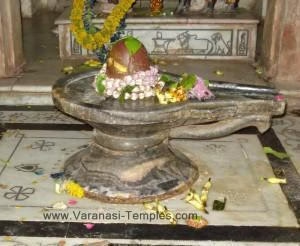
The temple is relatively compact but radiates a profound spiritual energy. The Garbhagriha (sanctum sanctorum) houses the Shiva Lingam (representing Markandeyshwar). Unlike grandiose structures, the beauty here lies in the intricate stone carvings and the Mandapa (assembly hall) that facilitates intimate gatherings during prayers.
The entrance is modest, characterized by heavy wooden doors and bells that announce the transition from the chaotic bazaar to a divine sanctuary. The walls often feature motifs found in traditional Varanasi architecture, depicting deities and mythological scenes.
Photo Gallery
Darshan & Ritual Logistics
To ensure a smooth spiritual experience, devotees are advised to plan their visit according to the daily schedule and upcoming festival dates.
Daily Timings
| Part of the Day | Timing | Activity |
|---|---|---|
| Morning | 05:00 AM – 12:00 PM | Mangala Aarti, Abhishekam, Darshan |
| Afternoon | 12:00 PM – 04:00 PM | Temple Cleaning / Rest Period |
| Evening | 04:00 PM – 09:00 PM | Aarti, Bhog, Shayan Darshan |
Note: Timings may vary slightly during festivals. Please check locally for exact seasonal adjustments.
Seva and Pooja
Devotees can perform various Sevas to seek blessings. Common rituals include:
- Abhishekam: Ritual bathing of the Shiva Lingam with water, milk, and honey.
- Archana: Offering of flowers and recitation of names.
- Pinda Daan: Specifically recommended here for ancestral peace (to be performed in nearby sacred areas as advised by priests).
Online Seva Booking
While traditional booking is prevalent at the temple office, many Varanasi temples are adopting digital systems. Devotees are encouraged to visit the official Varanasi Temple Trust or the local temple committee website for “Online Seva Booking” options for the year 2026.
2026 Major Festival Dates
- Maha Shivaratri: February 26, 2026 (Special night-long vigil and Abhishekam).
- Sharad Purnima: October 6, 2026 (Moonlight rituals).
- Kartik Purnima: November 15, 2026 (Deep Daan and Ganga Snan).
Practical Visitor Guidance
Rules and Etiquette
- Dress Code: Modest attire is mandatory. Men should wear dhotis or trousers (no shorts); women should wear sarees, salwar kameez, or long skirts.
- Photography: Strictly prohibited inside the sanctum sanctorum. Photography in the outer halls may be restricted; seek permission from the priest.
- Mobile & Lockers: As the temple is located in the crowded Gyan Vapi area, large bags are discouraged. There are no official mobile lockers; it is best to carry minimal belongings.
- Accessibility: The temple is reached by climbing down steps. While rails are provided, it may be challenging for those with severe mobility issues. Wheelchair access is not available due to the ancient structure.
Crowd Management & Best Time to Visit
The area near Gyan Vapi is extremely crowded, especially during the evenings and weekends.
- Best Time: Morning hours (6:00 AM – 8:00 AM) are ideal for a peaceful Darshan.
- Seasonal Advice: Varanasi summers (April–June) are intensely hot. Carry a water bottle and a handkerchief. Winters (Nov–Feb) are pleasant but require warm layers for early morning visits.
Pilgrimage Connectivity
How to Reach
Address: Markandeyshwar Temple, Ck.36/10, behind Gyan Vapi, Varanasi (Chowk Area).
- By Air: Lal Bahadur Shastri International Airport (LBS) is approximately 25 km away. Taxis and cabs are available to Chowk.
- By Rail: Varanasi Junction (BSB) is 5 km from Chowk. Auto-rickshaws can take you to Gyan Vapi.
- Walking Directions: From Chowk, proceed towards Gyan Vapi. Take a right turn, climb down the steps, and turn right again. The temple is located on the right side near Jalan’s (textile merchants) “cut piece wing.”
Nearby Sacred Sites (Circuit)
Complete your pilgrimage by visiting these nearby temples:
- Gyan Vapi Well: Located adjacent to the temple; considered a drop of the original Amrit during the Samudra Manthan.
- Sankat Mochan Hanuman Temple: A short drive away; famous for the “Sankat Mochan Hanuman Temple” to seek relief from troubles.
- Durga Temple (Monkey Temple): Another iconic shrine in the vicinity.
Contact Details
Official Address: Varanasi, Uttar Pradesh.
For specific inquiries or Pooja bookings, it is recommended to consult the local priests at the temple entrance or the Varanasi Temple Administration office.
Frequently Asked Questions
1. Is there a VIP Darshan entry at Markandeyshwar Temple?
As the temple is located in the historic Chowk area and is relatively compact, there is no separate VIP entry bridge. However, early morning access is generally open and less crowded, offering a peaceful experience.
2. Can I perform Pinda Daan at this temple?
Yes. According to Kashi Khand, this location is highly auspicious for ancestral rituals. However, specific water bodies (Teerths) mentioned in scriptures have evolved, so it is advisable to consult the local priest for the correct procedure to perform Pinda Daan in this vicinity.
3. What is the significance of the Markandeyshwar Shiva Lingam?
The Lingam here represents Lord Shiva in his form as the protector of his devotee Markandeya. It symbolizes the victory of devotion over death and the eternal nature of the soul.
4. Is photography allowed in the temple?
Photography is strictly prohibited inside the inner sanctum (Garbhagriha). Visitors should refrain from taking pictures inside the temple premises to maintain the sanctity of the space.
5. How far is the temple from the main Ganga Ghats?
The temple is in the Old City (Chowk), roughly 1-2 kilometers from the Assi Ghat and Dashashwamedh Ghat areas. The walk is scenic but through narrow, crowded lanes; a rickshaw is recommended for those unfamiliar with the area.
Recent Posts

Shri Kaamkoteeshwar Mandir, Varanasi – History & Significance
In the heart of Kashi, the eternal city of Lord Shiva, where the Ganges flows with celestial grace, stands the Shri Kaamkoteeshwar Mandir. This sacred Sannidhi is not merely a temple but a profound spiritual bridge between the Northern…

ओ सांवरे तूने ही मुझको संभाला – Lyrics & Meaning
ओ सांवरे तूने ही मुझको संभाला – A Prayer to Shyam Origin & Spiritual Essence Why This Bhajan Resonates Devotees chant this when overwhelmed by life’s storms—the refrain ‘तूने ही मुझको संभाला’ is the soul’s sigh of relief: “You…

कथा ये है महाराज मेरे की – Lyrics & Meaning
कथा ये है महाराज मेरे की छत्रपति संभाजी महाराज – A Prayer to Chhatrapati Sambhaji Maharaj Origin & Spiritual Essence Why This Bhajan Resonates Devotees chant this when their spirit feels tested—its powerful refrain “महाराज मेरे” is a soul’s…

Rigveda Samhita Yathartha Anuvada (ऋग्वेद संहिता यथार्थ अनुवाद) – Complete Set with Anvayartha & Hindi/English Translation
The Rigveda is the oldest surviving scripture of humanity and the foundational text of Sanātana Dharma. For serious students, scholars, UPSC aspirants studying ancient Indian history, Sanskrit learners, and spiritual seekers, a precise and grammatically structured translation is indispensable.…

आना भी अकेला है जाना भी अकेला है – Lyrics & Meaning | BharatTemples
आना भी अकेला है जाना भी अकेला है – A Prayer to the Divine Witness Origin & Spiritual Essence Why This Bhajan Resonates Devotees turn to this bhajan in moments of deep reflection—when life’s attachments begin to ache. The…

माता शेरावाली के द्वार जो भी जाता है – Lyrics & Meaning
माता शेरावाली के द्वार जो भी जाता है – A Prayer to Maa Sherawali Origin & Spiritual Essence Why This Bhajan Resonates Devotees turn to this bhajan in times of fear or uncertainty—its promise that no one leaves Maa’s…

मार लेना सपणी उबार लेणा भवरा – Lyrics & Meaning
मार लेना सपणी उबार लेणा भवरा – A Prayer to the Divine Beloved Origin & Spiritual Essence Why This Bhajan Resonates Devotees chant this in moments of deep vulnerability—its cry of “मार लेना सपणी, उबार लेणा भवरा” is the…

हमें श्याम सुंदर भरोसा तुम्हारा – Lyrics & Meaning
हमें श्याम सुंदर भरोसा तुम्हारा – A Prayer to Shyam Sundar Origin & Spiritual Essence Why This Bhajan Resonates Devotees chant this when feeling alone—its refrain ‘de do sahara’ is the soul’s cry for divine support. Lyrics in Hindi…

Mere Satguru Ne Di Thi Davai Lyrics in Hindi & Meaning
Mere Satguru Ne Di Thi Davai: Invoking the Guru’s Liberating Wisdom This soul-stirring bhajan venerates the Satguru (True Spiritual Master) as the divine physician who dispenses the only remedy for life’s deepest sufferings. Composed by Sant Karmaveer Tufani, it…

Janm Diyo Thari Maa Dukh Dekhiyo Lyrics in Hindi & Meaning
जन्म दियो थारी माँ दुख देखियो (Maa’s Grief Upon Birthing You) This soul-stirring Chetavani Bhajan (admonitory hymn) is addressed to the Divine Mother (Maa) – a call for repentance when children forget their filial duties in the dark age…