
Contents
Introduction & Spiritual Essence: The Temple of Yama Aditya in Varanasi
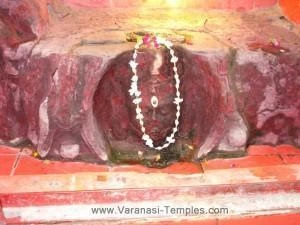
Amidst the spiritual density of Kashi (Varanasi), where every ghat and alley holds a cosmic secret, stands the Yama Aditya Temple. Located at the sacred intersection of CK.7/135, leading down to the revered Sankata Ghat, this temple is a unique spiritual beacon. It is dedicated to Lord Yama in his form as Yama Aditya—an amalgamation of the Lord of Death (Yama) and the Sun God (Aditya).
For centuries, pilgrims have sought this shrine not out of fear, but out of a profound desire for liberation. The primary deity here is believed to be a Swayambhu (self-manifested) idol. According to the Kashi Khand of the Skanda Purana, the spiritual benefits, or Phalaśruti, of worshipping at this temple are unparalleled.
Phalaśruti: Why Devotees Visit
The spiritual weight of the Yama Aditya Temple rests on the promise of freedom from naraka (hell) and the purification of ancestral lineage. Specific benefits include:
- Cleansing Ancestral Karma: It is believed that performing Shraddha and specific rituals here liberates ancestors from the cycle of rebirth and ensures their ascent to Swarga (heaven).
- Protection from Yama: The Kashi Khand states that any devotee who bathes in the adjacent Yam Teerth (now the Ganges at Sankata Ghat) and offers prayers to Yama Aditya is forever exempt from the tortures of hell.
- Astrological Relief: For those suffering from severe Pitru Dosha (ancestral flaws) or Saturn afflictions, this temple acts as a potent remedial center.
Historical Origins & Scriptural Legend
While the specific architectural dates are shrouded in the mists of time, the legend of Yama Aditya is documented in ancient scriptures.
Scriptural References & The Sthala Purana
Tradition holds that Yama Raj (the Lord of Death) himself installed a Shiv Ling (Yameshwar) and an idol of Lord Surya (Yama Aditya) within the precincts of Kashi to perform rigorous Tapas (penance). The idol worshipped here represents Yama in a benevolent, radiant form—Yama Aditya—signifying that death is not an end, but a transition guided by the Sun’s energy.
According to local folklore and the Kashi Khand, the land here was once dominated by the energy of Yamraj. By establishing the Yama Aditya form, the cosmic balance was restored, allowing the region to become a Mokshadayini (liberating) zone for devotees.
Architectural Marvels
The Yama Aditya Temple is a testament to the enduring Dravidian architectural style that found its way into the heart of North India’s spiritual capital. While modest in scale compared to sprawling complexes, its sanctity is amplified by its intricate carvings and spiritual orientation.
- Dravidian Influence: The temple features a tiered structure characteristic of Dravidian architecture, with a distinct Vimana (tower) that houses the sanctum sanctorum.
- Vastu Shastra Alignment: The temple is oriented to align with the cosmic energies of the rising sun and the south, the direction ruled by Yama, creating a unique spiritual resonance.
- The Mandapa: The entrance Mandapa (hall) provides a space for devotees to gather, adorned with pillars that feature traditional motifs. The proximity to the ghat adds a natural Vastu element of flowing water to the site.
Darshan & Ritual Logistics
Visiting Yama Aditya requires a mindful approach to timing and rituals. The temple operates on a schedule synchronized with the rituals of the Ganges and the daily Aartis of Varanasi.
Daily Darshan Timings
Note: Timings may vary slightly during festival seasons.
| Session | Timing | Details |
|---|---|---|
| Morning Darshan | 6:00 AM – 12:00 PM | Best visited after the morning bath at Sankata Ghat. |
| Evening Darshan | 4:00 PM – 9:00 PM | Coincides with the Ganga Aarti preparations. |
Key Sevas & Booking
Devotees can perform several rituals to honor their ancestors and seek blessings:
- Abhishekam: Ritual bathing of the Yama Aditya idol with milk, honey, and ghee.
- Archana: Recitation of Yama Gayatri and Mrityunjaya Mantra.
- Tarpan: A specific ritual for ancestors performed near the Ganges steps.
Online Seva Booking: While many local rituals are booked on-site, general puja samagri can be arranged via BharatTemples concierge services. For official temple administration, one may contact the Varanasi Temple Committee.
2026 Festival Dates
- Mahashivratri: February 26, 2026 (High significance due to Yameshwar Ling)
- Yam Chaturdashi: November 10, 2026 (Ideal day for ancestral rituals)
- Makar Sankranti: January 14, 2026 (Honoring Surya/Aditya aspect)
- Naraka Chaturdashi: October 31, 2026
Practical Visitor Guidance
Reaching the temple requires navigating the narrow, bustling lanes of Old Varanasi.
Rules & Etiquette
- Dress Code: Traditional attire is recommended. Men should wear dhotis or full-length trousers; women should wear sarees or modest full-length dresses.
- Photography: Strictly prohibited inside the sanctum sanctorum. Exterior photography may be allowed, but permission should be sought from the priest.
- Mobile Lockers: Since the temple is located at the ghat, it is advisable to carry minimal belongings. Leather items are prohibited in the inner sanctum.
- Accessibility: The temple is reached by descending stone steps. It is not wheelchair accessible.
Crowd Management
- Best Hours: 7:00 AM to 10:00 AM and 8:00 PM to 9:00 PM.
- Seasonal Advice: Varanasi summers (May–June) are scorching; carry water and an umbrella. Winters (Dec–Jan) are foggy but ideal for walking.
Pilgrimage Connectivity
How to Reach Yama Aditya Temple
Address: CK.7/135, Sankata Ghat, Varanasi, Uttar Pradesh 221001.
- Nearest Airport: Lal Bahadur Shastri International Airport (LBS), Varanasi (approx. 30 km).
- Nearest Railway Station: Varanasi Junction (approx. 5 km) and Kashi Vishwanath Temple (approx. 2 km).
- By Road: Accessible via NH 19 and NH 35. From the railway station, take an auto-rickshaw to Chowk. From Chowk, it is a 10-minute walk to Sankata Ghat.
- Boat Route: A boat ride along the Ganges from Assi Ghat or Dashashwamedh Ghat to Sankata Ghat is a scenic way to approach the temple.
Nearby Sacred Sites
Enhance your pilgrimage by visiting these proximity sites:
- Sankata Devi Temple: Located immediately adjacent to the ghat, this temple is the abode of the Goddess who removes obstacles (Sankat).
- Yameshwar Mahadev: The counterpart Shiva Ling installed by Yama Raj, usually found in the same vicinity.
- Manikarnika Ghat: The holy cremation ground, a few steps away, symbolizing the ultimate reality of life and death governed by Yama.
Frequently Asked Questions (FAQ)
1. Is there a VIP Darshan entry at Yama Aditya Temple?
Unlike larger temple complexes, Yama Aditya Temple operates on a traditional system. VIP entry is not typically available, but visiting early in the morning (6:00 AM – 7:00 AM) ensures a swift and crowd-free darshan.
2. Can non-Hindus visit the temple?
While the temple is primarily a Hindu place of worship, the cultural heritage of Varanasi is often open to respectful visitors of all backgrounds. However, entry into the inner sanctum may be restricted based on the specific sect managing the temple at the time.
3. What is the best way to perform rituals for ancestors here?
The most potent ritual is to take a bath in the Ganges at Sankata Ghat (formerly Yam Teerth), offer Tarpan (water) to the Sun, and then offer prayers at the Yama Aditya shrine. If possible, try to align this with a Tuesday when the Bharani Nakshatra is present.
4. Is there accommodation near the temple?
Due to the narrow lanes of Old Varanasi, there are no hotels directly at Sankata Ghat. However, numerous hotels and guest houses are available near Dashashwamedh Ghat and Godaulia, which is a 15-minute walk away.
5. What is the significance of the Ganges water here?
The water here is historically known as Yam Teerth. It is believed that the water here holds the energy to transform negative karmic debt into spiritual merit, making it essential to the worship of Yama Aditya.
Recent Posts

Shri Kaamkoteeshwar Mandir, Varanasi – History & Significance
In the heart of Kashi, the eternal city of Lord Shiva, where the Ganges flows with celestial grace, stands the Shri Kaamkoteeshwar Mandir. This sacred Sannidhi is not merely a temple but a profound spiritual bridge between the Northern…

ओ सांवरे तूने ही मुझको संभाला – Lyrics & Meaning
ओ सांवरे तूने ही मुझको संभाला – A Prayer to Shyam Origin & Spiritual Essence Why This Bhajan Resonates Devotees chant this when overwhelmed by life’s storms—the refrain ‘तूने ही मुझको संभाला’ is the soul’s sigh of relief: “You…

कथा ये है महाराज मेरे की – Lyrics & Meaning
कथा ये है महाराज मेरे की छत्रपति संभाजी महाराज – A Prayer to Chhatrapati Sambhaji Maharaj Origin & Spiritual Essence Why This Bhajan Resonates Devotees chant this when their spirit feels tested—its powerful refrain “महाराज मेरे” is a soul’s…

Rigveda Samhita Yathartha Anuvada (ऋग्वेद संहिता यथार्थ अनुवाद) – Complete Set with Anvayartha & Hindi/English Translation
The Rigveda is the oldest surviving scripture of humanity and the foundational text of Sanātana Dharma. For serious students, scholars, UPSC aspirants studying ancient Indian history, Sanskrit learners, and spiritual seekers, a precise and grammatically structured translation is indispensable.…

आना भी अकेला है जाना भी अकेला है – Lyrics & Meaning | BharatTemples
आना भी अकेला है जाना भी अकेला है – A Prayer to the Divine Witness Origin & Spiritual Essence Why This Bhajan Resonates Devotees turn to this bhajan in moments of deep reflection—when life’s attachments begin to ache. The…

माता शेरावाली के द्वार जो भी जाता है – Lyrics & Meaning
माता शेरावाली के द्वार जो भी जाता है – A Prayer to Maa Sherawali Origin & Spiritual Essence Why This Bhajan Resonates Devotees turn to this bhajan in times of fear or uncertainty—its promise that no one leaves Maa’s…

मार लेना सपणी उबार लेणा भवरा – Lyrics & Meaning
मार लेना सपणी उबार लेणा भवरा – A Prayer to the Divine Beloved Origin & Spiritual Essence Why This Bhajan Resonates Devotees chant this in moments of deep vulnerability—its cry of “मार लेना सपणी, उबार लेणा भवरा” is the…

हमें श्याम सुंदर भरोसा तुम्हारा – Lyrics & Meaning
हमें श्याम सुंदर भरोसा तुम्हारा – A Prayer to Shyam Sundar Origin & Spiritual Essence Why This Bhajan Resonates Devotees chant this when feeling alone—its refrain ‘de do sahara’ is the soul’s cry for divine support. Lyrics in Hindi…

Mere Satguru Ne Di Thi Davai Lyrics in Hindi & Meaning
Mere Satguru Ne Di Thi Davai: Invoking the Guru’s Liberating Wisdom This soul-stirring bhajan venerates the Satguru (True Spiritual Master) as the divine physician who dispenses the only remedy for life’s deepest sufferings. Composed by Sant Karmaveer Tufani, it…

Janm Diyo Thari Maa Dukh Dekhiyo Lyrics in Hindi & Meaning
जन्म दियो थारी माँ दुख देखियो (Maa’s Grief Upon Birthing You) This soul-stirring Chetavani Bhajan (admonitory hymn) is addressed to the Divine Mother (Maa) – a call for repentance when children forget their filial duties in the dark age…